



Millennium-old rice terraces survived in China









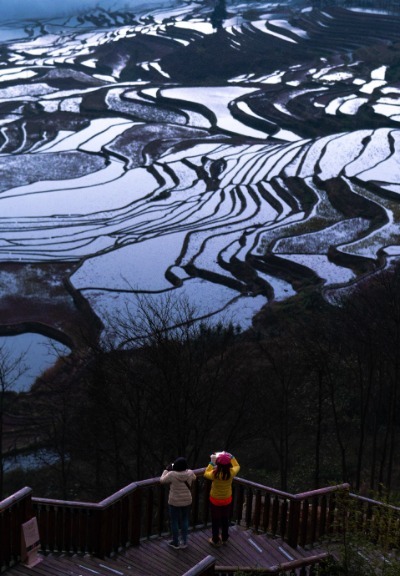
For over 1,300 years, the Hani people in Southwest China have been plowing their rice terraces that cascade down the lush hillsides and shape a spectacular rice-paddy terracing view.
The wonder of the terraced fields in Yuanyang county of Yunnan province made it onto the UNESCO World Heritage List in 2013.
The agricultural heritage was created by the local Hani, an ethnic group mostly inhabits the area across the Ailao Mountains.
Locals built a channel system to direct water from the forested hilltop to nurture paddies on mountain slopes. Tourists flood to the site for the breathtaking vista every winter. It is the season when the sky reflects in the flooded fields.
In late 2008, the Yunnan Expo Yuanyang Hani Terraced Fields Culture Tourism Development Co., Ltd. was established, with an initial capital injection of 12 million yuan (about $1.9 million).
Hotels and infrastructure were built to cater to tourists. Behind the glamorous world heritage site, however, challenges do exist.
The ancient civilization is confronting an obstacle -- fewer people, especially the younger generation, master the farming techniques on the terraced fields.
Agricultural machinery is not much use on the farmland due to the restrictions of the tiered landscape. It needs year-round planting procedures to grow the local red rice, a single-season rice variety growing at a high altitude.
"In our village, about 600 people are between 20 and 40 years old, roughly one-fifth of the total population, but only 40 of them know the whole procedure of growing the red rice," said Ma Youkai, chief of Aichun village.
This situation is not an exceptional case. To prevent the land from being abandoned, those who stay put in the village help till it.
The local government and tourist companies also cooperated with farmers, who lease their land to cooperatives or companies. Hence the land is managed in an orderly way, and villagers get stable incomes from both the rentals and the farm work.
While the land cultivation sustains, locals are open to more prosperous approaches, such as breeding ducks and fish in the paddies, known as the rice-fish-duck ecosystem. The field output value per hectare using such modes increased from less than 30,000 yuan to 120,000 yuan.
Another impediment that the locality has long been facing is conserving its traditional housing.
A Hani house usually consists of mud, wood, and other materials. It is two or three stories high, with the straw roof as its main feature, thus dubbed "mushroom houses."
There are only two well-preserved villages in the world heritage site that maintain the most original dwelling look. One of them is Azheke, sitting in a core area of the reserve site, with about 480 villagers inhabiting 61 traditional houses.
In 2018, the local government cooperated with the Sun Yat-sen University to develop tourism in the village to attract exported labor back. A tourism company was established, and the villagers received 70 percent of its shares.
Now tourists pay to enter the well-maintained village. Some villagers can work as tourist guides and ticket sellers, introducing the Hani traditions and bringing them along to experience farming work.
Seeing the opportunities, some migrant workers chose to come back. "The most effective way to protect the old houses is to let people live inside," said Wang Ranxuan, the village chief.
Wang added that residents need to replace the worn-out straw on the roofs with fresh ones every three or five years. It could cost 20,000 to 30,000 yuan every time -- a large sum of money for the families.
But now, all these expenses have been covered by the company and the government.
Besides, in 2018, more than 20 million yuan went into renovating the houses in Azheke. To date, the protection of the millennium-old housing is still underway.