Clean energy edging out coal as China embraces low-carbon, sustainable growth









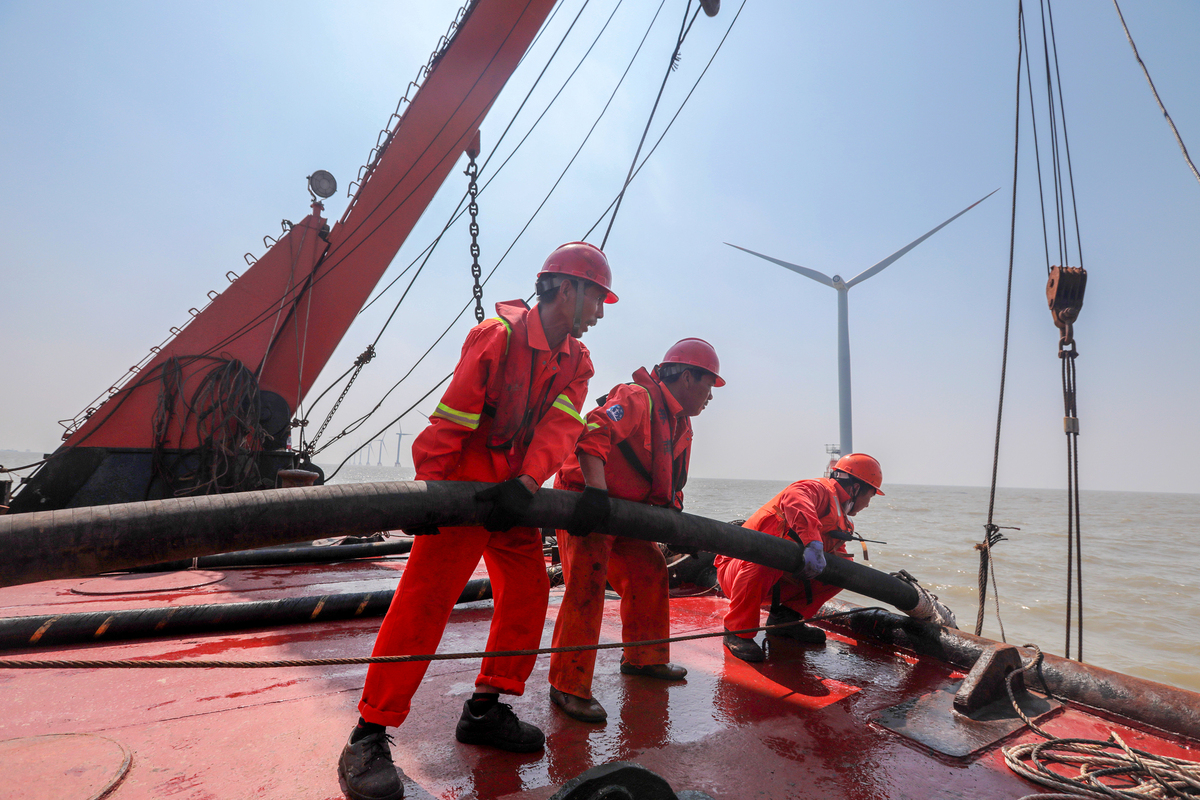
The increasing output and expanding use of clean energy in China have continuously reduced the share of coal consumption in overall energy consumption, the National Bureau of Statistics said in its annual communique released on Sunday.
Last year, the country's coal consumption accounted for 56.8 percent of energy consumption, down from 64 percent in 2015.
Share of natural gas, hydropower, nuclear power, wind power and other clean energy consumption reached 24.3 percent, up from 17.9 percent in 2015, the bureau said.
The transformation of the national energy consumption pattern is propelling China toward a low-carbon development path, according to a white paper titled "Energy in China's New Era" released by the State Council Information Office in December.
The paper said that by 2019, China had reduced its carbon intensity, namely carbon dioxide emissions per unit of GDP, by 48.1 percent from that in 2005.
The decline has fulfilled the country's commitment to the international community that the intensity will have decreased by between 40 percent and 45 percent by 2020.
Carbon intensity measures the relationship between a region's economy and carbon emissions. When a region's economy keeps growing with less carbon emissions, it has a high level of low-carbon development.
He Jiankun, vice-chairman of the National Committee of Experts on Climate Change, told People's Daily in February that reducing carbon intensity is key to achieve the carbon neutrality.
China aims to see carbon dioxide emissions peak before 2030 and achieve carbon neutrality-the realization of net zero carbon dioxide emissions-by 2060, goals that the country announced in September at the General Debate of the 75th Session of the United Nations General Assembly.
The communique from the NBS said that the country consumed 4.98 billion metric tons of standard coal energy last year, up 2.2 percent year-on-year.
"Unlike developed countries, China is still in the middle of developing its industrialization and urbanization so it is expected to continue with robust economic growth."
From carbon peak to neutrality, China has 30 years to act while some Western countries have had 40 to 60 years to realize it by around 2050.
"Despite enhancing its energy conservation and carbon reduction efforts, total energy demand will grow for a certain period of time. By 2030, we should try our best to make the annual decline rate of carbon intensity exceed the annual GDP growth rate to realize carbon peak," People's Daily quoted him as saying.
To achieve the goals, the National Energy Administration said that for the 14th Five-Year Plan period (2021-25), China will expand the utilization of clean energy and promote non-fossil fuel and natural gas as a major economic growth driver.
Zhang Xingying, a senior researcher at the National Satellite Meteorological Center, said that it is vital to reduce carbon emissions from the root by transforming the energy consumption pattern.
"End-of-pipe treatment, that uses equipment to eradicate polluting air at the end of the production process such as desulfurization, can only control the pollution, but switching to clean-energy mode will cut down both air pollution and carbon emission from the source. It's a win-win strategy," he said.
The country has adopted technologies to reduce carbon emissions. For example, the industrial sector is replacing coal boilers with electrical ones to reduce direct coal burning.
From 2010 till October 2020, the Chinese people have purchased 55 percent of the world's new energy vehicles. On a national basis, China owns the most number of such vehicles in the world, the Ministry of Ecology and Environment said.