Innovation, modernization sit atop government agenda









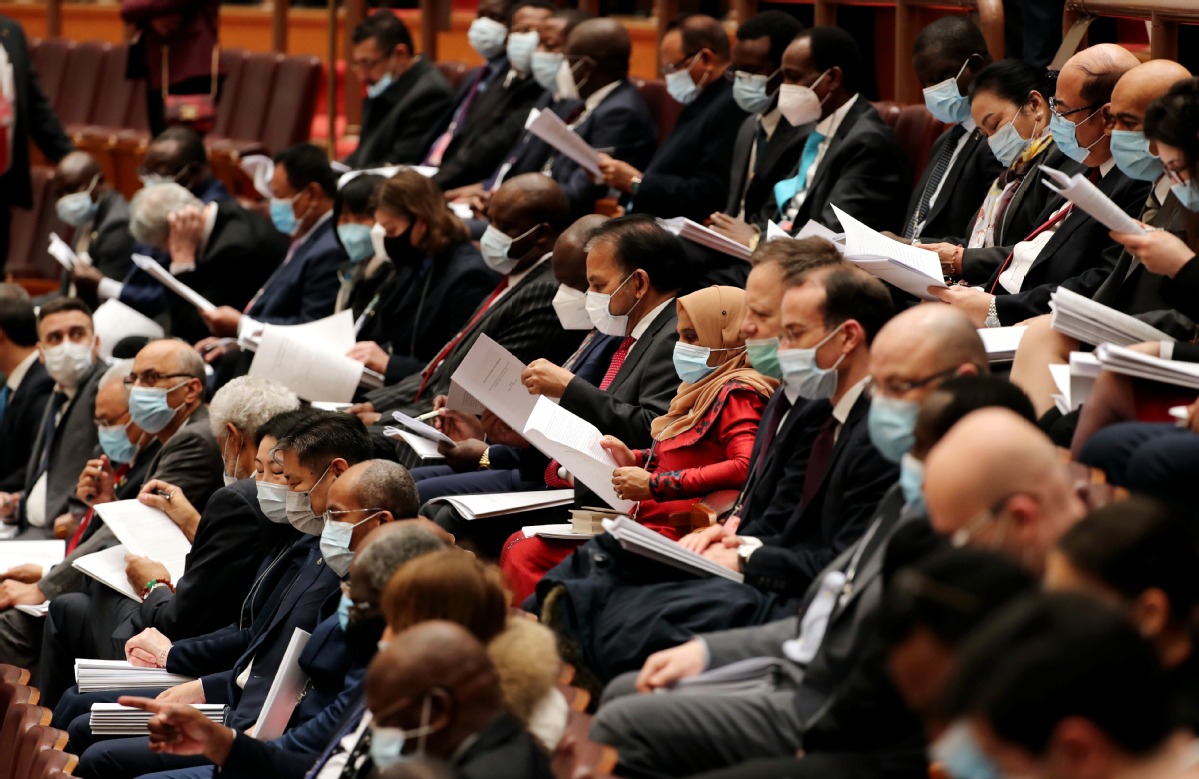
China will pursue innovation-driven development and accelerate the modernization of its industrial system by strengthening its science and technology research capability in the next five years, according to government reports released on Friday.
Artificial intelligence, quantum information technologies, brain sciences and other frontier sciences will receive more support. China will also help turn Beijing, Shanghai and the Guangdong-Hong Kong-Macao Greater Bay Area into global science and innovation hubs, the reports said.
Last year, China saw a stream of scientific and technological breakthroughs, including the Tianwen 1 Mars mission, the Chang'e 5 lunar mission and the Fendouzhe deep-sea manned submersible, according to the annual Government Work Report delivered by Premier Li Keqiang at the opening of the fourth session of the 13th National People's Congress on Friday.
Other major achievements included the Five-hundred-meter Aperture Spherical Telescope officially beginning operations, completion of the Beidou 3 Global Navigation Satellite System and the Jiuzhang quantum computer prototype, as well as the nation's anti-pandemic efforts with new vaccines and treatments available, according to a report issued on Friday by the National Development and Reform Commission.
China has also intensified efforts to make major breakthroughs in core technologies in key fields, set up the country's first group of national laboratories, encouraged collaborative innovation among enterprises and promoted pilot reforms, Li said.
"Innovation remains at the heart of China's modernization drive," he said. "We will strengthen our science and technology to provide strategic support for China's development."
This year, one of the nation's key objectives is better leveraging the roles of science, technology and innovation in driving development, supporting the real economy and promoting people's well-being.
"Basic research is the wellspring of scientific and technological innovation," Li said. "So we will ensure the stable functioning of funding mechanisms for basic research and boost spending in this area by a considerable sum."
Central government expenditure on basic research will increase by 10.6 percent this year. Research institutes will enjoy more autonomy over their project funds, and mechanisms for assessing projects and evaluating personnel will be improved.
"These actions will help relieve researchers of undue burdens and enable them to fully devote their time and energy to making scientific explorations and major breakthroughs in key technologies, just as a sword smith in the past would spend years forging the perfect blade," Li said.
In the coming years, China will expand its strategic scientific and technological capabilities by developing national laboratories, formulating a 10-year action plan for basic research and achieving breakthroughs in core technologies.
"We will enhance the capacity of enterprises to make technological innovations, unlock creative talent and improve the systems and mechanisms that make scientific and technological innovation," he said, adding that China's R&D spending will increase by more than 7 percent per year in the coming years.
Wu Weiren, chief designer of China's Chang'e lunar exploration missions and a member of the National Committee of the Chinese People's Political Consultative Conference, the country's top political advisory body, said China is now fully aware of the importance of science and technology and attaches "unprecedented importance" to their development, which was best demonstrated by it putting a 10-year plan for basic research on the country's agenda.
Fang Xiang, president of the National Institute of Metrology and a CPPCC National Committee member, said major scientific projects should not only produce influential findings, but also set new standards to serve as references for future research.
Moreover, many core technologies such as chipmaking require a robust and comprehensive network of supporting technologies including new materials and advanced scientific instruments. Therefore, he said, it is crucial to take a holistic and systemic approach when designing key scientific projects.
Cui Jia contributed to this story.






- First cross-border event debuts at the National Games
- China Focus: National Games enhances coordination under 'one country, two systems'
- China's Fujian aircraft carrier to make regular appearances on high seas: spokesperson
- A decade of dialogues
- HK: a stage for art and cultural dialogue
- Tapping truly unknown wonders