Hong Kong is and will remain one of the world's freest economies









Undoubtedly, the last two years have been very challenging for Hong Kong, socially and economically, and 2021 is not being any easier either. The 2019 civil unrest was seamlessly followed by the ravages of the COVID-19 pandemic.

COVID-19 is plunging its embattled economy further into recession. The unemployment rate jumped to 6.6 percent in the October-to-December period from 6.3 percent previously, returning to levels not seen since December 2004, according to a government report, getting worse to 7 percent in January as coronavirus fourth wake took toll.
Local businesses are struggling under strict social distancing measures and a lack of tourism (the arrival of visitors declined drastically), with restrictions on group gatherings.
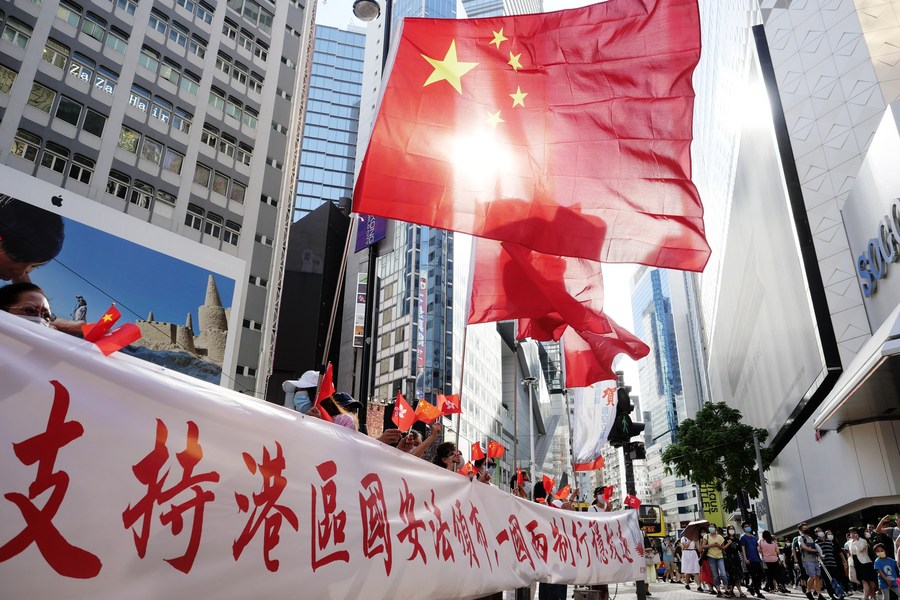
However, we can try to see the glass half full, instead of half empty: when it comes to civil unrest and the riots that ravaged the Special Administrative Region in 2019 and early 2020, the National Security Law seems to have quelled the unrest, whereas, even though Hong Kong is not free from the effects of the pandemic, it has managed to keep the number of COVID-19 infections well under control compared with many other places in the world, and the city's massive financial reserves were able to help employers avoid some job cuts that would have made the pain even worse than it has been. And, now that vaccination is being rolled out in the region, we can expect the situation to improve these coming months (and I am sure that we will eventually see Hong Kong partially reopening its borders, by resuming the travel bubble project with Singapore and similar projects).
In the midst of all these challenges, we recently had some news that could not come at a worse time: Heritage Foundation has just dropped Hong Kong from its 2021 Index of Economic Freedom, a list which is topped by Singapore, in a decision which also affects China's other Special Administrative Region, Macao.
Basically, the Heritage Foundation said its annual Index of Economic Freedom, issued last Thursday, no longer included Hong Kong and Macao because it "measures economic freedom only in independent countries where governments exercise sovereign control of economic policies." In other words, the Foundation implies that the governments of both Hong Kong and Macao have lost their autonomy in formulating economic policies.
According to the Foundation, while Hong Kong and Macao enjoy more economic freedom than the Chinese mainland, "developments in recent years have demonstrated unambiguously that those policies are ultimately controlled from Beijing".
To me, the decision of removing Hong Kong and Macao from the Index is completely wrong and biased, and shows a profound lack of understanding of how "one country, two systems" works, as well as a profound lack of understanding of what the National Security Law was and what it actually implied for Hong Kong.
Let me start from the beginning: Following the 1984 Sino-British Joint Declaration, Hong Kong returned to China in 1997 under the "one country, two systems" principle, by which the region continues to enjoy its distinct political, socioeconomic and legal arrangements under a unified China--for at least fifty years without change (note "at least", which means that 2047 does not need to be at all the end of the "one country, two systems" formula).
So far, "one country, two systems" has worked well, allowing Hong Kong to become stronger than it was, albeit the 2019-2020 riots. Actually, in 2017, exactly 20 years after the handover I did some research comparing, from a socioeconomic perspective, Hong Kong of 1997 with Hong Kong of 2017. The data showed that Hong Kong was in better shape in 2017 than in 1997. While Hong Kong people's life expectancy increased by eight years for men and women to 82 and 88 years, respectively, over that period, the public rental housing stock increased from 704,300 apartments in 1997 to more than 760,000 in 2017.
The thing that makes some people claim that "one country, two systems" has been undermined is the promulgation of the National Security Law (NSL) last year, But, let's make no mistake, the law was not and will not be an attempt to undermine Hong Kong's normal status quo, but simply a tool to put an end to the unsustainable situation that Hong Kong was living due to the social unrest.
As I mentioned in "Security law will secure future of Hong Kong" (June 19, 2020, China Daily HK Edition), almost every nation has laws to protect its national security, including the US. Some businessmen and investors have been worried over the national security law. But the new legislation has proven to be beneficial because it brought back stability and security whilst preserving Hong Kong′s special status, which has not been challenged.
Back in June, senior Chinese officials tasked with the Hong Kong portfolio publicly asserted that 99.9 percent of Hong Kong people will not be affected by this new law, since it targets only separatist activities, subversion of State power, terrorism and foreign interference.
Nine months later, I reckon that most Hong Kong citizens can state that they have indeed not been affected by the NSL in any negative way and their lives have not changed, at least not due to the NSL.
So, if the US also has laws to protect national security, as most countries do, and if most similar laws in other countries are actually harsher, what all the fuss is about? Hong Kong has been treated as a chess piece in the US-Sino rivalry initiated by former US President Donald Trump, which has been labeled by some as a new cold war.
As Hong Kong Financial Secretary Paul Chan Mo-po said, the city still enjoys economic competitiveness, with the free flow of capital continuing under "one country, two systems"; and the rule of law is respected in the city. In other words, regardless of what changes have been made to the economic freedom index, Hong Kong remains one of the world's freest economies, one of the most important global financial hubs and one of the best places in the world to do business in.
The author holds a doctorate in real estate law and economics, and has worked as a business analyst in Hong Kong. He is currently a member of the Blockchain, Digital Banking and Greater Bay Area Committees at the Fintech Association of Hong Kong.


- China's AI breakthrough set to be game-changer for early cancer detection
- A glimpse into 'The Louis'
- Scientists decode fruit flies' entire life cycle, offering clues for human health
- China to unveil cultural events marking 80th anniversary of victory against Japanese aggression, fascism
- Xi stresses building unified national market, promoting marine economy's high-quality development
- 2 dead, 6 missing after torrential rainfall in Central China