China's five-year plan: a democratic perspective









BEIJING -- China's latest medium and long-term economic and social development plan, approved at the country's top legislature on Thursday, unfurls a roadmap of China's development for the next five years and beyond.
China initiated its first five-year plan in 1953. Over the half-century, the country achieved rapid development with many five-year plans performing as an important mechanism to guide the economic and social activities, one after another.
The latest Outline of the 14th Five-Year Plan (2021-2025) for National Economic and Social Development and the Long-Range Objectives Through the Year 2035 is of even greater significance. It is a blueprint for the world's second-largest economy as it kicks off a new journey toward fully building a modern socialist country.
How this outline takes shape offers the outside world a glimpse into China's democracy and how it functions.
From blueprint to roadmap
The drafting of an outline usually takes three years. The current one was guided by proposals, drawn up by the Communist Party of China (CPC) Central Committee, for formulating the five-year plan and the long-range objectives through 2035.
Xi Jinping, general secretary of the CPC Central Committee, led the proposals' formulation himself. He undertook field research and hosted seven symposiums from July to September in 2020, taking account of people's suggestions from all walks of life.
The 60-item proposals of some 20,000 words were adopted in October 2020 at the fifth plenary session of the 19th CPC Central Committee.
To turn the CPC leadership's proposals into a detailed plan, the State Council, or the cabinet, took the lead in formulating the draft outline before it was submitted to the top legislature's annual session for review and approval.
The formulating process is a vivid embodiment of the practice of China's socialist democracy. The Party's major decisions, based on the will of the people, become the will of the country through statutory procedures, analysts said.
It also demonstrates the unity of the leadership of the Party, the position of the people as masters of the country, and law-based governance, according to analysts.
Pooling people's wisdom
Democracy is in full swing during the whole formulating process of the outline. It is a constructive mix of top-level design and people's wisdom.
To better draw up the proposals, the Party leadership solicited suggestions online in August 2020, receiving over 1 million comments.
The formulation of the draft outline also solicited public opinions both online and offline.
Various symposiums with national lawmakers and political advisors were held to collect constructive suggestions.
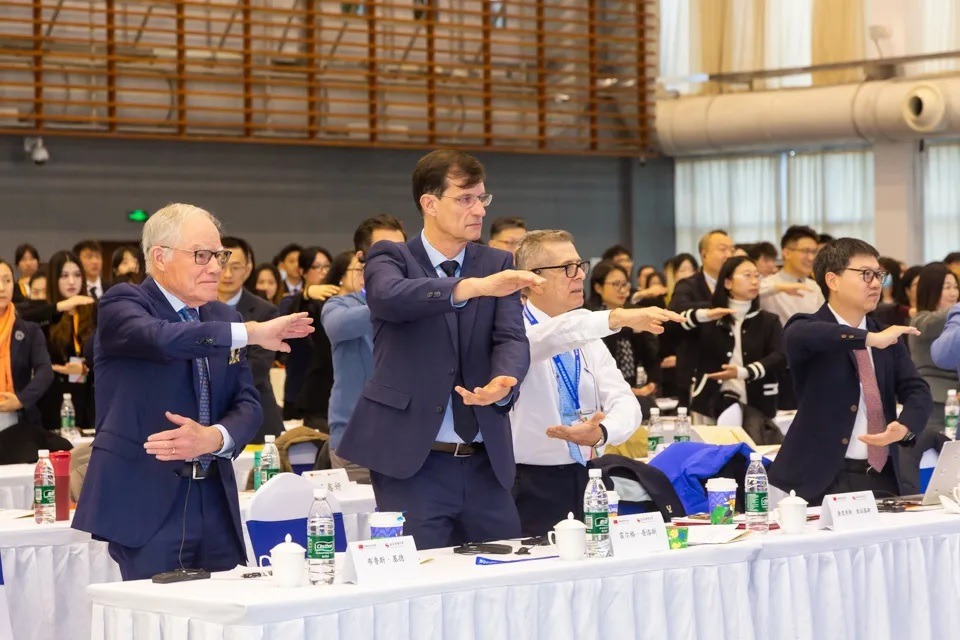
Laurence J. Brahm, a senior international fellow at the Center for China and Globalization, said Chinese democracy is a system of consensus-building, and it is different from that in the West. "It is quiet, and in many ways, like Tai Chi."
Implementation at all levels
To reach the final version of the outline, national lawmakers and political advisors offered their wisdom at this year's "two sessions." A total of 55 revisions were suggested by Tuesday.
"You have a situation where there's planning, but there's also a process," said Einar Tangen, a political and economic affairs commentator from the United States.
When China, a country with 1.4 billion people, has a national five-year plan, people from the national level down to grassroots units have a say in how their work can be integrated with the overall strategy of the country, said Tangen.
It is a combination of millions of hours of work from the beginning of drafting to implementing a five-year plan, he said.
Many great achievements have been accomplished in China in this way, including the eradication of absolute poverty, observers say.
This corroborates what Xi said: "Democracy is not an ornament to be used for decoration; it is to be used to solve the problems that the people want to solve."




- 2,309 regulations filed with China's top legislature for review in 2025
- Chinese researchers pinpoint seed genes for enhancing food security
- Public interest litigation plays prominent role in China's governance
- 15 arrested in 1b yen robbery in Hong Kong
- Chinese lawmakers conduct third deliberation of draft national development planning law
- Multiple cities probe illegal activities in 'private cinemas'