Sanxingdui discoveries shed light on ancient China










Chinese archaeologists announced the discovery of over 500 cultural relics on Saturday, during an ongoing excavation at the Sanxingdui Ruins site in Guanghan, Sichuan province.
The relics were uncovered in six sacrificial pits which date back over 3,200 years.
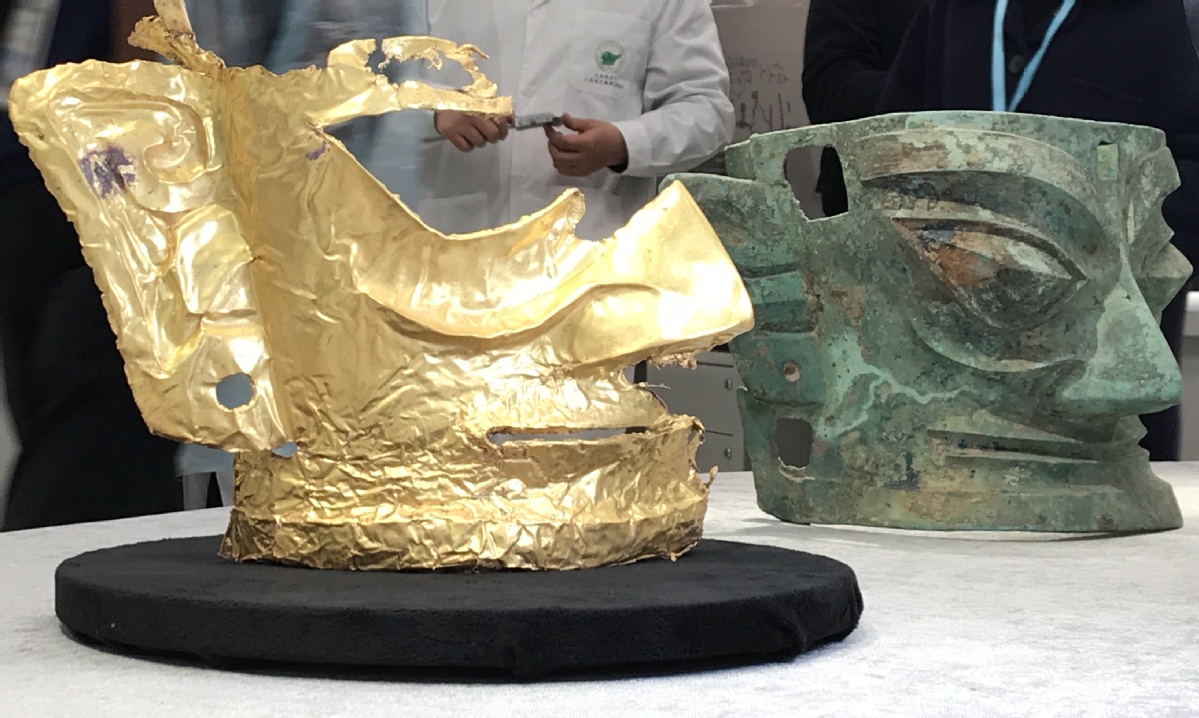
Among the important cultural finds are gold and bronze masks, bronze ware, more than 100 ivory tusks, textiles and jade among other artifacts.
"Thanks to the new discoveries, we've basically figured out the layout of the sacrificial zone of the Sanxingdui site," said Lei Yu, a researcher at the Sichuan Provincial Cultural Relics and Archaeology Research Institute who heads the ongoing excavation.
The about 12-square-kilometer site was discovered in 1929, and major breakthroughs were made in 1986 with the discovery of two pits believed to be for sacrificial ceremonies. The pits were accidentally uncovered by local farmers digging up earth to make bricks.
Over 1,000 artifacts were found at that time, including elaborately decorated bronze ware, face masks and "divine trees"-bronze sculptures of trees with stretching branches.
Explaining to China Daily why the new round of excavations has come after a hiatus of decades, Lei said the previous excavations of pits No 1 and No 2 were made to rescue artifacts after the accidental discovery.
"Once the two pits had been cleaned, the urgency for further excavation did not exist," he said. "Archaeology cannot be hasty. We have to wait for the need for a well-planned academic purpose to take the initiative for more excavations."
Following an academic project aimed at more deeply understanding the ancient civilization in Sichuan province known as Shu, whose historical records are lacking, investigations in the area around the No 1 and No 2 pits were restarted in October 2019.
The No 3 pit was then found in December 2019. Follow-up field research began in March 2020, and five more pits were uncovered. In October, ongoing and detailed excavations were started on all six pits.
The biggest among the six pits, the No 8 pit, is 19 square meters. The smallest, No 5, which covers 3.5 sq m, is where the most recent gold mask was found.
Lei pointed out there were many similarities among the more recently discovered pits and the two found in 1986, in terms of the types of artifacts unearthed. Divine trees and bronze masks were found once again.
The recent discoveries further confirm the theory that the pits were used for sacrificial purposes as many of the items found had been smashed and burned before being buried. Lei said that deeper study is needed to rule out any other speculation as to the pits usage.