Shanghai builds on its smart approach









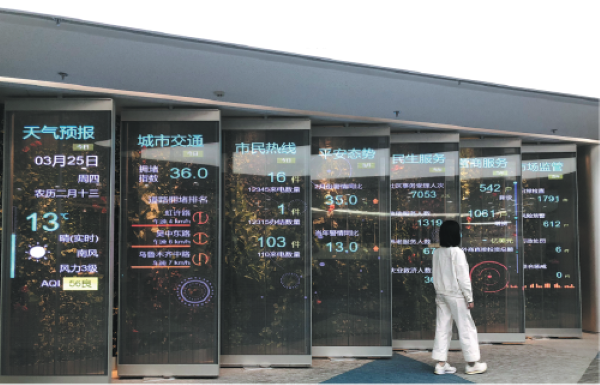
City management
Shanghai has explored citywide intelligent management in recent years.
In September, a three-tier management system for the city, 16 districts and 215 sub-districts was established, enabling problems to be detected in every area of the metropolis.
The Shanghai Urban Operation Management Center said 1,700"vital signs" are included in the city's intelligent management platform, detailing how Shanghai handles social incidents, the environment, traffic, daily life and infrastructure.
In a written reply, the center said 185 systems and nearly 1,000 smart applications from 50 government departments have been integrated with the platform to enable the sharing, exchange and analysis of real-time data.
One example of the progress made emerged during the winter, when temperatures in Shanghai dropped below zero. More than 30,000 digital sensors in the city's water supply network monitored water volumes in neighborhoods and also spotted potential problems.
Xu said, "In many cases, warnings about water pipe failures were sent before residents made phone calls asking for help."
In 2016, Shanghai experienced a similar extremely cold spell, with the water supply authority receiving 230,000 calls about pipe failures. However, during the recent cold snap, only 20,000 such calls were received and repairs were completed more quickly.
Smart systems also enable precise weather forecasting for an area as small as 1 square kilometer for the coming hour. They can also regulate traffic lights by assessing the volume of vehicles on the roads to ensure smooth flows during peak hours.
Last week, an online platform was launched for grassroots community workers in Shanghai. The first of its kind in the country, it enables them to locate or request mini apps to make their daily work easier.
Dao Feng, vice-president of Tencent, which developed the platform jointly with Shanghai Big Data Holdings Co, with guidance from the Shanghai Urban Operation Management Center, said more than 200 apps, which can be accessed without downloading, are already available on the platform.
"They cover areas from epidemic prevention and control to business administration and the provision of better services for residents. They are intended to provide various solutions to facilitate work at community level," he said.
Xu, the management center's deputy director, said there had been strong demand for mini apps since early last year among community workers carrying out pandemic prevention and control work.
The apps helped the workers with epidemiological investigation work in neighborhoods, but many of the employees were unfamiliar with the technology and did not know how to choose a suitable app developer, Xu said.
As a result, technical support was sought at city level from leading enterprises, who were asked to design mini apps to meet the common needs of community workers.
Xie Xujun, a worker from the Xietu sub-district community service office in Shanghai's Xuhui district, said the apps had saved workers a considerable amount of time in surveying residents' travel history and potential contact history with confirmed or suspected COVID-19 cases.
Previously, when Xie and her colleagues received name lists for people who needed to surveyed at district level, they had to manually sort individuals according to their address. The lists were then sent to neighborhoods so that grassroots workers could complete the surveys.
"There was a lot of paperwork involved. We first had to hand out the forms that needed to be filled out for the grassroots workers," Xie said.
"If we printed out all the questions on one sheet of A4 paper, the characters were often too small to read. If we used a big font, there was the risk of some people complaining there were too many questions to answer on several sheets of paper."