Plain facts about Xinjiang cotton industry speak louder than lies









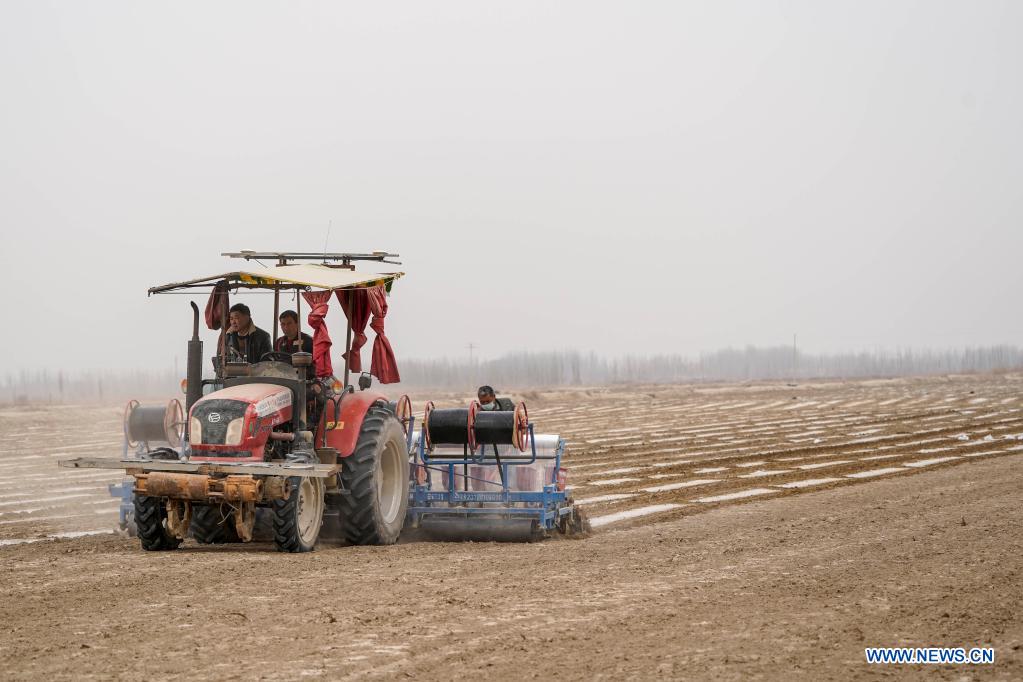
URUMQI -- Tractors are busy plowing cotton fields in Bachu county, one of the cotton hubs in Northwest China's Xinjiang Uygur autonomous region, as the season for cotton sowing arrives.
Across Xinjiang, spring plowing season usually starts in late March and early April as the weather becomes favorable.
Farmer Yimam Tursun, from Bachu, has over a dozen years of cotton growing experience. Before last year, he needed to pay about 9,000 yuan (about $1,370) each season to hire workers to help harvest his 1.13 hectares of cotton. It would take five workers more than half a month to finish hand-picking cotton in his field.
Last year, he rented a harvesting machine, which completed the work in less than an hour, thus greatly lowering the cost on labor. Yimam Tursun spent only 3,060 yuan on renting the harvester.
Mechanized farming is increasingly popular in Xinjiang. In 2020, the mechanized cotton harvesting rate in Xinjiang reached nearly 70 percent, according to Elijan Anayat, spokesperson of the Information Office of Xinjiang regional government.
But cotton-picking used to rely heavily on manual labor. When the harvesting season arrived, hundreds of thousands of migrant workers from China's labor abundant provinces such as Henan and Sichuan would take train trips to Xinjiang to join local residents in the manual picking of cotton, which was considered a well-paid job.
For southern Xinjiang where Bachu is located, mechanization in the cotton fields has seen rapid development.
Bai Jianxin, director of the mechanization development center of Bachu County's bureau of agriculture and rural affairs, said mechanization has been realized in all aspects of cotton sowing, harvesting and quality control.
Bachu has introduced foreign machinery including agricultural equipment imported from Case Corp and John Deere in the United States.
From cotton planting to harvesting, farmers in Xinjiang, especially in the southern areas, are more willing to get involved in the industry, which has yielded good profits, said Elijan Anayat.
Cotton has become a cash cow for many Xinjiang farmers. Mijit Hemit, a cotton grower in Aksu prefecture, southern Xinjiang, said his family farm spreads over 20 hectares of cotton fields and brings 150,000 yuan of income a year.
Talking about the so-called "forced labor" that was recently hyped by some Western countries, Elijan Anayat said it was ridiculous. He welcomed enterprises from all over the world to visit cotton farms in Xinjiang and see with their own eyes.
He said even before mechanization had developed, there was no such thing as "forced labor," let alone now when mechanization is gaining steam.
Official statistics show that the cotton planting areas in Xinjiang reached 2.5 million hectares, and the region's cotton output last year was 5.16 million tonnes, accounting for 87.3 percent of the country's total.
Some 7 million rural residents in Xinjiang are engaged in the cotton-related industry, with the majority from ethnic minority groups.
The development of Xinjiang cotton and textile industry has increased demand for high-end textile machinery, providing business opportunities for global machinery manufacturers.
The region has become an important purchaser in the global textile machinery supply chain. By the end of 2018, there were 3,650 sets of cotton harvesting machines in China, with half of them imported, according to official statistics.
Between 2017 and 2019, Xinjiang imported 1,895 units of cotton textile machinery and equipment worth $462 million, figures from the General Administration of Customs showed.