


Museum showcases vital clues to past









Convincing proof
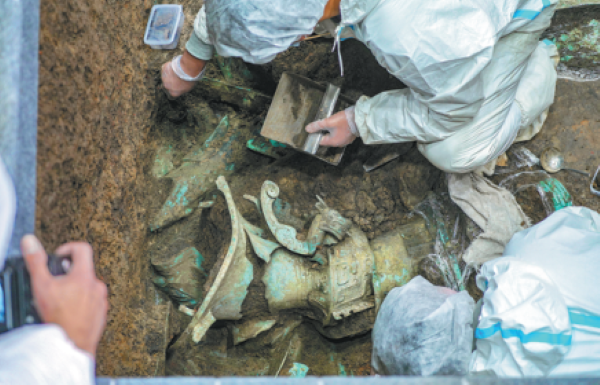
The site is viewed as one of the most important archaeological discoveries made in China during the 20th century.
Chen said that before the excavation work was carried out, it was thought that Sichuan had a 3,000-year history. Thanks to this work, it is now believed that civilization came to Sichuan 5,000 years ago.
Duan Yu, a historian with the Sichuan Provincial Academy of Social Sciences, said the Sanxingdui site, located on the upper reaches of the Yangtze River, is also convincing proof that the origins of Chinese civilization are diverse, as it scotches theories that the Yellow River was the sole origin.
The Sanxingdui Museum, located alongside the tranquil Yazi River, draws visitors from different parts of the world, who are greeted by the sight of large bronze masks and bronze human heads.
The most grotesque and awe-inspiring mask, which is 138 centimeters wide and 66 cm high, features protruding eyes.
The eyes are slanted and sufficiently elongated to accommodate two cylindrical eyeballs, which protrude 16 cm in a manner of extreme exaggeration. The two ears are fully outstretched and have tips shaped like pointed fans.
Efforts are being made to confirm that the image is that of the Shu people's ancestor, Can Cong.
According to written records in Chinese literature, a series of dynastic courts rose and fell during the Shu Kingdom, including those founded by ethnic leaders from the Can Cong, Bo Guan and Kai Ming clans.
The Can Cong clan was the oldest to establish a court in the Shu Kingdom. According to one Chinese annal, "Its king had protruding eyes and he was the first proclaimed king in the kingdom's history."
According to researchers, an odd appearance, such as that featured on the mask, would have indicated to the Shu people a person holding an illustrious position.
The numerous bronze sculptures at the Sanxingdui Museum include an impressive statue of a barefoot man wearing anklets, his hands clenched. The figure is 180 cm high, while the entire statue, which is thought to represent a king from the Shu Kingdom, is nearly 261 cm tall, including the base.
More than 3,100 years old, the statue is crowned with a sun motif and boasts three layers of tight, short-sleeved bronze "clothing" decorated with a dragon pattern and overlaid with a checked ribbon.
Huang Nengfu, the late professor of arts and design at Tsinghua University in Beijing, who was an eminent researcher of Chinese clothing from different dynasties, considered the garment to be the oldest dragon robe in existence in China. He also thought that the pattern featured renowned Shu embroidery.
According to Wang Yuqing, a Chinese clothing historian based in Taiwan, the garment changed the traditional view that Shu embroidery originated in the mid-Qing Dynasty (1644-1911). Instead, it shows that it comes from the Shang Dynasty (c. 16th century-11th century BC).
A garment company in Beijing has produced a silk robe to match that adorning statue of the barefoot man in anklets.
A ceremony to mark completion of the robe, which is on display at the Chengdu Shu Brocade and Embroidery Museum, was held in the Great Hall of the People in the Chinese capital in 2007.
Gold items on display at the Sanxingdui Museum, including a cane, masks and gold leaf decorations in the shape of a tiger and a fish, are known for their quality and diversity.
Ingenious and exquisite craftsmanship requiring gold-processing techniques such as pounding, molding, welding and chiseling, went into making the items, which showcase the highest level of gold smelting and processing technology in China's early history.