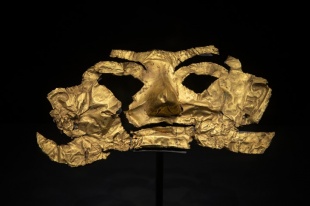



Sanxingdui finds reflect similarities of Chinese, Maya cultures









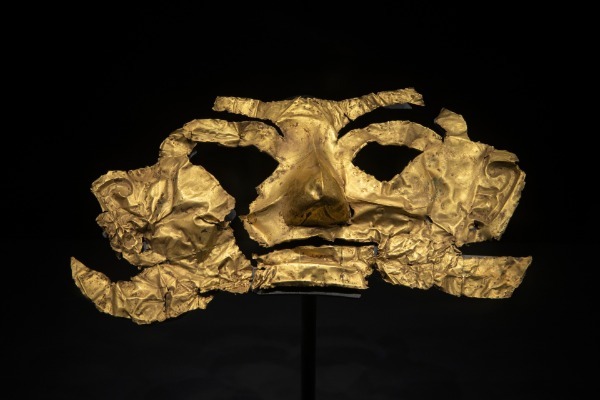
Discoveries at the legendary Sanxingdui ruins in Southwest China show that the region's ancient Shu state civilization shared similarities with the Maya, according to the director of the Chichen Itza archaeological site, Marco Antonio Santos.
The Sanxingdui ruins, located in the city of Guanghan, about 60 kilometers from Chengdu, the provincial capital of Sichuan, belonged to the Shu Kingdom that existed at least 4,800 years ago and lasted more than 2,000 years.
China announced on March 20 that archaeologists uncovered gold, ivory and jade objects dating back about 3,000 years in six sacrificial pits.
The Maya civilization built its city-states around 200 A.D. The pre-Hispanic city of Chichen Itza, a key Maya ceremonial center featuring the famed Kukulcan pyramid as an important emblem for the Maya, existed from approximately 700 to 1200 A.D.
Santos told Xinhua that the bronze-made remnants of trees buried in sacrificial pits at the ruins of the Shu Kingdom recall the Maya's sacred ceiba tree, which symbolized the union of heaven, earth and the underworld for the civilization that flourished in Mesoamerica.
"They are very important similarities," said Santos, stressing that "the representations of trees in both cultures provide us with a symbolism that is very similar."
The findings at the ruins, considered one of the greatest archaeological discoveries of the 20th century, also show a new aspect of the bronze culture, indicating the ancient civilization already had knowledge of technologies that were thought to be from later cultures, said Santos.
While the time lag between the millennial Shu Kingdom and the Maya culture that flourished in the jungles of southeast Mexico was great, the findings highlight the closeness between the two civilizations, said Santos.
The two civilizations developed in regions with comparable climates and reflected their worldview in kindred symbols, he noted, adding that among the over 500 artifacts recently unearthed in Sanxingdui, were pieces of gold and jade, materials the Maya also used to represent characters and scenes related to royalty and the gods.
"At the end of the day, man is still man independent of time and space, and what we have is that, at this latitude, both that culture and the Maya looked at the same sky, they had the same stars on the horizon," the expert said.
One notable feature of the recent discoveries at Sanxingdui, with excavations of its No. 1 and No. 2 sacrificial pits in 1986, was the interdisciplinary work and technology applied by teams of Chinese archaeologists, Santos said.
The technology allowed the unearthing of artefacts as fragile as silk remnants, which other types of less careful excavation methods would not have been able to register, he said.
Collaboration between Chinese and Mexican archaeologists could benefit projects in the Maya world, where the rainy climate and humidity are problematic for the conservation of objects, said Santos.
"Every time our cultural knowledge increases, regardless of whether we speak one language or another, what it shows us is that we continue to be increasingly fraternal, we continue to be sister cultures and, therefore, the exchange of such knowledge is fundamental," said Santos.