


Firm foundations









Leading Sinologist points to crucial role of educational, cultural links in China's development, Alexis Hooi reports.
Editor's note: Many people from overseas have made a contribution to China's development over the years. As China celebrates the 100th anniversary of the founding of the Communist Party of China, China Daily looks at the lives and contributions of these friends from afar, who've not only witnessed, but also participated in, the country's transformation over the years.
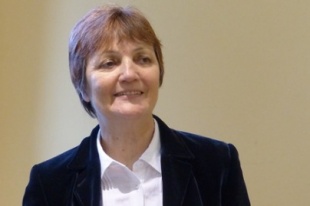
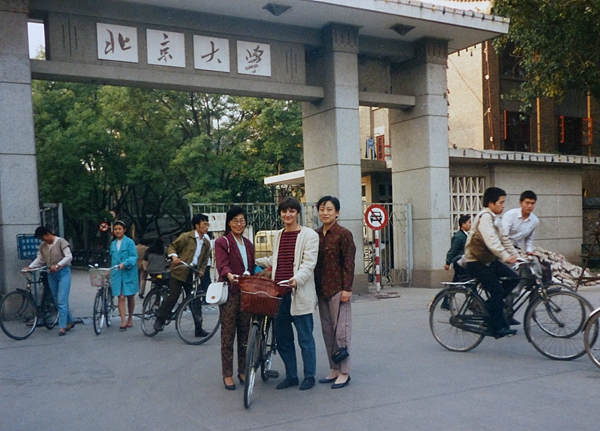
When German Sinologist Mechthild Leutner arrived at Peking University in the mid-1970s, it marked her journey through the "gateway to China" toward a lifelong understanding and analysis of the country's development.
"On the one hand, PKU itself was and is in constant development, a small social microcosm in which China's social developments are reflected, but also already hinted at," she says.
"On the other hand, it is the university staff, starting with academics and students, to colleagues in the international office and the libraries, to the various management levels, who have supported me in many ways in 'walking through the door', in analyzing Chinese developments."
Leutner is a historian and professor of Sinology at the Free University of Berlin. A pioneer and leading figure of China-related women's studies, social history and German colonial history in China, Leutner was one of the first West German students at Peking University in 1974-75. The elite educational institution has recorded her formative experiences there under a major oral history book project.
Taking stock of China's development in an increasingly interconnected world, under the leadership of the Communist Party of China which marks its centenary this year, Leutner says her links with the university reflect the importance of academic partnerships as "bridges between societies".
"Cooperation is a central concept for me. Cooperation has always been important and is becoming more important every day, not only for me but for many people, in academia as well as in business and politics. The world is globally interconnected in all areas, and we are all part of this interconnectedness and gain from it," she says.
"This experience of mine is very much based on the long-standing academic collaborations that I have been able to realize together with colleagues, but also on the university exchange between Peking University and Free University of Berlin, which has now existed for 40 years and has been successively expanded over the decades.
"I still remember the very helpful support of my history professor Zhang Jiqian in researching my master's thesis on the historian Jian Bozan when I was a German exchange student at PKU in 1974-75. In the 1980s, I was able to complete all my research and fieldwork for my postdoctoral thesis on 'Birth, marriage, and death in Beijing. Popular culture and elite culture from the 19th century to the present', with great support from the university administration and historians and political scientists at PKU. Especially the then Party secretary Wang Xuezhen, the historian Zhang Zhilian and the political scientist Zhao Baoxu made a great effort to enable me to conduct my field research in the surrounding rural areas at an early stage, to attend weddings there and to conduct interviews," Leutner says.
"Starting in the 1990s, I collaborated intensively with my former fellow student Zang Jian, who works as a historian at PKU, in the field of women's studies and social history and organized workshops and publications together with colleagues from Free University and Peking University."
Leutner's work from the early stages of China's development drive, particularly through reform and opening-up, has allowed her to witness the unprecedented achievements in areas ranging from industrialization to poverty alleviation.
"I remember China in the 1970s. It was a very poor country, two-thirds of the population barely had enough to eat," she says.
"For me, China's greatest success is that it was much more successful in fighting poverty than any other developing country. Related to this were the great efforts of the people to develop the economy, primarily through industrialization, and to promote education and science very much. Central to this was the idea that people's standard of living should be raised.
"This leap to a modern developed country with a secure standard of living for all has been achieved by China, also, of course, through the country's involvement in the international community and networking with other countries, other societies and academic communities on many levels."