In desert, profits grow from modern factories









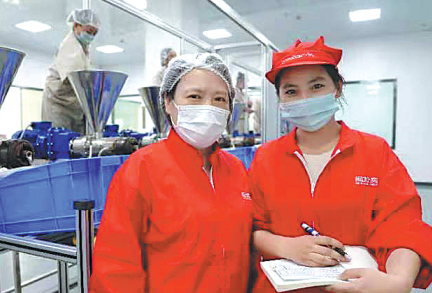
Building three processing plants for agricultural goods on the edge of the Gobi Desert-where electricity, water and other infrastructure is in short supply-has been a 10-year battle for Ren Changyan.
However, the factories have brought dramatic changes to the lives of people in Zepu and Yarkant counties in Kashgar prefecture, Xinjiang Ugyur autonomous region.
With modern processing plants, the abundant agricultural crops in the remote counties no longer end up rotting in the fields along with lost profits. The three factories have provided job opportunities for about 1,000 individuals, while produce is bought from 20,000 households for processing, resulting in stable incomes for farmers.
"For many locals it was their first time as part of modern industries, which has altered their lives, their way of living and their ideas about the importance of education for future generations," Ren said.
The 51-year-old is general manager of Shanghai Minlong, an enterprise established in 1995 specializing in processing agricultural products. In 2010, she was part of a group of businesspeople from Shanghai who volunteered to help modernize the agricultural industry in Kashgar.
In February, Ren was recognized as a national outstanding individual in the country's poverty alleviation cause.
"I devoted my best years to the national strategy of poverty alleviation and witnessed local people's lives improve step by step over the years," she said."I've helped them in a practical way and that rewards me with joy and pride."
Foundations
The first processing plant was built in Zepu in 2010. Ren said her company overcame problems such as clearing rocks to lay the foundations of the factory, an unstable electricity supply and access to clean water.
"We built the factories from scratch," Ren said. "Before we arrived there were only small workshops and few job opportunities. People lived in adobe dwellings, which needed repair when it rained, and children walked barefoot all year round."
There was also a mountain of administrative hurdles to get over."Officials in Kashgar didn't know how to cope with food-processing license applications and I went to Urumqi (the regional capital) to make inquiries several times," Ren said.
The lack of sealed roads was also a problem, with nothing more than desert tracks for passenger vehicles and heavy trucks."I clearly remember a middle-aged man driving me to the airport. It took more than five hours and my luggage kept bumping in the back of the vehicle as we traveled through the desert without a proper road. I don't know how he figured out the direction in the desert," she said.
The first factory used advanced freeze-drying technology to process fruit, including apples, Hami melons and jujube to maximize their preservation.
The second factory, established in Yarkant in 2018, processes a number of products from badam (almonds). The county boasts the world's second-largest production area of the almond variety, which in the past had struggled to find markets.
Ren's product designers used the almonds to make cooking oil, candies, and meal replacement powder. The Shanghai company's mature offline and online sales channels were also utilized to sell the Xinjiang products.
"We even invited internet celebrities to promote these products from Xinjiang in their online live broadcasts, which has become a popular way of marketing to young people nowadays," Ren said.
Last year, a third plant began operations in Yarkant despite the COVID-19 outbreak, processing products from quinoa, a crop high in protein and low in calories.
"We receive regular visits from other local enterprises and government officials and share our food-processing technologies so that more locals become confident in the agricultural and industrial development," Ren said.
Brighter futures
Job stability has allowed many of the factory workers to plan for their children's futures, she said.
"At first, many workers disappeared after getting a salary for a week or two," Ren said."They were satisfied with having a little money to buy themselves some good food. But now, after acquiring food-processing techniques, they are more ambitious and want to work hard.
"Working in a factory after graduation has become normal and children's education has become a priority for a family."
As an added benefit, Ren said she witnessed schoolteachers from more developed provinces and cities dispatched to the counties to boost primary education over the years.
Abudurexiti Yibila, 31, has been working in the Zepu factory for six years, and oversees the freeze-drying equipment.
Before joining the factory, he had done random jobs in various factories in East China owing to the limited job opportunities in his home county.
"I'm deeply grateful for the modern enterprise built from scratch in my home county that has created an opportunity of self-realization and contributes to Xinjiang's development," he said.
He said he earns more than 5,000 yuan ($773) a month, second only to the factory managers, which has improved the quality of life for him and his family.
Ren said that a lot of the women are more energetic and vibrant after joining the workforce.
"Many lived a frugal life and there was no spare money. But today, they've become more self-confident and are more willing to spend on clothing and cosmetics," said Ren, adding that women account for roughly 70 percent of the factories' workers.
Ren said she wants to develop more production lines for local specialties, such as flour and naan bread. "In the long-term, I hope to continue to contribute to rural vitalization and retire in Kashgar," she said.





- Audit: China fixes bulk of fiscal problems tied to 2024 budget
- China reports major gains in circular economy
- Chinese lawmakers review draft revision to banking supervision and regulation law
- Top legislature to study draft laws on environment, ethnic unity, national development planning
- Administrative organs must secure people's interests: senior judge
- 2,309 regulations filed with China's top legislature for review in 2025