


Notes from the past









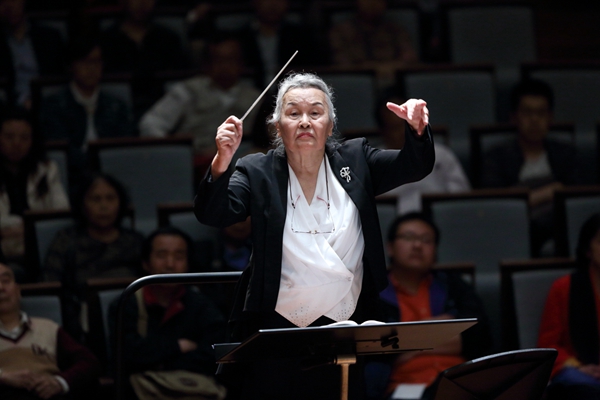
Accomplished conductor Zheng Xiaoying brings a composition about the history and lives of the Hakka people to the nation's capital, Chen Nan reports.
Despite a lifetime of achievement, most notably, perhaps, being the country's first female orchestral conductor following the founding of the People's Republic of China in 1949, Zheng Xiaoying, at the age of 92, still feels that she has some unfinished business.
She simply has a desire to introduce The Echoes of Hakka's Earth Buildings, an original Chinese music piece composed by Liu Yuan about the Hakka people's history and lives, to as many people as possible.
On Friday, she will lead musicians of the symphony orchestra of the Xiamen Municipal Opera and Dance Drama Troupe to perform the 40-minute composition at the National Center for the Performing Arts in Beijing.
During the upcoming concert, conductor Xia Xiaotang will also lead the children's chorus of Xiamen Art School in performing the Chinese musical piece, Anqi Capriccio, composed by Xie Peng.
The concert is part of the venue's seventh China Orchestra Festival, which, from April 8 to May 7, presents 21 concerts featuring 22 symphony orchestras from 14 provinces across the country.
"It's been about 10 years since we last performed The Echoes of Hakka's Earth Buildings in Beijing and I am excited to bring it back," says Zheng. "One of the best ways to keep a piece of music alive, and successful, is to perform it as many times as possible and to introduce it to new audiences."
The ancestors of the Hakka people, a part of the Han ethnic group, moved from the northern and central parts of China during the Tang Dynasty (618-907) to avoid war and natural disasters. Nowadays, they live in regions such as Fujian, Jiangxi and Guangdong provinces. Over the course of their history, the Hakka people have created a unique culture based around a unique language, traditional music and the skill of erecting dwellings known as tulou, or earth buildings.
The Fujian tulou, multifamily, communal living structures, built in a circular or square shape and designed for defense purposes, have been hailed by UNESCO as "the most representative and best preserved examples of such buildings in the mountainous regions of southeastern China". They were inscribed onto the organization's World Heritage List in 2008.
Zheng herself is from a Hakka family. In November 2000, The Echoes of Hakka's Earth Buildings was premiered in Fujian's Longyan city by Zheng and the Xiamen Philharmonic Orchestra, which she founded in 1998.
"It was a gathering of Hakka people from around the world and we wanted to commission a symphonic composition reviewing the history of the Hakka people. When we played the piece, the audience was captivated and responded warmly," recalls Zheng, adding that since 2000, she has performed the piece more than 70 times and in countries including the United States, Australia and New Zealand. In 2005, the piece also won the Golden Bell Award, which is issued by the Chinese Musicians' Association.
Earlier this year, Zheng performed with the symphony orchestra of the Xiamen Municipal Opera and Dance Drama Troupe at three concerts in Shanghai. Zheng says that the Friday concert will mark the first performance by the orchestra in the nation's capital.
"As a Chinese conductor, I always want to introduce musical works composed by Chinese composers to international audiences. The Echoes of Hakka's Earth Buildings is one of those pieces that is enjoyed by audiences around the world, which makes me proud," she adds.