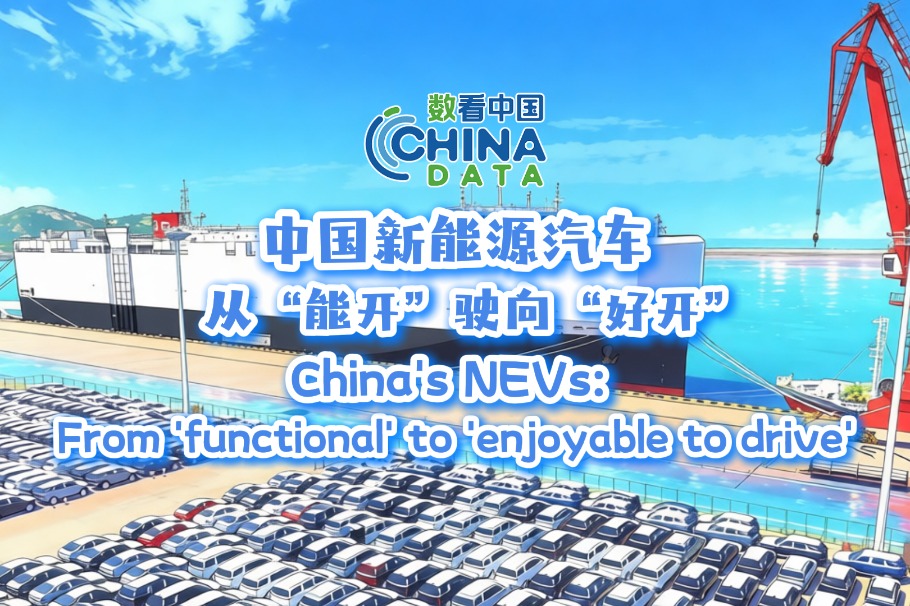
Auto industry gets smart, adapts to market changes










While auto sales in China suffered a significant drop of 42.4 percent in the first quarter of 2020, they have steadily rebounded and, in 2020, exceeded 25 million units, accounting for 33 percent of the world's auto sales.
The Chinese government has made development of new energy vehicles a priority for the country. In September, President Xi Jinping announced the plan to have the country's CO2 emissions peak before 2030, and to achieve carbon neutrality by 2060.
Two months later, the State Council, China's Cabinet, also announced a 15-year (2021-35) industry development plan, setting clear targets for penetration of new energy vehicles: to achieve 20 percent by 2025, 40 percent by 2030, and more than 50 percent by 2035.Major government incentives include tax exemptions and support for the construction of electric vehicle charging stations.
As a result, new energy vehicles accounted for 5.4 percent of total auto sales in China last year and are expected to grow to 6.9 percent this year, according to the China Association of Automotive Manufacturers.
Vehicles are now considered to be the next big thing in the era of the internet of things, so intelligent connectivity is becoming standard in today's vehicles.
Along the way, China's auto industry is also rapidly commercializing self-driving vehicle technology. L4(a high degree of driving automation) robo-taxi trials are already taking place in a number of Chinese cities, including Shanghai, Guangzhou, Nanjing and Changsha.
L4 autonomous vehicles are also being used for the movement of goods. In July, Chinese automaker SAIC announced its quasi-commercial operation of a self-developed "5G plus L4" smart heavy truck at Yangshan Port in Shanghai. Chinese tech giants like JD.com, Alibaba and Meituan are all experimenting with unmanned last-mile delivery.
The Chinese government has also relaxed its requirement for ownership by foreign original equipment manufacturers. Previously, they could only operate in China through 50/50 joint ventures with local Chinese partners, but now they can have full ownership. Tesla entered China through a wholly owned operation based in Shanghai, and Volkswagen restructured its joint venture with Jianghuai Automobile Group Corp to have 75 percent ownership.
Investments are ramping up in China, the world's largest auto market. In 2020, the amount of investment and financing in the nation's automobile and transportation sector reached $8.6 billion, predominantly in new energy and autonomous vehicles.
Attracted by the upward exponential growth potential of this industry, new players with different backgrounds are entering the market.
For example, Internet giant Baidu has set up a joint venture with local carmaker Geely, which recently built the next generation of smart vehicles.
In addition, Xiaomi, the world's third-largest smartphone maker, has announced it will set up a new business aimed at making electric cars that will be led by the company's CEO, Lei Jun, with $10 billion of investment over the next 10 years.
Startups are popping up along the entire value chain of the auto industry. Horizon Robotics, a 5-year-old company specializing in artificial intelligence chips for autonomous vehicles, aims to raise more than $700 million in its series C round. The new capital injection will be used to accelerate the development and commercialization of the next-generation L4 and L5(full driving automation) autonomous chips. Neolix, a self-driving logistics startup based in Beijing, is chasing after the rapid growth of China's autonomous vehicle market and says it has sold more than 200 vehicles to such customers as Huawei, Alibaba and JD, with the vehicles deployed in 20cities throughout China.
At the same time, incumbent original equipment manufacturers have been repositioning themselves in order to strengthen their competitive advantages in the new game.
In October 2018, Daimler's mobility service and Geely announced the formation of a joint venture to provide a premium ride-hailing service called StarRides. The service, which was launched in December 2019 in Hangzhou, Zhejiang province, now covers the majority of China's metropolises and popular travel destinations.
As one of the biggest domestic players in China, Geely is aiming to become a full-range transportation solutions provider through self-built capabilities and partnerships. Over the past decade, Geely has launched Lynk& Co (a connected car brand providing personalized mobility services), Polestar (a premium electric vehicle brand that uses a subscription model), Caocao (a new energy vehicle ride-hailing platform), and has acquired Volvo Cars, London Taxi Co, Terrafugia (the first flying car company in the world) and has signed strategic agreements with Baidu, Tencent, Foxconn and Daimler to provide vehicle-related services.
In the past, the dominant form of corporate structure in China's auto industry was joint ventures between Chinese and foreign companies. Going forward, a plethora of new corporate relationships will surface, ranging from wholly owned operations to various types of joint and corporate ventures.
Demand and supply will continue to increase significantly. It is quite possible that oversupply will emerge, at least in certain segments. More rigorous customer demand might increasingly emerge, new policies reshaping the industry will continue to evolve, and hyper-intensive competition will manifest.
To this end, past success won't be a guarantee for future success. Some companies will end up being marginalized and perhaps be squeezed out of the picture. The winning companies will be the ones that can learn, adapt and strengthen along the way.
Edward Tse is founder and CEO of Gao Feng Advisory Co. Bill Russo is founder and CEO of Automobility Ltd. The views do not necessarily reflect those of China Daily.