Racism deeply rooted in US









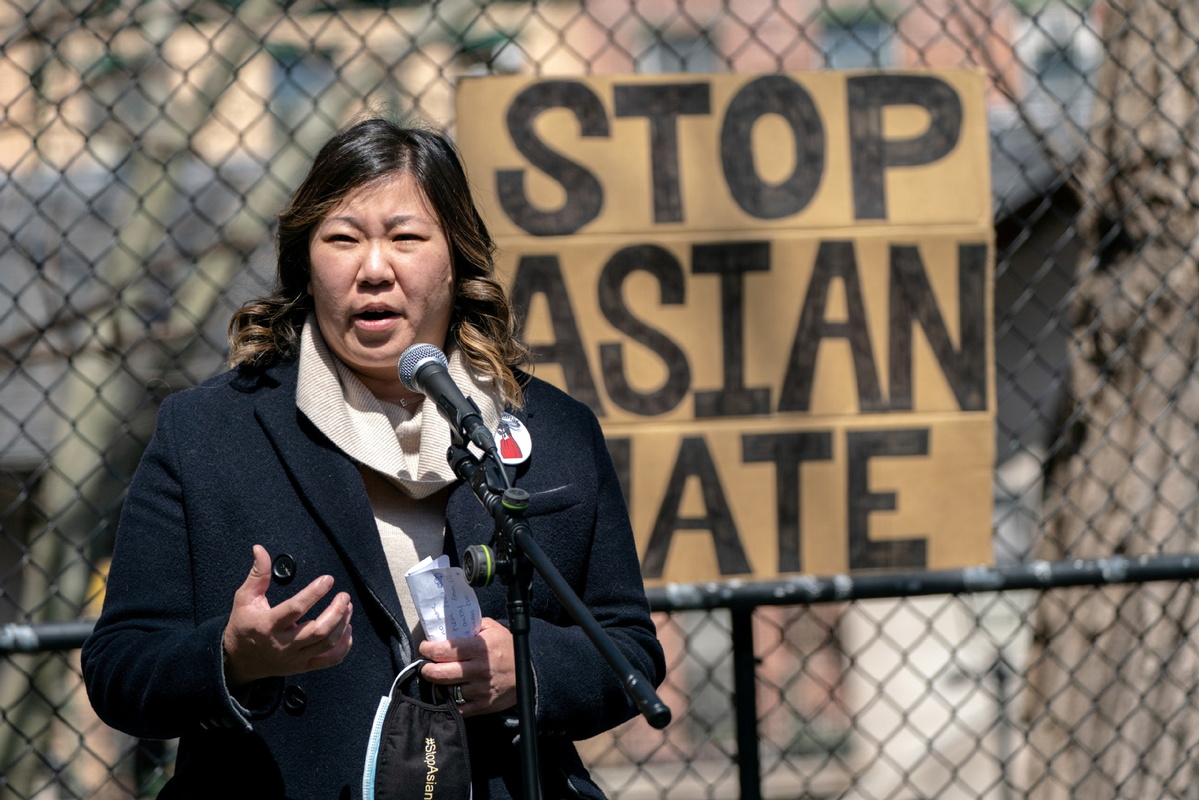
Following the outbreak of COVID-19, Asian Americans have become targets of racial discrimination. The number of anti-Asian American hate crime cases reportedly increased by 150 percent in 2020, and in New York City, it increased 833 percent.
The emergence of hate crimes has sparked an unprecedented, nationwide wave of demonstrations by Asian Americans.
Asian Americans, often referred to as the "model minority", have been forced to take to the streets, which is yet further proof of the comprehensiveness and seriousness of the problem of racial discrimination, and exposes chronic human rights problems in the United States.
The recent increase in violent crimes of racial discrimination against Asians is due to a number of factors, including political, economic, historical, cultural, legal and social ones, and deeply rooted in the country's flawed political and judicial systems and history of racism.
Politically, although the US Constitution provides that all people are born free and equal, there are plenty of whites who consider themselves a superior race. White supremacy is deeply rooted in US society. Racism has also spread to some ethnic minorities, resulting in systemic racial discrimination.
In fact, the US has a long history of racial discrimination, ranging from the genocide of Native Americans in the early years, to the enslavement of black people, to the persecution of Chinese laborers in the late 19th century, and more recently to the killing by a white police officer of George Floyd, a black man.
Historically, the US has experienced large-scale, sustained instances of discrimination against Chinese. The infamous Chinese Exclusion Act of 1882 was the first racial discriminatory immigration law passed in the US against a particular ethnic group. The act authorized the US government to suspend Chinese immigration, resulting in the tragedy of a large number of Chinese laborers in the western US being permanently separated from their families in China. It wasn't until 2012 that the US House of Representatives passed a bill to issue a formal public apology for the Chinese Exclusion Act. It seems the legacy of racial discrimination against Chinese Americans is still strong today.
Legally, the serious lack of relevant legislation is a major problem. The long-standing legislative inaction of the US government has been an important reason for the growing problem of racial discrimination and hate crimes targeting ethnic minorities. As a state party to the Convention on the Elimination of All Forms of Racial Discrimination, adopted in 1965, the US has not only failed to fulfill its obligation under the convention, but also has not taken effective measures to eliminate its domestic systemic racial discrimination.
While acceding to the convention, the US made a reservation declaring that the convention is not self-executive domestically and could not be cited as a legal basis for claiming equal rights in US courts. The US further made a reservation under the guise of freedom of speech against Article 4 of the convention, which explicitly prohibits incitement to racial discrimination and the dissemination of expressions of racial discrimination.
The United Nations has repeatedly reminded the US that its reservations are incompatible with the object and purpose of the convention, and has urged it to withdraw or modify the reservations in question, which the US has ignored. As a result, the convention has been shelved and totally neglected by the US.
The US is the largest immigrant country in the world. Minority immigrants have made an indelible contribution to the development and prosperity of the US, but they have been the victims of racial discrimination. Asian Americans in particular are in a weak position. Whenever economic recession and social unrest occur, they are vulnerable and become the main targets of racial discrimination and hatred.
The current wave of hatred and violence against Asian Americans has come at a historical moment when COVID-19 is raging in the US.Former president Donald Trump had tweeted about the "China virus" and there was a spike in anti-Asian hate crimes. Asian Americans are once again used as pawns by some politicians for shifting blame.
Internationally, the issue of persistent racial discrimination within the US has been of great concern to international human rights organizations. Several experts from UN human rights bodies observed that racism and ethnic discrimination in the US and xenophobia were on the rise, and that the US had a long history of systemic and structural racism. In a joint statement in November 2018, they severely criticized the irresponsible racist statements and actions of some senior US officials that incited racial hatred and xenophobia and created a hostile social environment for non-whites in violation of international human rights standards.
In June 2020, the Committee on the Elimination of Racial Discrimination, the body of independent experts that monitors implementation of the convention, called for immediate structural reform in the US to end racial discrimination and to fulfill US obligations under the convention.
Asian Americans adore the Confucian Doctrine of the Mean and value peace. The outbreak of hate crimes against Asian Americans this time is extremely unusual. It shows, on the one hand, that the recent hate crimes against Asian Americans have reached the point of intolerance, and on the other hand, Asian Americans are awakening and united. In the face of the rampant crime of ethnic hatred, there will be no way out without a fight.
It is a constitutional principle of the US that "all men are created equal", but the record of the US government in that regard is far from satisfactory. The US should first do its own work well instead of interfering in the internal affairs of other countries everywhere.
The author is a member of the UN International Law Commission and a distinguished professor at Wuhan University's Institute of International Law.