


Alleys offer combination of rich history and modern charm









Yangmeizhu West Street
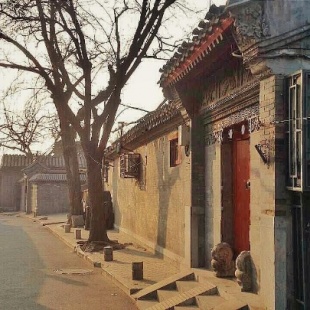
It is a traditional Beijing hutong alley lined by single-story residences in Dashilan, a busy commercial area of the capital's Xicheng district, and is about 500 meters away from Tian'anmen Square.
Originally called Yangmei West Street and named after a female matchmaker, it was renamed Yangmeizhu West Street-the street of poplars, plums and bamboo in Chinese-early last century.
Located in the center of Beijing, the 496-meter-long and more than 600-year-old alley attracts tourists not only for its examples of traditional architecture, but also for several cultural figures. For example, Shen Congwen, a late 20th-century Chinese author and a scholar, lived in this hutong.
Besides the traditional Chinese houses and old-style bookstores, visitors can also enjoy a cozy afternoon or a coffee break in the alley. It has become a cultural and business innovation area after being renovated with artist shops, cafe and bars starting over the past eight years.
You can start your journey of the alley at Mofan Bookstore. From there, you can head west and take a window seat at Soloist to have a cup of drip coffee. On the way, you may see Beijing locals playing Chinese chess or come across interesting people talking about their own ideas on arts and life.
Dongjiao Minxiang
It is a hutong about 1,500 meters long east of Tian'anmen Square. It is also home to a few high-end restaurants and luxury retailers as well as some cheap eateries and common shops.
You can see a number of Western-style buildings that are protected by the city's artifact preservation authority. They were once homes of some foreign diplomats.
The hutong was called Rice Alley during the Yuan Dynasty (1271-1368) for its proximity to the river port by which rice and grains arrived in the capital from the south. During the Ming Dynasty (1368-1644), a number of ministries moved to the area, including those in charge of diplomatic affairs.
Following China's defeat during the Second Opium War in 1856-60, the Zongli Yamen was built in the area as the foreign office of the Qing Dynasty (1644-1911) and the hutong was reopened for diplomats from many other countries, including Japan, France and Germany. Soon after 1959, the diplomats were moved to the Sanlitun area.
You can find St. Michael Catholic Church, which was established in 1902 on the site of a church destroyed during the Boxer Rebellion (1899-1901).
Xianyukou Street
Strolling along Qianmen Pedestrian Street, you will find an old lane called Xianyukou. It was a hutong built during the Ming Dynasty, and it has been named as a historical and cultural street protected by the Beijing government since its renovation in 2004.
Some Beijing time-honored restaurant brands, including Bianyifang, famous for its roast duck and Beijing-style cuisine, and Duyichu, known for its flower-shaped shaomai dumplings, gather together on the street. Their presence makes the area full of hustle and bustle day and night.
Besides enjoying the Beijing-style food, you can also learn traditional skills in some workshops, watch dramas in the Tianleyuan Theater and read books in a library called Chunfeng Xixi, or Spring Wind, on the old-fashioned commercial street.
Gongmenkou Ertiao
It is a 266-meter-long hutong in Fuchengmen, Beijing's Xicheng district. It is a short alley, but is filled with history, culture and innovations.
In this hutong, you can visit Beijing's Lu Xun Museum. Lu Xun (1881-1936) is regarded as the founder of modern Chinese writing and revered as a scholar and teacher. He played a significant role in the anti-imperialist May the Fourth Movement in 1919, and his legacy also includes leading the revolution of simplified Chinese script.
The museum is mainly comprised of two sections.
One is Lu Xun's former residence where he lived from 1924 to 1926, which is also a cultural heritage site under the protection of the Beijing government. The other is an exhibition hall displaying copies of his works, including letters and journals, photos and personal objects.
After a visit to the museum, you can have a cup of coffee at You Shu, a cafe hidden in an old house that has been turned into a homestay.
?