Xi's civilization view offers insight into today's world









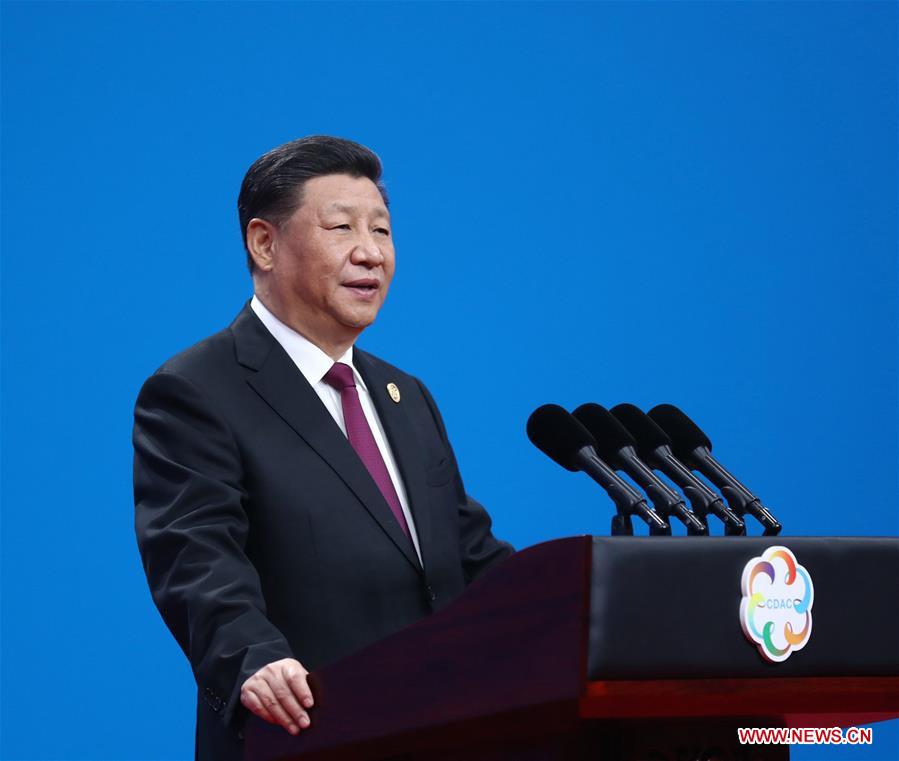
BEIJING -- President Xi Jinping has stressed the unique and important role of the world civilizations in his address at the 2019 Conference on Dialogue of Asian Civilizations.
"To meet our common challenges and create a better future for all, we look to culture and civilization to play their role, which is as important as the role played by economy, science and technology," Xi told the audience.
Over the past two years, China's culture and civilization has played an important part in contributing to the world afflicted with COVID-19 and conflicts.
As the pandemic still rages and new challenges arise, people across the world need to come together to promote interaction among civilizations and make joint efforts to build a community with a shared future for mankind.
PROMOTING PEACE AND DEVELOPMENT
As the international landscape undergoes profound changes, Xi's remarks on multiple international occasions, which demonstrate China's view on world civilizations, offer an insight.
"Diversity spurs interaction among civilizations, which in turn promotes mutual learning and their further development," Xi told the Conference on Dialogue of Asian Civilizations in May 2019.
"No two leaves in the world are identical, and no histories, cultures or social systems are the same," Xi told the World Economic Forum Virtual Event of the Davos Agenda in January 2021.
"Diversity is what defines our world and makes human civilization fascinating," Xi told the Boao Forum for Asia Annual Conference in April 2021.
Russian sinologist Yuri Tavrovsky said he was impressed by Xi's remarks at the Conference on Dialogue of Asian Civilizations two years ago.
"The meaning of the speech goes far beyond the cultural scope. President Xi hopes that different civilizations will strengthen exchanges and mutual learning to promote world peace and development," he said.
As humanity has been battling COVID-19 over the past two years, regrettably, the debate of "clash of civilizations" resurges, with some countries forming values-based alliances to provoke ideological confrontation.
At this critical time, Xi's remarks may shed light upon how to understand and handle cultural and civilizational differences.
"The moderate tea drinker and the passionate beer lover represent two ways of understanding life and knowing the world, and I find them equally rewarding," Xi said, using a comparison of tea and beer to explain the diversity and inclusiveness of human civilization.
China's view of world civilizations is rooted in its traditional values of peace, harmony without uniformity, and harmonious coexistence, which have not only shaped its own action model but also added impetus to global efforts to promote world peace and development.
China's view of world civilizations is characterized by equality, mutual learning, dialogue and mutual accommodation. It calls for replacing mistrust with exchange, clashes with mutual learning, and a false sense of superiority with coexistence in order to safeguard world peace and development.
FACILITATING DIALOGUE AND COOPERATION
In March, significant discoveries were made at China's legendary Sanxingdui ruins, which show that the region's ancient Shu state civilization may bear similarities with the Maya in their perception of the universe.
"At the end of the day, man is still man independent of time and space, and what we have is that, at this latitude, both that culture and the Maya looked at the same sky, they had the same stars on the horizon," said director of the Chichen Itza archaeological site, Marco Antonio Santos.
Cultural exchange and dialogue prompt the evolution of human civilization. The ancient Chinese Silk Road, for instance, has played a big role in connecting peoples and cultures over centuries. In this day and age, China's exchanges with other countries in culture, arts, archeology and education go far beyond the past.
As the president of a country with an ancient civilization, Xi has made personal efforts to promote exchanges and mutual learning among civilizations.
Xi has been fascinated by the diversity of civilizations during his overseas trips, including those to the ancient Mayan ruins of Chichen Itza in Mexico, the Acropolis Museum in Athens, the Luxor Temple in Egypt, the ancient city of Bukhara in Uzbekistan and India's Group of Monuments at Mahabalipuram.
His respect and admiration for other civilizations were also manifest in his frequent reference to foreign culture, ranging from world-famous classics to well-told stories and arts and crafts symbolizing intermingled cultures.
The COVID-19 outbreak, though dramatically reduced international travels, has not stopped cultural exchange. Chinese music, TV dramas and books continue to be staged and read on foreign soil, not to mention abundant resources of Chinese culture online.
WORKING FOR BETTER WORLD
On a nine-story Basantapur complex in Kathmandu, a UNESCO World Heritage Site that was badly damaged during the 2015 earthquake, Chinese conservation engineers are putting finishing touches on their meticulous restoration work.
The exquisite and sophisticated wood and brick structures damaged in the 7.9-magnitude earthquake were brought back to life by the Chinese team, who stayed in Nepal and worked around the clock despite difficulties imposed by the pandemic.
Apart from cultural heritage conservation, China is also working with other countries in poverty reduction, environmental protection and other fields as part of its efforts to jointly build a community with a shared future for mankind.
Rooted in traditional Chinese culture, the vision of building such a community is China's contribution to human civilization. Beijing has applied and enriched such a vision in developing bilateral and multilateral relations, and practised it in such areas as ocean, health and environment.
As a key platform for building a community with a shared future for mankind, the Belt and Road cooperation has won increasing popularity, eyeing further development in health, environment, digital growth and other areas.
In addition, China's anti-poverty cooperation continued despite the pandemic, with new pilot projects announced in Southeast Asian countries, and training programs expanding to help African farmers.
Civilization has a soft yet powerful influence. Learning from a different civilization can and should help build friendship between peoples, promote progress of human society and safeguard world peace for a better world for all.

- Exhibition highlighting the 'Two Airlines Incident' opens in Tianjin
- Average life expectancy in Beijing rises to 83.93 years
- Energy drink overdose sends delivery worker to hospital
- GBA and Hainan deepening cooperation to boost innovation and sustainable growth
- Beijing mulls including the costs of embryo freezing and preservation in medical insurance
- Rocket developed by private Chinese firm fails, loses three satellites