Manifesto becomes village heirloom










Thanks to generations of caretakers, 1926 communism booklet survives wars
Liu Yuhui, a member of the Communist Party of China from Liuji village in Guangrao county, Shandong province, could not have known that the Chinese-language version of The Communist Manifesto she brought back to her home village in 1926 would become an heirloom a century later.
This small pamphlet, which has survived wars and natural disasters, sowed the seeds of communism in the small hamlet.
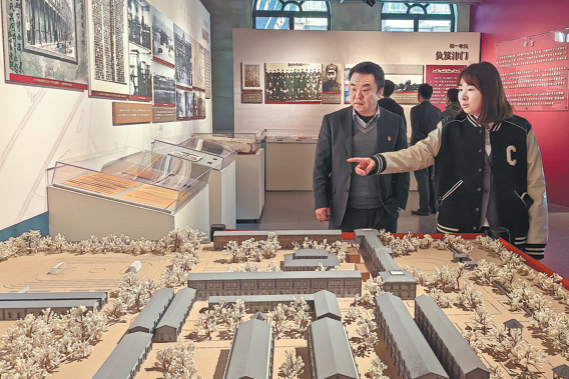
To celebrate the 100th anniversary of the founding of the CPC, the village exhibition hall that contains the manifesto has just been renovated. Liu Hongye, a 65-year-old villager, likes to hang out there when he has time. The objects and the photos exhibited in the memorial hall bring back memories of his childhood.
Liu Hongye's grandfather, Liu Shihou, was the manifesto's caretaker. He donated it to the memorial hall when it was built.
"I remember from a young age that my grandfather had a booklet locked in a box. He treated it as an object above all others and would not let the family touch it," Liu Hongye said, adding that the image of his grandfather sitting on the bed talking about 'Big Beard' (Karl Marx) remains deeply imprinted in his mind.
In 1925, one of the first CPC village branches was secretly established in Liuji. Former village Party chief Liu Liangcai was given the manifesto by Liu Yuhui, who acquired it in the provincial capital, Jinan, in 1926. He then "translated" it into the local dialect. The farmer distilled the manifesto's meaning into one vivid saying: "Follow the words of 'Big Beard', and there will be land to till and food to eat."
Liu Liangcai wove the manifesto into local operas, which quickly became popular. More and more peasants began to realize the truth; that they had to unite and be bound together like the strands of a rope and resolutely fight for liberation. As a result, under Party leadership, local residents took part in countless revolutionary battles.
Liu Liangcai was promoted to Party chief of Weixian county in 1931 and gave the booklet to a member of the Liuji Party branch, Liu Kaowen, who then passed it on to Liu Shihou, an "honest and reliable" Party member.
Soon afterward, Liu Liangcai was killed in a revolutionary battle, and Liu Kaowen was arrested. To protect the booklet from Kuomintang searches and the Japanese puppet army's "mopup campaign", Liu Shihou carefully wrapped it up and hid it in his house. In January 1945, the Japanese army started a fire that burned over 500 houses in the village to ashes. Liu Shihou was able to rescue the booklet, although its cover was partly burned.
"My grandfather sneaked back into the burning village to search for it. If he had gone a moment later, it might have been burned completely," said Liu Hongye. His grandfather protected the booklet like a treasure for decades.
In the autumn of 1975, the Guangrao county cultural administration committee visited Liuji in search of cultural relics. The then 84-year-old Liu Shihou donated the manifesto to the county, and it was quickly identified as a first-class national cultural relic.
Liuji has more than 190 Party or army members, 27 of whom are recognized as revolutionary martyrs.
Zhang Feng, curator of the memorial hall, said: "The Communist Manifesto took root in the hearts of the farmers and helped them find the right direction for their mass movement and revolutionary activities."
The village has become a Red tourism attraction, receiving 200,000 visitors a year, and tourism revenue is now a reliable source of revenue for the farmers.



- Cross-talk performance at Great Wall in Tianjin attracts over 1,500 spectators
- China sees rise in influenza, rhinovirus, and other respiratory infectious diseases
- Zhang Chaoyang emphasized active thinking in AI era
- CIIE concludes with record-high intended deals
- Lhasa's GDP grows 7.1 percent in first three quarters of 2025
- Co-hosting games boosts GBA integration