Rebuilding Hainan's reefs, polyp by polyp









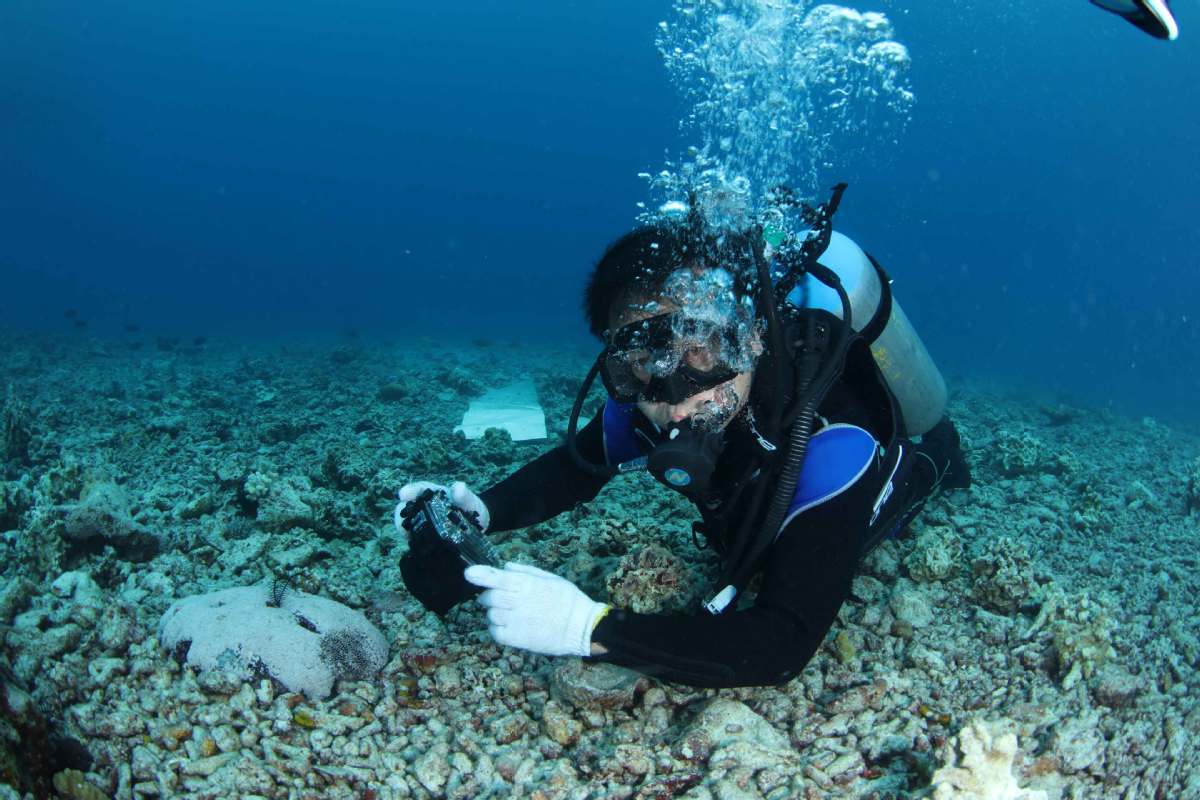
The spread of COVID-19 has prevented marine scientist, Chen Hong, from planting coral in faraway locations since last year, but he has made progress in building up coral germ plasm banks in coastal locations, and in his spacious lab in Sanya, at the southern tip of Hainan Island.
"We started planning for the germ plasm banks in 2019, and initially established three kinds-an indoor bank, a sea bank and coral tissue balls," said Chen, who has been engaged in scientific research and technological development into the breeding and restoration of coral and associated species in Hainan for the past 33 years.
"Establishing germ plasm banks is like building a Noah's Ark for the ecological restoration of coral reefs, and provides precious germ plasm resources for sustainable scientific research on coral," said the 56-year-old, who is also director of the Hainan South China Sea Institute of Tropical Oceanography, the first such specialist research entity in the country.
A native of Zhejiang province, Chen said that China has made the protection of coral and coral reefs a strategic issue, not only as key components of the marine ecological environment, but also as a move to build natural fences to safeguard global ecological security.
He has undertaken scientific research with local government support over the years, and helped develop an asexual reproduction method for single polyp coral seedling and tissue culture.
"We are now able to replant all kinds of hard coral through the asexual reproduction of a single polyp, and we have strengthened these asexually reproduced corals to be able to survive even strong typhoons," he said. In 2003, Chen set up his research institute in the wake of a large instance of coral bleaching-a process that causes the affected corals to die.
The marine scientist has a blueprint to grow 1 million coral polyps in Hainan's sea waters. To date, Chen and his team have planted more than 230,000 of them in the waters around Sanya, Lingshui and the Xisha Islands. Chen said they will reach the 1 million target in about two years, as soon as the epidemic is under full control.
"It is my life's mission to restore these precious resources, and ensure their survival," Chen said, adding that after years of experiments, his team has mastered at least six methods for growing coral in different environments, and that the survival rate of corals like the Goniastrea (a genus of stony coral that resembles a sponge) is as high as 90 percent.
As a participant in a number of Hainan's marine ecosystem research projects, Chen has traveled to Xisha Islands with his team about 20 times, planting coral, Tridacna, or Southern Giant clams, and large-size seaweed.
During a trip in 2017, he discovered a new coral species and a seaweed bed ecosystem, which enrich Xisha's biodiversity.
"Our restoration efforts also led us to discover that with global warming, shell algae can latch onto coral chippings and grow to form small coral reefs, which inspired us to come up with a new technical solution to the ecological restoration of reefs."
"And it was amazing to discover that soft coral forms a symbiotic relationship with shellfish, which help keep the coral clean of tiny, harmful strands of seaweed, while the corals provide the shellfish with living space," said Chen, adding these findings could have a global impact.
"A normal diver can stay under water for 90 minutes a day, but he (Chen) can dive several times a day, for 90 minutes each time, planting as many as 500 corals in one day," says Xu Daoning, a fisherman in Xisha, who has often helped the hardworking scientist.
Experts say that coral reefs are the forests of the ocean and are at the top of the biodiversity system, and that most kinds of marine species live among them. Reefs account for less than 0.25 percent of the world's ocean area, but shelter and nourish more than one quarter of its fish resources.
Chen began to build coral gardens as demonstration zones in the waters around Phoenix Island in Sanya Bay in 2011.
"As little as only a centimeter when they were planted, many of the corals have grown as tall as 50 centimeters in the past 10 years. The coral gardens are about two hectares in area, and will help create an ecosystem that encourages fish, shellfish and sea plants, and form a completely new ecological landscape," he said.
This year, Chen plans to collect over 50 living coral species for his germ plasm bank, and will develop a technique for culturing coral tissue balls and a molecular identification method for coral seedlings.




- Guangdong urged to drive high-quality development
- Shanghai hosts 6th intl 3E talent fair
- Xi's special envoy attends inauguration of Bolivian president
- Countdown to 15th National Games: On-site warm-up entertains audience
- Eight missing after cargo ship collides with fishing vessel near Shandong
- Investing in people: a worthwhile investment