German couple devote lives to deaf kids in Changsha









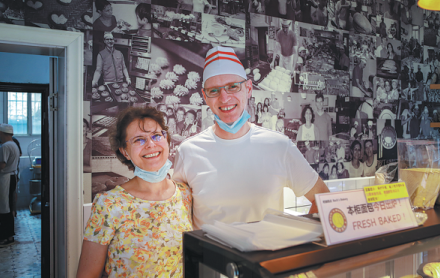
It was a damp, chilly day when Dorothee Brutzer and her husband Uwe arrived in Changsha, the capital of Hunan province, for the first time in November 1999.
"I remember the airport was very small, and I didn't see many children on the street," said Dorothee, who now speaks fluent Mandarin with a Changsha accent.
The German couple, who are known by their Chinese names of Du Xuehui and Wu Zhengrong, had just completed a two-year Chinese language course when they came to visit the Hunan Disabled Persons' Federation to learn about a charitable program funded by a German organization helping the province's deaf children with speech rehabilitation training.
Du, a primary school teacher, and her husband Wu, a chemical engineer, shared the same desire to "do something meaningful".
After receiving professional training back in Germany, the couple moved to Changsha in 2002 and planned to work as volunteers with the charity.
"At the time, we lived in the suburbs. The surroundings were mostly single-story houses built by farmers and rented to migrant workers. It took 15 minutes walking to get to the nearest bus station," Wu said.
The couple have lived in Changsha for nearly 20 years now and have watched skyscrapers rise from the ground, transforming the city.
"When we see children who previously didn't have access to rehabilitation training starting to make progress in learning to speak, we feel a sense of accomplishment, and so staying here becomes the natural choice," Wu said.
Du remembers that there was only one teacher's manual for special education when they arrived, and only 15 pages were dedicated to speech rehabilitation training for hearing-impaired children.
"But now, there are countless books on this subject," she said, adding that children also have more advanced hearing aids and even artificial cochleae today.
"Moreover, teachers will now be sent to learn the latest methods in rehabilitation training every year, and the training is subsidized by the government."
According to Wu, only a small percentage of the province's deaf children had access to rehabilitation training in the past. Further, most of them missed the best time to start because their diagnoses were often delayed, and their conditions were only confirmed at about the age of 5.
Wu said that as China enjoys rapid development and the authorities pay growing attention to deaf children, most of them now have access to the rehabilitation training they need.
"On the one hand, government-sponsored projects and subsidies have increased and cover the expenses for children from poverty-stricken areas. On the other hand, parents living in cities now are able to afford to pay for their children," he explained. "The progress has been great."
In recent years, Hunan has focused efforts on helping people with disabilities in order to realize the national goal that "not a single person with disabilities should be left behind in building a moderately prosperous society in all respects".
According to statistics from the Hunan Disabled Persons' Federation, by the end of 2019, the province's 448,300 certified disabled children and adults had been offered basic rehabilitation services, and 76 of the province's 404 rehabilitation centers provide hearing and speech rehabilitation services.
As more and more deaf children have access to rehabilitation training, Du has begun to work with International China Concern, a charity set up in 1993 to care for abandoned disabled children, to provide funding and speech rehabilitation training for those with disabilities like brain paralysis and autism.
In 2011, Wu opened a bakery in Changsha that hires deaf people and teaches them bread-making free of charge, because the couple discovered that deaf children face difficulty finding stable jobs when they grow up.
"In my hometown, bread is an ordinary staple that can be easily made. You don't need to communicate with others when making it, so it's a suitable job for deaf people," Wu said.
Six of his 10 employees and one apprentice are deaf, and Wu's bakery has trained more than 20 apprentices so far, some of whom later became bakers at renowned restaurants and star-rated hotels, earning themselves salaries and self-respect.
"A secure job with stable income is very important," Wu said, adding that deaf people who do not have professional skills like bread-making or machine maintenance tend to change jobs frequently, and employers generally don't make an effort to retain them because replacements are easily found.
In the future, Wu hopes that he can remain in Changsha and run the bakery for as long as possible so that more deaf people will have the chance to learn bread-making and live by their own abilities.






- National Games vibe is everywhere in Guangzhou
- Forum unites global experts to enhance city image communication
- Miao New Year celebrations get underway in Guizhou's Leishan county
- Mainland spokesman reiterates stand on Taiwan
- Fujian county's rural development becomes a big draw for Taiwan investors
- Nobel laureate in chemistry: Give young scientists more independence