A Testament to "Pauk-phaw" Friendship — Premier Zhou Enlai and Myanmar's National Costume









Editor's Note: To celebrate the 100th founding anniversary of the Communist Party of China, we are launching the "100 CPC Stories in 100 Days" series, featuring foreigners who witnessed and participated in the CPC's history and helped the world better understand the CPC. The following is the 30th story of the series.
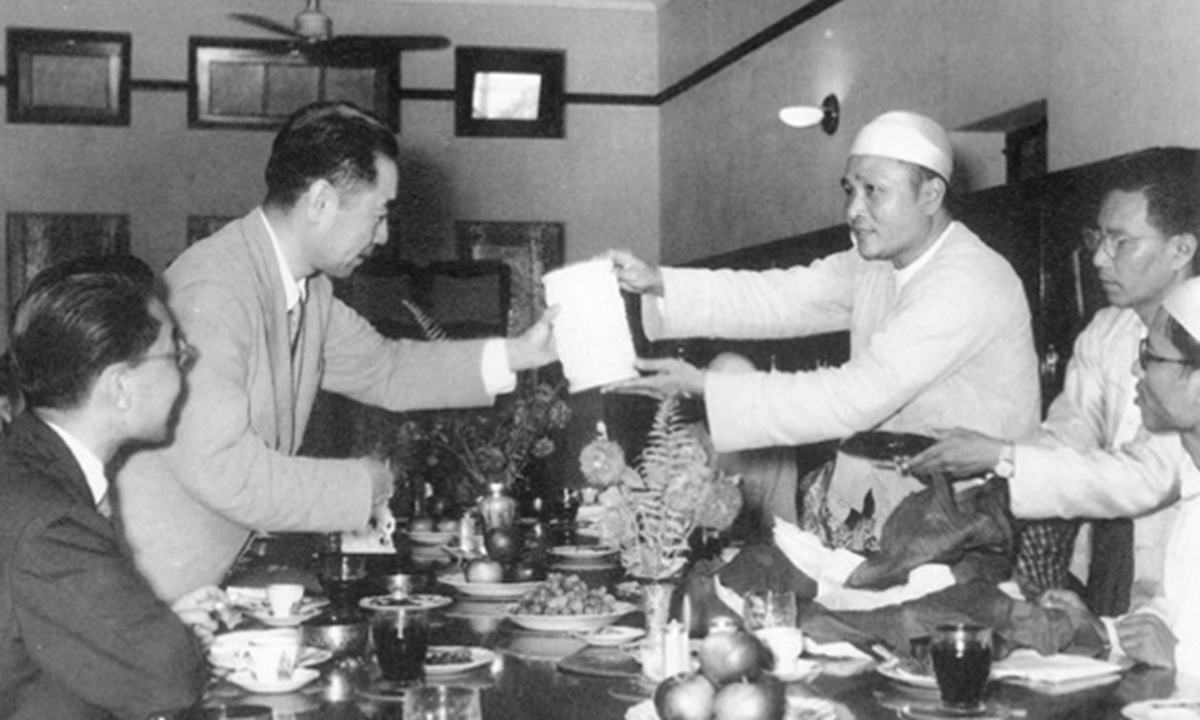
Connected by mountains and rivers, China and Myanmar are neighbors sharing a longstanding "pauk-phaw" friendship. Myanmar is one of the first countries to establish diplomatic relations with New China. Between leaders of the two countries, there is a tradition of paying high-level mutual visits. For instance, Premier Zhou Enlai visited Myanmar nine times and Prime Minister U Nu visited China six times. During those visits, Premier Zhou's three appearances in Myanmar's national costume, and Prime Minister U Nu's two appearances in Zhongshan suit, a modern Chinese tunic suit, are still remembered fondly by people in both countries.
A reception during his visit to China in 1954 was the first time that Prime Minister U Nu dressed himself in Zhongshan suit, just like his Chinese hosts. On another visit to China two years later, he wore the Chinese costume again when visiting an air force base,which enlivened his interactions with the Chinese servicemen there. His choice of attire on those two occasions impressed the Chinese people deeply.
Premier Zhou, a strong believer in the equality of countries, reciprocated by wearing Myanmar's national dress three times during his visits to Myanmar.
In April 1960, accompanied by Vice Premier Chen Yi, Premier Zhou visited Myanmar. The visit coincided with Thingyan, an important festival in Myanmar featuring water splashing. Following a suggestion from Prime Minister U Nu, Premier Zhou joined the celebration dressed in Myanmar's traditional costume, holding a silver bowl in his hand. On the route of his motorcade, there were four roadside tents where the local people splashed water on passers-by. Instead of making only symbolic gestures as suggested by his entourage,Premier Zhou would disembark at every tent and join the crowd in splashing water on each other, highlighting China-Myanmar friendship.
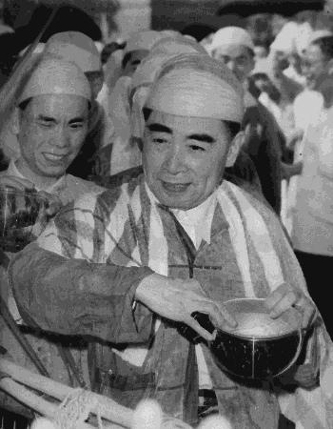
Concerned about his health, the Premier's entourage covered his shoulder with a bath towel, but that got drenched straight away. Tossing the towel aside, Premier Zhou observed that as water is auspicious in local culture, the wetter one gets the more blessed he becomes, adding that he could feel the warmth of every drop of the water and did not feel cold at all. The approachable Chinese premier and his respect for local customs won him the hearts of the local people.
On 2 January 1961, Premier Zhou and Vice Premier Chen made another goodwill visit to Myanmar. At an Independence Day reception held on 6 January in Yangon, Premier Zhou put on a light-colored satin sarong, a white silk shirt, and an exquisite kerchief. The following day, accompanied by Prime Minister U Nu, Premier Zhou visited Mandalay, a big city in central Myanmar. Citing the enthusiastic response of the people in Yangon to Premier Zhou's appearance in their national dress, Prime Minister U Nu urged him to do the same in the ancient city of Mandalay. Zhou readily acted on the suggestion and put on Myanmar's national costume for the third time when taking a boat tour along the Irrawaddy River that afternoon.
When visiting Bagan in Mandalay, Zhou made a donation to the preservation of the cultural heritage site. The local community later used the donation to build a pavilion beside the famous Shwezigon Pagoda. They named it the Zhou Enlai Pavilion. Today, this pavilion stands proudly as a symbol of China-Myanmar friendship. Zaw Min Tun of the Myanmar-China Friendship Association said that as a resting place for visitors to the Pagoda, the pavilion provides much convenience to the local people. He praised Premier Zhou as a Chinese leader who cared about the people of a neighboring country, a sentiment that helped preserve an everlasting friendship between the two countries.
The two premiers' efforts to reach out to the people of each other's countries have brought the two peoples closer and become widely told stories in the friendly exchanges of the two countries. With China-Myanmar friendship deepening further with the passage of time, there is every reason to believe that the two countries will build on the friendly exchanges between the older generations of leaders and write new chapters in the millennia-old "pauk-phaw" ties.

- China's commercial rocket maker puts two satellites into orbit
- People in Taiwan commemorate victims of White Terror period
- China successfully launches new test satellites
- China launches Lijian 1 Y9 carrier rocket
- First cross-border event debuts at the National Games
- China Focus: National Games enhances coordination under 'one country, two systems'