Dual-circulation, emissions goals drive industry change









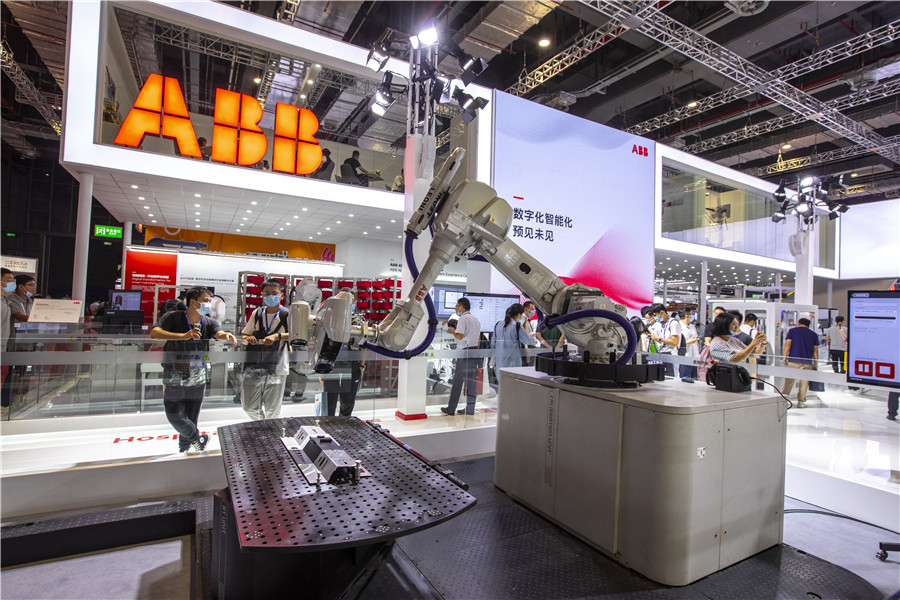
Automation, robotics helping meet skilled labor shortages, boost overall quality
Running a manufacturing business used to be a snap for many senior executives in China two or three decades ago. They received orders from both Chinese clients and their headquarters from cities such as Munich, Chicago and Tokyo, then manufactured and shipped the items to various destinations across China and the rest of the world. Many of these bosses had more time to enjoy their morning coffee and afternoon tea during that period.
Today, this kind of management and business mode certainly would get a CEO in trouble.
Together with China's rapid economic growth and vast home market, many multinational corporations have already changed their operational focus from serving the Asia-Pacific or other offshore markets to focusing primarily on the Chinese market.
Many have been accelerating the transformation of their business operations from a manufacturing company to a service-oriented manufacturer in order to better adapt to China's changing market environment.
The key to promoting business in China these days increasingly relies on e-commerce channels, digital technologies and platforms as well as localized products and services.
Consumers are using digital tools to make comparisons between foreign and domestic products, and share the information about product quality and related services with friends, family and colleagues, said Cha Sheng, general manager for China at Vorwerk Group, a German industrial and technology company.
The firm will establish a digital solutions center in Shanghai in the third quarter to facilitate its transformation from a manufacturing company to a service-oriented manufacturer.
Apart from putting new production lines in its factory in Shanghai to boost production capacity this year, Vorwerk plans to introduce more digital products to meet surging demand for smart household appliances in China.
"We hope to seize the fresh opportunities arising from China's dual-circulation development paradigm by introducing more personalized products and services that add value and health relevance to consumers' lives," Cha said.
Proposed by the central leadership, the dual-circulation development pattern has emerged as the overriding economic theme, with innovation, opening-up and the need to boost domestic demand identified as priorities during the 14th Five-Year Plan period (2021-25). It sees domestic circulation as the mainstay and domestic and international circulations reinforcing each other.
After years of growth, consumption has become a key growth engine for China. Last year, consumption spending accounted for 54.3 percent of the country's GDP, the highest in recent years, and it remained a major driving force for economic growth for the seventh consecutive year, said the National Development and Reform Commission.
Cha's opinion is echoed by Cecilia Qi, vice-president and general manager of pharma and vaccines for China at British pharmaceutical company GlaxoSmithKline, who said China has significantly improved its capabilities in scientific and technological innovation in recent years.
Qi said China is the world's second-largest research and development spender and intellectual property creator. With improving innovation competency, China has caught up with or even overtaken other regions in some cutting-edge fields, therefore becoming a technological powerhouse.
China has made impressive achievements in healthcare innovation over the years. Data showed that China led among second-tier players in its contribution to global pharmaceutical R&D in 2020. Particularly, China's share of the global R&D pipeline rose to around 14 percent last year, trailing only the United States, she said.
In the first five months of this year, foreign direct investment in the Chinese mainland in actual use surged 35.4 percent on a yearly basis to 481 billion yuan ($75.3 billion), the Ministry of Commerce said.
During the same period, the actual use of FDI in the services sector totaled 381.9 billion yuan, an increase of 41.6 percent year-on-year, while the amount of FDI actually used by the high-tech industry soared 34.6 percent, of which the high-tech services sector grew 37.6 percent and high-tech manufacturing rose 25 percent on a yearly basis.
The services sector continues to be a magnet for FDI serves as China's new characteristic for economic development at the present stage, said Chen Fengying, a researcher with the China Institutes of Contemporary International Relations.
"High-level opening-up, innovation-driven development, advanced manufacturing and green development are top priorities during China's 14th Five-Year Plan period," Chen said.
Chen Yudong, president for China of German industrial giant Bosch Group, said that in line with China's new development paradigm, innovations in key technologies are seen as important supporting factors for quality growth.
Chen of Bosch said the company will continue to invest in China and adhere to its "local for local" strategy. At the same time, Bosch regards China as an important innovation hub for the group.
"In the field of home appliances, the new BSH home appliances R&D center in Nanjing has officially begun operations. In terms of local cooperation, Bosch and domestic commercial vehicle manufacturer Qingling Motors established a joint venture in China to develop fuel cell solutions," he said.
Ren Xingzhou, former director-general of the Institute for Market Economy of the Development Research Center of the State Council, China's Cabinet, reiterated that stabilizing foreign investment inflows is a vital policy target, as it is key to technological upgrading and ultimately to long-term growth.