'All hands on deck' urged in electric vehicle sector to achieve green goals









Total electric vehicle sales are expected to reach $46 trillion between now and 2050, with China, the United States and European economies to lead the market. Yet more policy support is needed to reach net zero carbon emissions goals, said a recent report.
The report, released by BloombergNEF, said that the outlook for EVs is brighter than ever. With no additional policy measures, global sales of zero-emission vehicles are expected to rise from 4 percent of the market in 2020 to 70 percent by 2040.
China, the US and Europe have even more enthusiastic expectations, but lower levels of EV use in emerging economies weigh on the global average, said the report.
Colin McKerracher, head of the advanced transport team at BNEF, said: "The growth of electric transport is an amazing success story to date, and the future of the EV market is bright. But there are still over 1.2 billion internal combustion cars on the road and fleets turn over slowly. Reaching net zero by midcentury will require all hands on deck."
He added: "The year 2030 is only two model-refresh cycles away for automakers, so policy certainty will be needed very soon to make investments for a higher rate of penetration possible. Early adoption is vital for building infrastructure and broader consumer interest."
The Ministry of Industry and Information Technology said sales of Chinese new energy vehicles topped the world for six years in a row, and this May, China's NEV market penetration rate surpassed 10 percent. In the second half of 2020, the penetration rate surged from 5 percent to 9 percent.
Brian Luo, public relations director of Shenzhen, Guangdong-based NEV giant BYD, said: "Currently, the automobile industry is experiencing a revolution, and the direction of vehicle electrification is very clear. It is an inevitable trend. The industry has shifted from merely policy-driven to increasingly market-driven. Individual consumers' acceptance of NEVs has been rising, and the driving force of the market will continue to strengthen."
Luo added that: "With the maturity of NEV technologies including batteries, motors and electronic control systems-and the fact that NEVs have already outperformed fuel vehicles in acceleration, noise reduction, energy consumption, maintenance convenience, smart technology and costs-NEVs have the traits necessary to fully replace fuel vehicles. Now, the industry is at a stage where new is replacing old. China's NEV industry has entered a rapid development stage, and the industry will embrace accelerated reshuffling."
Mi Siyi, automobile analyst at BNEF, said: "In terms of China's passenger electric vehicle market, raising the penetration rate not only requires policy support, but automakers also need transformation to increase consumer acceptance of NEVs. They need to solve consumers' pain points, such as charging issues."
Industry players are already taking action. To increase driving distances between charges, BYD established a dual mode plug-in hybrid platform. At the beginning of this year, the platform launched its DM-i super plug-in hybrid technology, which raises between-charge driving mileage to over 1,200 kilometers, and shortens the acceleration time from 0-100 km/h by two to three seconds compared with similarly sized fuel vehicles.
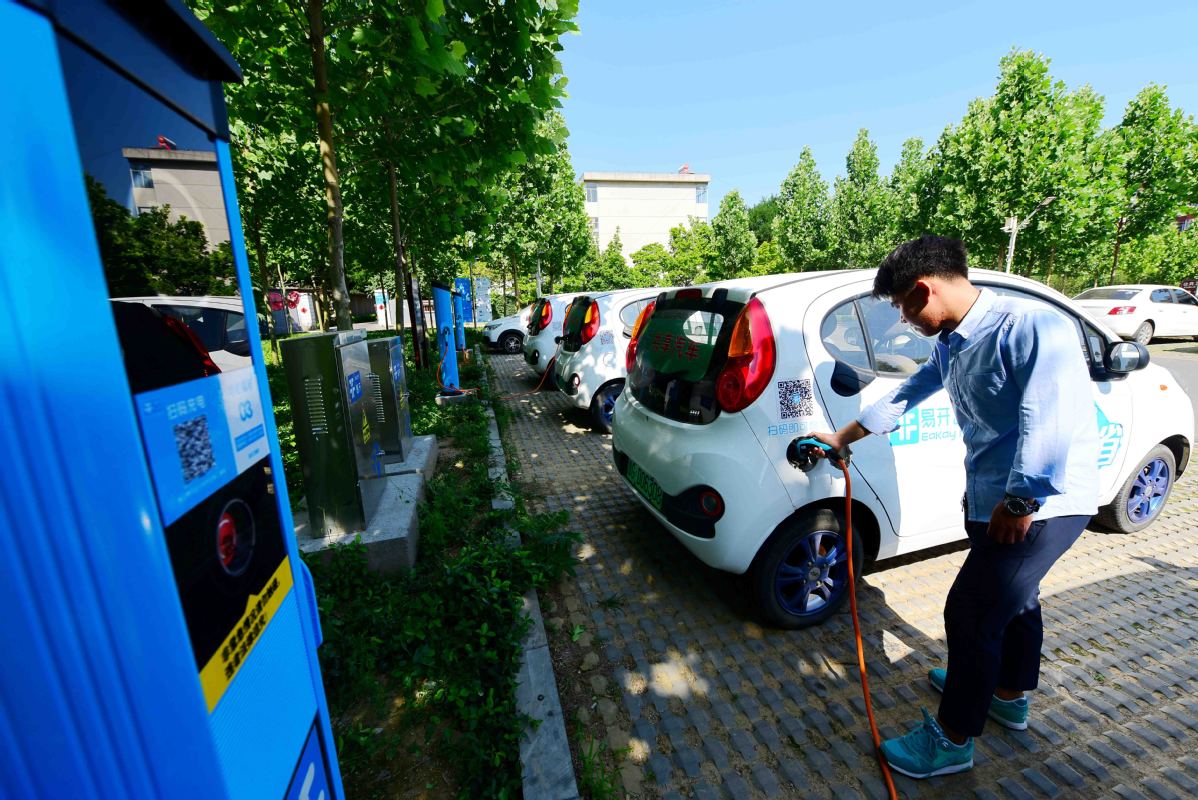
To make charging facilities more available, industry players have been investing in charging pile construction. On June 20, Huizhou, Guangdong-based battery maker EVE Energy Co Ltd announced its investment in EV charging network operator Teld. One day later, EV charging app YKCCN announced its latest investment.
Lyu Jinghong, an intelligent mobility analyst at BNEF, said: "In terms of governmental policies, it is suggested that China propose a timetable for banning fuel vehicle sales. The proposal of the timetable will not only increase sales and penetration rates of NEVs in China, but also set a good example for the world. Besides, the government should think of ways to encourage the public to travel in a more low-carbon way, such as giving priority to developing public transportation in order to achieve net-zero emissions in the road transport sector by 2050."