


A place at home with history
Temples and other intriguing sites draw the crowds to a city where multicultural tradition is part of its modern appeal, Wang Kaihao reports.










The end of the Song-Yuan era may indicate a pinnacle of ancient maritime trade in China had passed, but it is not the end of Mazu belief. Following the continuous migration from Quanzhou across the Taiwan Straits during the Ming (1368-1644) and Qing (1644-1911) dynasties, the belief system was also introduced to Taiwan.
After 1684, when Emperor Kangxi of the Qing Dynasty bestowed the honorary title of Tianhou (meaning "heavenly queen") to this temple in Quanzhou, Mazu temples were established across Taiwan.
"One temple derived from another, and so on," He says. "A complete and stratified system of Mazu belief was thus built up starting from Tianhou Temple in Quanzhou, like a tree and its branches, and the system remains a key emotional attachment across the Straits."
Following Fujian emigrants, Mazu belief also spread across Southeast Asia and even further to the rest of the world.
On Qingyuan Mountain in Quanzhou, a Song Dynasty statue of Lao Tze (Laozi), a philosopher from the Spring and Autumn Period (770-476 BC) and founder of Taoism, is seen as a symbol to reveal the rich historical context of the city. This biggest surviving Taoist stone carving from ancient China and its surrounding environment with lush vegetation is perhaps the best explanation of harmony between humanity and nature, which is a key concept of Lao Tze's ideas.
The Confucius Temple and School in the city, the largest institution of its kind in southeastern China, also witnessed how generations of ancient scholars worked hard to succeed in examinations.
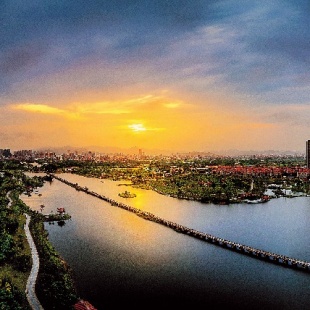
"Quanzhou grew to be China's biggest port in the 12th century, and, as a window to the outside world, it represented the country's general image," He says. "Consequently, Confucianism, Taoism and other indigenous beliefs remained the mainstream in spite of cultural diversity of the city and reflected a country's willingness to display its cultural tradition."