'A Leader with Unmatched Wisdom' — Deng Xiaoping in the Eye of Oriana Fallaci









Editor's Note: To celebrate the 100th founding anniversary of the Communist Party of China, we are launching the "100 CPC Stories in 100 Days" series, featuring foreigners who witnessed and participated in the CPC's history and helped the world better understand the CPC. The following is the 58th story of the series.
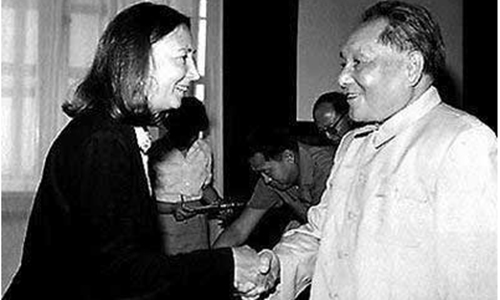
Oriana Fallaci was a journalist with Italian newspaper Corriere Della Sera, and a freelance writer for major newspapers of many countries. Her book Interview with History records her many interviews with prominent figures worldwide, including Henry Kissinger, Norodom Sihanouk, former Israeli Prime Minister Golda Meir, Jordanian King Hussein bin Talal, Chairman of the Palestine Liberation Organization Yasser Arafat, and Iran's religious leader Ruhollah Khomeini. Fallaci said that she wrote in the book her impression and comments about her interviewees in the most outspoken language.
China's reform and opening-up drew Fallaci's attention to the country, in particular to Deng Xiaoping, the "chief architect" of reform and opening-up. She learned about Deng's life from the materials she collected and Deng's biographies by foreign writers.
Fallaci wanted to share with the world firsthand information about China. At the time, there was great interest about China, and many people speculated that China would follow Khrushchev's step. China was in a period of great transformation which was started by Deng Xiaoping. Yet, the world barely knew about Deng or what he wanted to achieve. Fallaci believed that Deng was the key to understanding where China was heading.
On August 21, 1980, Deng Xiaoping met with Fallaci in Room 118 of the Great Hall of the People. The interview took place in an unusual arrangement. Fallaci wanted it to be an exclusive one without the presence of any other media personnel, not even Chinese reporters. So the Chinese photojournalists only stayed for a few minutes to take pictures, and then there were only five people left in the room: Deng Xiaoping, Qian Qichen (then Director-General of the Foreign Ministry's Information Department), Oriana Fallaci, Shi Yanhua (the interpreter), and a recording secretary.
As a veteran journalist, Fallaci put her recorder on the tea table right after she took her seat. Yet deep down, face to face for the first time with this great man of the century, she was not sure if the interview would work out. Trying to make a good impression with Deng, she started by a birthday congratulation, "Tomorrow is your birthday. Happy birthday to you!" Deng replied with a sense of humor, "Is it my birthday tomorrow? I never cared when my birthday is." Fallaci added, "I learned it from your biography." "Even if it is, there's nothing to congratulate about. I'm 76, an age already on the wane," said Deng. "My father is also 76," said Fallaci, "And if I tell him that this age means decline, I think he would give me a good slap in the face." Deng then commented: "Of course you wouldn't say this to your father."
The interview started with a light-hearted tone, which though didn't last throughout the event. After the small talk, a more serious conversation began.
Referring to the portraits of Marx, Engels, Lenin and Stalin she saw on Tiananmen Square, Fallaci argued that Stalin should not be honored and Khrushchev was a hero because he denounced Stalin. She disputed with Deng on that point. After a long argument, Deng cut to the chase of her question, "I must tell you that we will never do to Chairman Mao Zedong what Khrushchev did to Stalin!" He pointed to Fallaci's pen and asked her to note down this particular sentence.
Fallaci could not understand Deng's words. She was straightforward, "That was the first thing I couldn't understand since we started to talk. And I hope you will not feel offended if I tell you that some in the West, not me, call you the Khrushchev of China. What's your comment?"
The question was rather blunt; the air in the room got tense. Why would she ask such a rude question? Shi Yanhua, Deng's interpreter, thought to herself. After Shi translated the question, she looked at Deng with a little unease. Deng was not ruffled in the least. Instead, he gave a hearty laughter and said with perfect composure: "Listen, they can call me anything they like in the West, but I know Khrushchev well, I have dealt with him for 10 years, and it would be absurd to compare me to Khrushchev."
Deng recounted the many things that Khrushchev did to China: suspending aid programs, meddling in China's internal affairs, attempting to control China, asking to set up military bases in China, and so on. Knowing that he might not be able to convince Fallaci with these examples and that continuing the argument would lead nowhere, Deng chose an accommodative approach, "It seems that we could not agree with each other on this matter. What about you keeping your opinion and I keeping mine, and let's put Khrushchev aside?"
Dropping the topic of Khrushchev, Fallaci continued to pursue her question as to where reform and opening-up would lead China. She asked Deng: "Does it mean that not all in capitalism is so bad?" She also thought Deng's endorsement of private plots in rural areas contradicted the theory of Communism. These questions not only drew international attention but also were found hard to explain by many within the country.
Deng gave a clear-cut answer: "It depends on how you define capitalism. Any capitalism is superior to feudalism. And we cannot say that everything developed in capitalist countries is of a capitalist nature." He said: "For instance, technology, science — even advanced production management is also a sort of science —will be useful in any society or country. And these things as such have no class character." He pointed out: "Socialism is the first stage of communism and it covers a very long historical period in which we must combine the interests of the state, the collective and the individual, for only thus can we arouse people's enthusiasm for labor and develop socialist production."
On the morning of August 23, Deng met with Fallaci again. The two sessions totaled more than four hours. This time, Deng made an in-depth analysis of the international landscape. Deng concluded the second session in high spirit; he stood up to shake hands with Fallaci and say goodbye. "Did I pass the test?" he joked. "With flying colors," Fallaci replied.
On August 31 and September 1, major Western newspapers carried the transcript of Fallaci's interview with Deng. The interview riveted international attention, as it opened a window on the ongoing reform and opening-up in China. On an American TV program, Fallaci commented that among the world leaders she had interviewed, none had talked about historical issues in such a candid and in-depth manner as Deng did. Deng shared his insights in great depth about historical issues without being affected by his personal misfortune. She regarded the interview with Deng as the most successful one in her career. In September the same year, she wrote a letter to thank Deng for his time, at the end of which she wrote: "I've been longing for an interview with you. I was concerned if the language barrier would prevent it from coming true. But now this concern has proved to be unnecessary."

- Control of precursor chemical exports tightened
- Xi greets Ouattara on reelection as Cote d'Ivoire president
- 'Book of Songs' from Chinese imperial tomb proves oldest complete copy ever found
- Exhibition highlighting the 'Two Airlines Incident' opens in Tianjin
- Average life expectancy in Beijing rises to 83.93 years
- Energy drink overdose sends delivery worker to hospital