Isabel Crook: Founder of New China's Foreign Language Education









Editor's Note: To celebrate the 100th founding anniversary of the Communist Party of China, we are launching the "100 CPC Stories in 100 Days" series, featuring foreigners who witnessed and participated in the CPC's history and helped the world better understand the CPC. The following is the 70th story of the series.
On 29 September 2019, the presentation ceremony for the National Medals and Honorary Titles of the People's Republic of China was held at the Great Hall of the People in Beijing. A white-haired senior walked slowly onto the stage and was awarded by President Xi Jinping the Friendship Medal, the highest order of honor of the PRC for foreigners. The laureate was Isabel Crook, one of the founders of New China's foreign language education. In her more than a century of life, she spent more than 90 years in China, witnessing the Chinese revolution from hardship to victory, and cultivated a large number of foreign language students for New China.
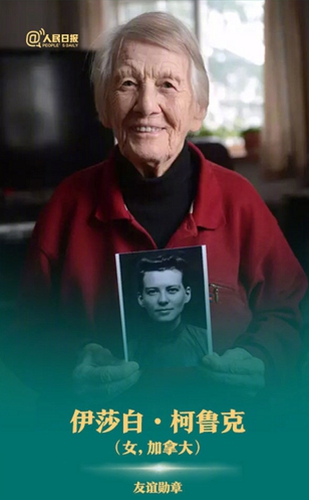
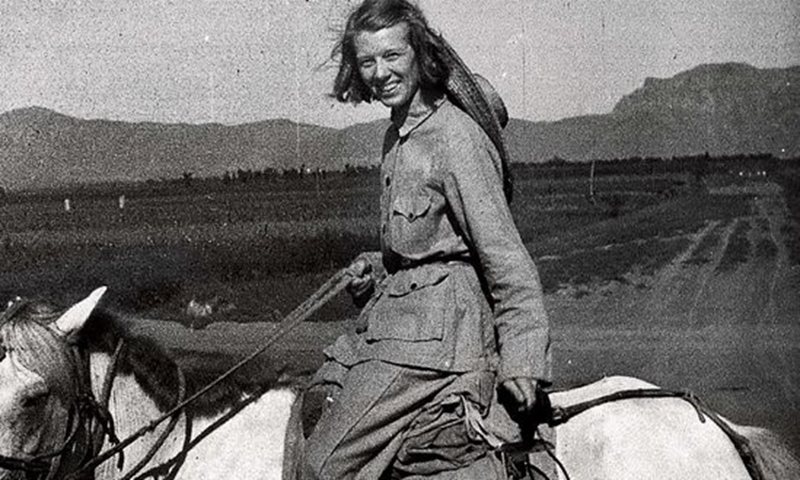
In 1915, Isabel was born to a Canadian missionary family in Chengdu, Sichuan Province. After graduating from the University of Toronto with a master's degree in 1938, 23-year-old Isabel couldn't wait to return to Sichuan. Back then, the "hometown" where she was born and raised was battered by war. Determined like a fearless woman warrior, she nevertheless decided to settle down there and devote herself to anthropological studies.
Putting on a blue sackcloth shirt, a straw hat and a pair of straw sandals, Isabel turned herself from a well-bred young lady to a village girl, and got along well with the local peasants. With hard work, she and her colleague completed the survey of more than 1,500 households in Xinglongchang and surrounding villages in Bishan County. She recorded the daily life of the villagers in Xinglongchang with miscellaneous and detailed field notes, including marriage customs, planting, breeding and trading, which can be called "the most complete big data of Xinglongchang in history" and give the young people today some idea of the state of affairs in villages at that time.
Isabel's love for China and the Chinese people was closely linked to the life of a man called David Crook, her husband and comrade.
David Crook, a member of the Communist Party of Britain, came to China as a teacher under the arrangement of the Communist International. In 1940, Isabel met David in Chengdu and the two fell in love. Two years later, they got married in London and Isabel became a member of the Communist Party under her husband's influence.
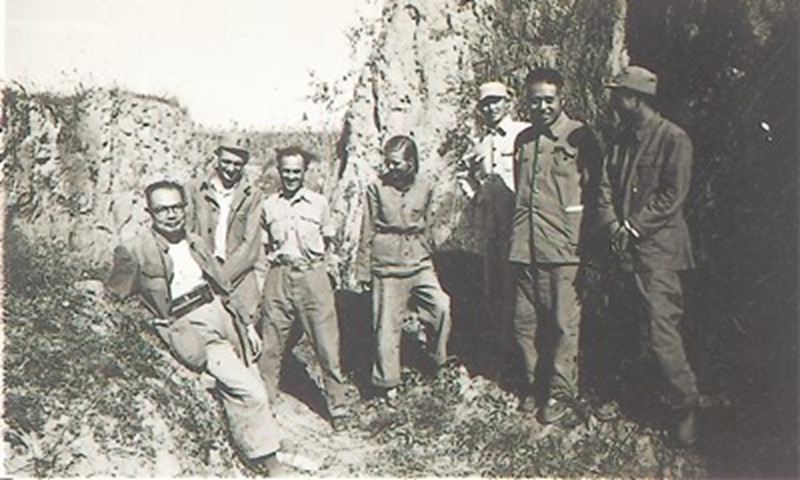
China was always on the mind of the Crooks. In November 1947, they came to Shilidian Village, a liberated area at the foot of the Taihang Mountains in Hebei Province, to investigate the ongoing land reform as international observers. In the spring of 1948, they completed the study and was about to leave China. Wang Bingnan, who was then in charge of CPC's foreign affairs work, warmly invited them to stay. After careful consideration, they accepted the invitation and decided to stay in China for language teaching. From then on, they started the journey of education in China, sharing weal and woe with the Chinese people and taking a direct part in the Chinese revolution.
Isabel was a bit unsure when she began to teach English, as both she and her husband had no professional teaching experience before. The good thing is that they knew a lot about the Chinese revolution. Isabel wanted to see how socialism would be built and learn about Mao Zedong Thought and its practice.
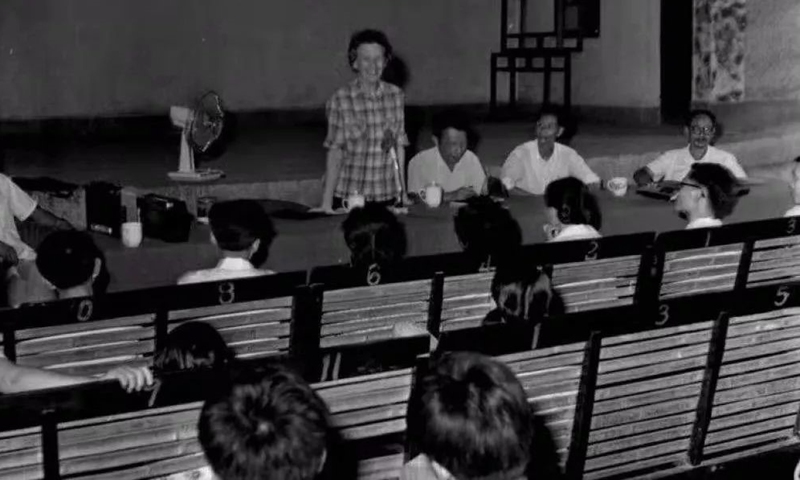
One could hardly imagine the teaching conditions in the midst of a war. The Crooks lived and ate with the students, trying every means for flexible and mobile teaching. They asked their students to take small stools with them so that they could give class everywhere. They tailored teaching approaches to suit students of different language proficiency levels. Without handy teaching materials, they collected articles from English newspapers and periodicals. Isabel often had to work deep into the night on her typewriter before she used a stencil plate to print out the final text. This was how the textbooks, plain but useful, "came off the press".
In oral English teaching, Isabel asked the students to watch their teachers in a given conversation first. Since there were no tape recorders at school, she had to perform the conversation herself again and again. Before long, she developed a sore throat, but she paid little attention.
After the outbreak of the War to Resist US Aggression and Aid Korea in 1950, the army was in urgent need of English language professionals. Under Premier Zhou Enlai's instruction, a small class of 16 students was opened and the Crooks were in charge of specialized training. They not only gave lessons during the day, but also helped the students with learning difficulties in the evening. What impressed Isabel was that everyone was eager and proud for joining the army. When they learned English well enough, they went to the battlefield.
Isabel also trained the first group of interpreters for the Ministry of Foreign Affairs. She carefully selected a variety of tapes for her students to listen to and imitate. After more than a year of training, the language skills of all students were greatly improved.
The Crooks achieved a lot in English education. In addition to their teaching roles, they also participated in the development of New China's first college English curriculum and the compilation of the Chinese-English Dictionary. When asked about her teaching career, Isabel said that the thing impressed her most was the equal relationship between teachers and students.
Isabel retired at the age of 66 in 1981, but she did not stop working. She returned to Southwest China many times to set up student grants for children from poor families. She also went to Inner Mongolia, Ningxia and other places to help with foreign language teaching. She said she and her husband had always been part of the Chinese revolution and they had a sense of belonging because of the trust the CPC placed in them. They never regret coming to China.
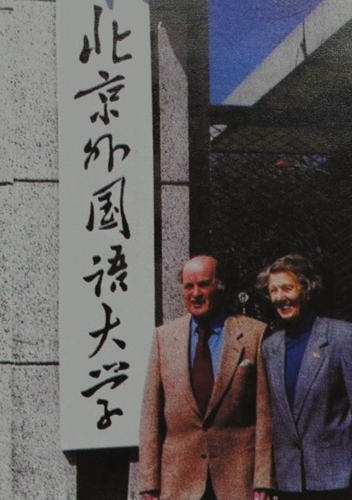
From the Central Foreign Affairs School to Beijing Foreign Studies University (BFSU), from the War of Resistance Against Japanese Aggression to the reform and opening-up, Isabel has witnessed and personally contributed to the development of foreign language education in China. Together with her husband, she has helped many Chinese with a vision to make their voice heard on the international stage. Throughout her life, she has been doing what she loves and what society needs. Her whitening hair and aging gait has borne witness to a scholar's integrity, conviction as well as her commitment to her ideal, belief and original aspiration.
In December 2020, on the occasion of celebrating her 105th birthday by BFSU faculty and students, Isabel said that she was honored to participate in China's socialist construction and the development of its higher education, and to witness China's rejuvenation over the past 100 years. She expected to witness the great historical moment of the centenary of the CPC in 2021.
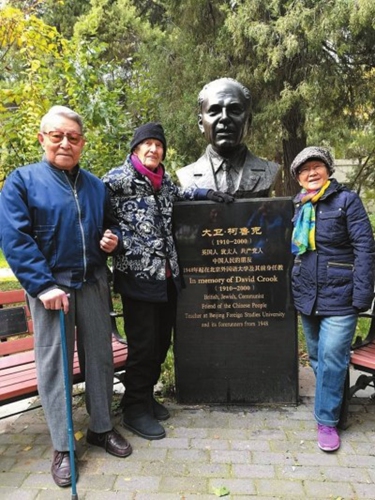
At the east campus of BFSU stands a bronze statue of David Crook. Isabel comes here from time to time to reminisce her beloved husband and their old days.






- Youth trace roots by sharing stories
- Food delivery platforms to do away with financial penalties, sparking debate
- Data show rising labor, business disputes
- Bocholt group visits Wuxi to honor friendship
- Domestic tourism sees major jump in visitors and spending
- Vibrant autumn colors attract tourists to Changchun park