A quantum leap
The Belt and Road Initiative brings opportunities, wealth and good fortune to Tunisia









Ten years have passed since the "jasmine revolution" in Tunisia. The uprising in the North African country ended the strongman rule of President Ben Ali, and the West attempted to make Tunisia a model for democratic transition in the Middle East. However, under the West's tutelage and patronage, the transition has suffered many setbacks and the democratic institutions have remained on shaky ground.
In the 10 years following the revolution, there have been nine Tunisian governments, some of which had been in power for only a few months. The political whirlwind has slowed the country's economic recovery and development, triggering protests on various scales.
Since 2021, the pandemic situation in Tunisia has gone from bad to worse, and the country has the highest death rate in Africa, perhaps even the world. On July 25, people in many Tunisian cities rallied to protest at the government's failure to curb the pandemic and improve the economy, demanding the dissolution of government and parliament. On the same day, the president of Tunisia announced the decision to suspend parliament and dismiss the prime minister who was also the interior minister. This has failed to resolve the political crisis as the discontent is still simmering.
Political turmoil, deteriorating social stability and the threat of terrorism have destroyed Tunisia's economic recovery and its two pillar industries-tourism and manufacturing. Soaring prices and a high unemployment rate have lowered living standards. From 2011 to 2019, the average economic growth rate was only 1.5 percent. In 2020, due to the epidemic, it plummeted to negative 8.9 percent. The projection for this year's growth is even lower.
China and Tunisia, two geographically distanced countries, have stark differences in their political systems and development paths. However, since the establishment of diplomatic relations in 1964, the two countries have never been estranged from each other because of those differences. Instead, they have agreed to disagree and respected the core interests and major concerns of the other.
Upholding the principle of noninterference in other's internal affairs, China has always refrained from commenting on the political situation in Tunisia. It has maintained friendly and cooperative relations with the successive Tunisian governments and tried to help them maintain stability and development when needed. After the COVID-19 pandemic broke out in Tunisia, the central and local governments of China, some Chinese NGOs and enterprises have reached out to aid Tunisia, sending batches of medical supplies and protective equipment, such as masks, protective clothing, gloves and testing kits. Chinese healthcare experts have also shared their experience in fighting the epidemic with their Tunisian counterparts through video conferences.
Mutual respect has always been a feature and the cornerstone of the political relationship between China and Tunisia. In his speech at headquarters of the League of Arab States in January 2016, President Xi Jinping said, "The key to choosing the right path is to make sure that it suits the national conditions. Given the varied historical conditions, it is only natural that different countries may choose different paths of development. The development path of a country can only be determined by its people in light of its history, cultural traditions and its level of economic and social development." China respects the choice of the Tunisian people and supports Tunisia to proceed from its national conditions to find the right path.
In 2013, China proposed the Belt and Road Initiative, in which Tunisia has been proactively participating. According to Dhia Khaled, Tunisian ambassador to China, the relations between Tunisia and China have taken a quantum leap since the Belt and Road Initiative was launched.
In recent years, the economic cooperation with China has promoted Tunisia's economic recovery and the bilateral relations, delivering benefits to the two peoples. China has undertaken or assisted the construction projects of several landmark buildings in Tunisia, including the Cultural and Sports Center for Youth in Manza of downtown Tunis, a new China-funded hospital in Sfax, the second largest Tunisian city, and the China-assisted Tunisian Diplomatic Training Academy. Such high-quality projects have helped with local employment and development.
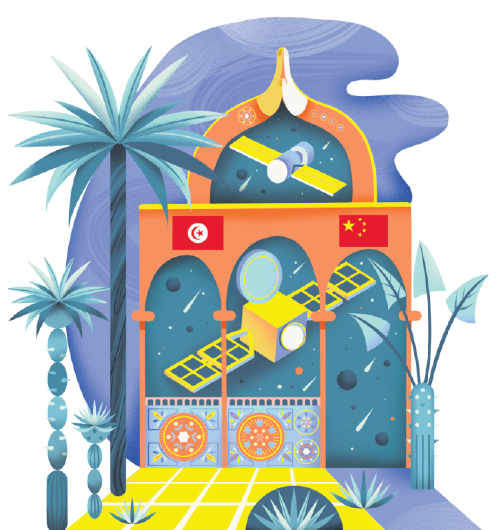
Tunisia is a nation of competitive education, science and technology. China has expanded its cooperation with Tunisia, making a splash in some high-tech fields. In April 2018, the China-Arab States BDS/GNSS Center, the first overseas center for China's indigenous Beidou Navigation Satellite System, was inaugurated in Tunisia. The center has become the first of its kind to conduct international cooperation and an important component in the Beidou service network to serve the Arab countries and the world.
China and Tunisia have been engaged in cultural exchanges too. Several Tunisian universities have established Chinese language programs, and the first Confucius Institute in Tunisia was opened at the University of Carthage in 2019.A number of Chinese universities have also set up Tunisian research centers to conduct joint research with Tunisia. In 2017, Tunisia announced the visa exemption for Chinese citizens, leading to a hike in the number of Chinese tourists and closer people-to-people exchanges between the two countries.
The future cooperation between China and Tunisia under the framework of the Belt and Road Initiative will continue to unleash the potential of cooperation and enhance the stability and development of the region. Ambassador Khaled has commended the Belt and Road Initiative for setting an example for bilateral and multilateral cooperation mechanisms. His predecessor, Ambassador Mohamed Sahbi Basly, said that the Belt and Road Initiative brings opportunities, wealth and good fortune to Tunisia and new vitality to the Arabic and African regions and the Mediterranean coast.
At present, the national economy is still in tatters. Most Tunisians are pro-West, as the country is heavily influenced by Europe and adopts a number of European industrial standards. When pursuing cooperation with Tunisia, to produce timely responses and accurate risk assessments, China must keep an eye on any government and policy changes. Meanwhile, it is necessary to maintain friendly relations with both the central and subnational governments, and cement cooperation with the Tunisian Parliament, trade unions and other organizations.
The author is an associate researcher of the Institute of West Asian and African Studies at the Chinese Academy of Social Sciences. The author contributed this article to China Watch, a think tank powered by China Daily.