Hybrid work model becomes popular in nation









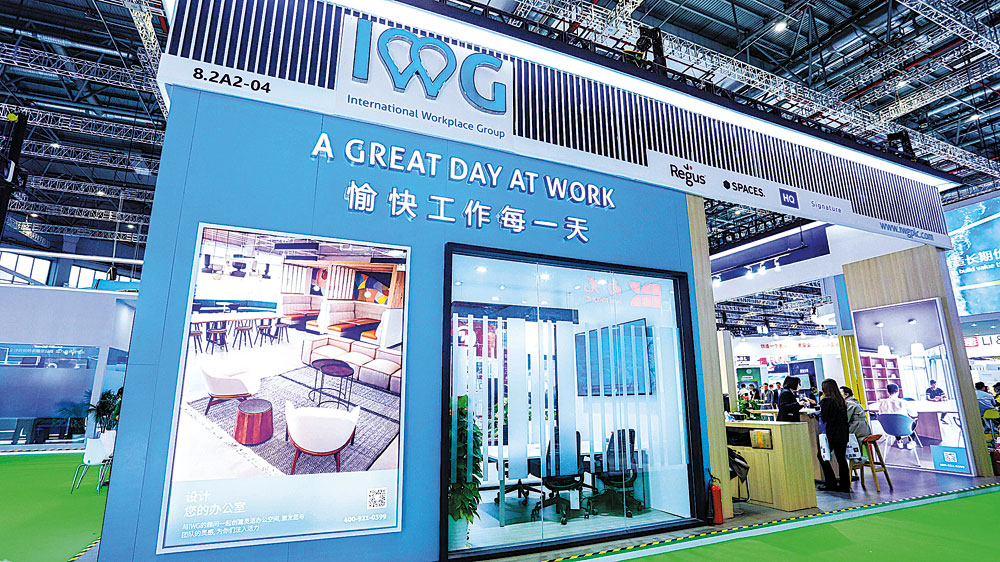
COVID-19 has ignited a change in the way people work, and a daily commute to a downtown office is no longer the norm in China, with employees increasingly embracing the hybrid work model.
As the hybrid work model gains momentum nationwide, employees can work not only in major hubs, but also beyond big cities. By spreading employees across regions, the flexible model contributes to social equity and leverages the development potential of smaller cities other than Shanghai and Beijing.
Shanghai dominates the country's flexible workspace market in terms of overall supply figures. Besides, Beijing, Chengdu in Sichuan province, and Guangzhou in Guangdong province, have grown at a fast pace with the emergence of local players and as more companies decided to open bases outside of Shanghai, said the Europe-based International Workplace Group, an operator of flexible workspaces.
IWG entered the China market 26 years ago, and the group has workspaces in 120 locations across 30 cities and regions, including in smaller cities in China. Now, its average occupancy stands among the highest in the industry. IWG said it hopes to add thousands of new centers in China in the next decade.
"As more enterprises recognize the positive impact that hybrid work has on employees, costs and productivity, we expect more partnerships to be unveiled in the years to come, creating new opportunities for the industry," said Edward Hu, country manager of IWG China.
"With sustainability becoming part and parcel of enterprises' strategic development goals, flexible workspaces will be more needed than ever. With technological development and shared economic models being a major highlight this year, flexible workspaces need to brace for an increase in demand," Hu said.
IWG owns flexible workspace brands such as Regus, Spaces, HQ, No 18, Basepoint and Signature. When seeking flexible workspaces in China, enterprises consider numerous factors while assessing their options. In addition to choosing workspaces located near the homes of employees, companies look for proximity to the market, clients and partners, IWG said.
For employees who might have chosen Shanghai as their first choice, flexible work is also a way for them to develop their potential in other cities, such as in Chengdu, Wuhan of Hubei province, or Xi'an of Shaanxi province, the group said.
IWG's main customers include companies in sectors ranging from finance and health to technology and the arts. Those companies include multinationals looking for decentralized solutions, small and medium-sized enterprises, and individual freelancers searching for professional workspaces.
Before the pandemic, there was no significant trend for flexible work in China. IWG's global survey in 2019 found that 51 percent of businesses in China had flexible workspace policies, compared to 69 percent in the United States.
Yet, these figures did not necessarily take into consideration locations such as working from home, and focused on the ability of employees to manage their own workload.
"In China, larger enterprises have shown the highest demand for flexible workspaces, followed by startups and freelancers. Many larger companies have their corporate head offices act as hubs and flexible workspaces as spokes. For smaller companies with fewer employees, flexible workspaces give them adequate tools to respond to the markets' demand," Hu said.
Separately, New York-based WeWork went public in New York in October. The company entered the China market in 2016, and has increasingly localized operations in China. Currently, it has launched about 100 workspaces nationwide.