Vision of ecological civilization benefits all










China's development vision of ecological civilization shares core values with other nations' endeavors in promoting sustainable development, experts said.
With its more complex approach, the vision has provided the world with an effective solution for addressing global environmental challenges that are looming larger, while the vision also features strong Chinese characteristics, they said.
Chinese central authorities have attached unprecedented importance to the advancement of ecological civilization, a core principle of which is harmonious coexistence between humans and nature. The concept was inscribed into the Party's Constitution in 2012 and into the nation's Constitution six years later.
The development vision is highlighted in a recent landmark resolution on the major achievements and historical experience of the Communist Party of China. Adopted in November, the resolution is the third of its kind in the Party's 100-year history.
Since Xi Jinping became general secretary of the CPC Central Committee in 2012, the committee has devoted greater efforts to ecological civilization.
"The whole Party and the entire nation have become more conscious and active in pursuing green development, and made significant progress in building a Beautiful China," the document said.
At a tone-setting national ecological and environmental protection conference held in 2018, Xi Jinping Thought on Ecological Civilization was officially established.
Experts said ecological civilization and sustainable development were advanced against the same historical background, with the world suffering from an escalating environmental crisis.
Since the dawn of industrial civilization, mankind has created such massive material wealth that it dwarfed the total of that made in previous development stages, said Hu Kanping, a researcher at the Chinese Ecological Civilization Research and Promotion Association.
However, industrialization has also created many thorny issues, such as environmental pollution and ecosystem degradation, Hu said.
Ecological civilization, along with the concept of sustainable development in Western countries, was proposed based on painful reflection on these thorny issues, he said, adding, "We realize that we have failed to properly handle the relationship between man and nature."
Arthur Hanson, former president of the International Institute for Sustainable Development in Canada, said: "People rely on a healthy planet for their economic and social progress. Globally, these relationships are threatened and the situation is worsening."
Against this backdrop, China and other countries seek transformative action to address environmental deterioration and its impacts. Internationally, such efforts have increasingly been undertaken under the banner of sustainable development, said Hanson, who is also a senior adviser for the China Council for International Cooperation on Environment and Development, a think tank of the Chinese government.
From 2012 to 2015, the global search to find new paths for sustainability focused on the United Nations 2030 Sustainable Development Goals, Hanson said, adding that for the most part, ecological civilization has been a "made in China "endeavor with global implications.
The Chinese development vision "differs from sustainable development in the emphasis placed on political and cultural factors, as well as on defining new relationships between people and nature that would permit living well, and within the eco-environmental bounds of planet Earth", he said.
According to the Integrated Reform Plan for Promoting Ecological Civilization, which was unveiled by Chinese central authorities in September 2015, ecological civilization is vital not only to sustained, healthy economic development, but also to political and social progress. It must therefore be given a position of prominence and incorporated into every aspect and the whole process of economic, political, cultural and social development, the plan said.
As two additional major elements of the existing environmental, economic and social components of sustainable development, politics and culture "make for a much more complex approach than the usual sustainable development triangle, including the political role of central authority and leadership, more comprehensive planning and accountability, and differentiated approaches based on cultural considerations", Hanson wrote in a paper titled "Ecological Civilization in the People's Republic of China: Values, Action, and Future Needs" that was published in 2019.
Sustainable development has been embraced by a wide array of multilateral organizations, business and civil society elements as well as governments of all political stripes. Its broad acceptance has provided an essential normative framework that sets out basic criteria on development-related decisions, he said.
However, sustainable development has also faced considerable revisionist thinking and even heavy criticism in some circles, Hanson added. While some see it as an impossible mission that is too malleable or vague, others think it is too closely aligned to ideologies they do not support.
Qian Yong, director of the Research Center for Xi Jinping Thought on Ecological Civilization, said the development vision of ecological civilization has already stood the test of the time and proved its effectiveness in China.
China has seen its forest areas expand for 30 consecutive years. On average, desert land in the country has decreased by more than 2,400 square kilometers every year, he said.



- National Games vibe is everywhere in Guangzhou
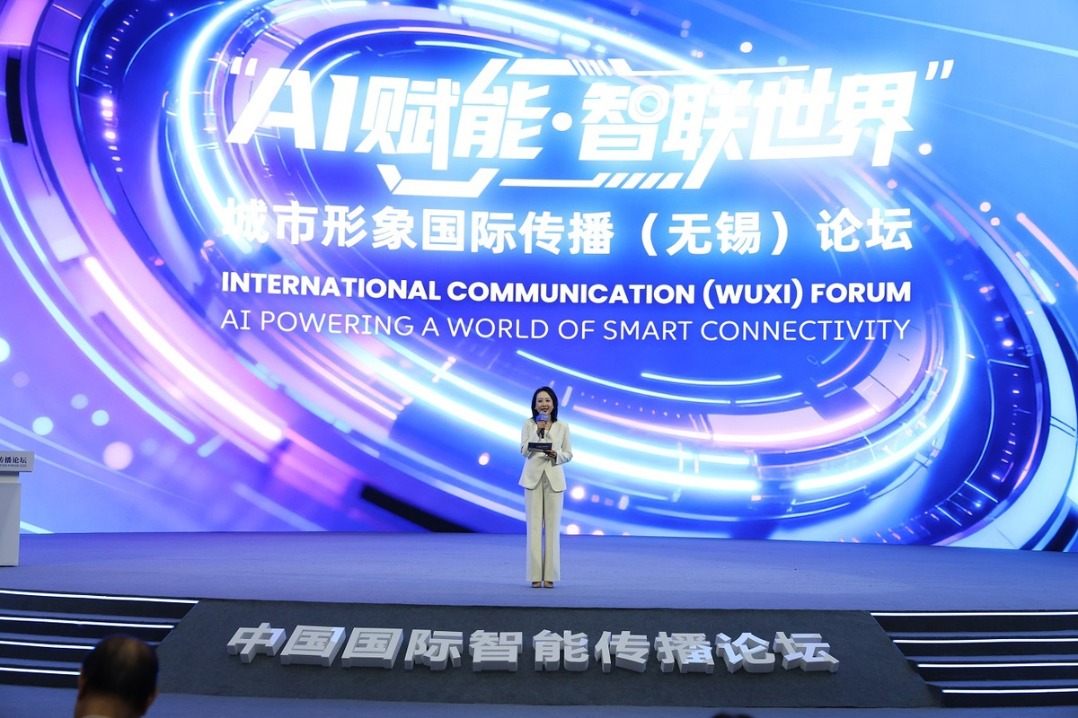
- Forum unites global experts to enhance city image communication
- Miao New Year celebrations get underway in Guizhou's Leishan county
- Mainland spokesman reiterates stand on Taiwan
- Fujian county's rural development becomes a big draw for Taiwan investors
- Nobel laureate in chemistry: Give young scientists more independence