Honoring phones with in-house 'crowns'









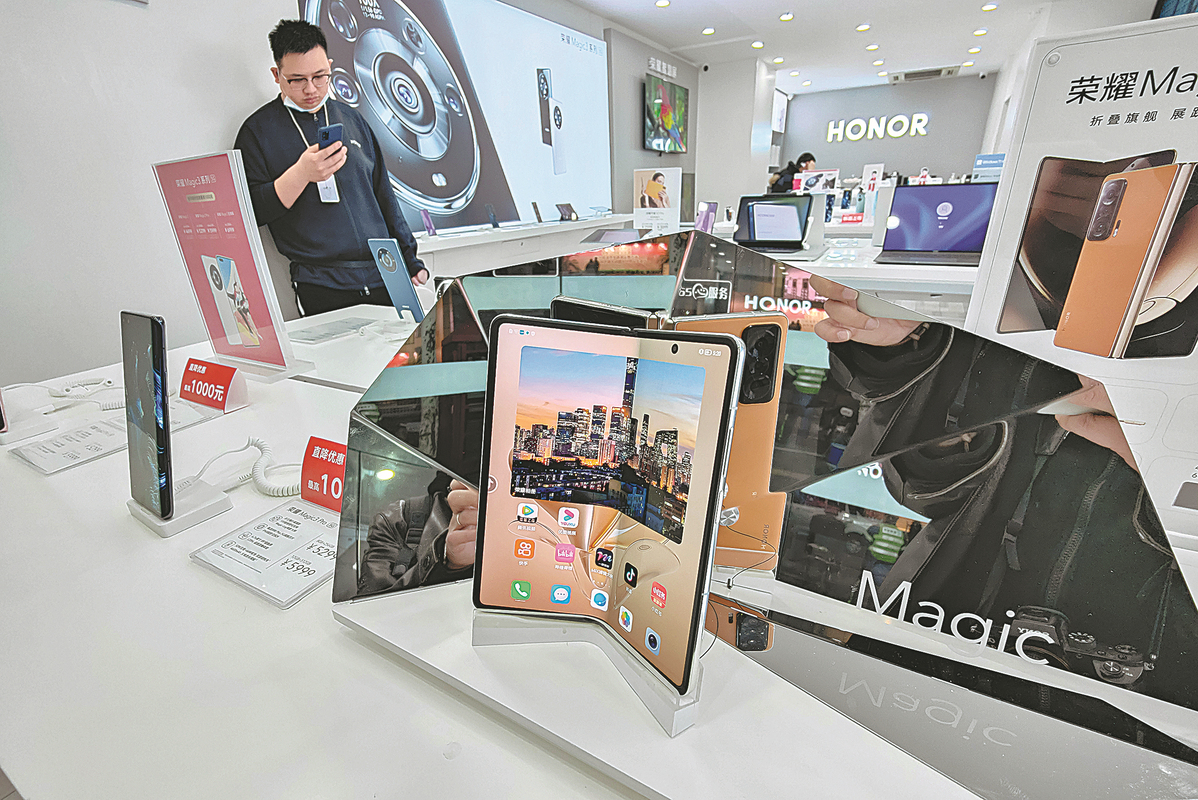
My friends often turn to me for advice on what smartphone to buy. That's because I'm a tech reporter and have the chance to try on a wide range of new models at product launches. But, I have a confession to make: I find it hard to differentiate one Android smartphone from another.
Here's the deal: smartphones are getting increasingly similar in both hardware and software, as technologies in the segment have already become very mature. When one vendor adopts a new feature for a smartphone, others can quickly follow suit, because more often than not they source materials from the same supplier. Even if they don't, other suppliers can offer similar or even better features in a jiffy these days.
The smartphone market is saturated and competition is cutthroat-and coming up with new innovative features becomes increasingly hard for the industry players.
Against such a background, smartphone vendors are banking on tailor-made chips to stand out from competition. They are allocating resources for self-designed chips to make their products unique and have more control over their own semiconductor supply chain.
The goal is also to hone their technological prowess and to build their image as high-end tech brands.
As Xiaomi founder Lei Jun said, chips are the crown of smartphones; they mirror how high the technical thresholds for hardware are and reflect the technical accumulations a company has in hardware.
"Xiaomi wants to take one step further to really become a global pioneer, and chips are a battle that we must fight," Lei said.
Chen Yongming, CEO of Oppo, said the development of in-house chips is inevitable. "Without the underlying core technology, there is no future, and flagship products without underlying core technologies are a cloud castle," Chen said.
Chinese firms' sustained efforts for self-sufficiency in semiconductors coincide with their failure to impress consumers in the high-end smartphone market. All Chinese smartphone brands are working hard to fill the void created by the exit of Huawei Technologies Co from the premium phone segment, after the latter faced US restrictions.
But so far, none of them appears to have succeeded. Many users of Huawei's smartphones are now switching over to Apple's iPhones, and Chinese smartphone brands are still struggling, some market insiders said.
In such cases, highlighting their commitment to chips and increasing research spending can boost their image among consumers and show that they are evolving from smartphone makers to tech firms.
But developing in-house chips is certain to be bumpy. The business is widely seen as technology- and cash-intensive. Small wonder, Oppo named its first self-designed chip Mariana to reflect the difficulty in developing in-house chips.
Smartphone makers such as Vivo have started designing image-related chips that can help boost smartphones' camera performance. Experts said technologies involved in image-related chips are easier to develop than system-on-chips (SoCs) that take a single platform and integrate an entire electronic or computer system onto chips.
Some of them have bigger ambitions. For instance, Xiaomi and Oppo are setting aside heavy resources to fight the battle and target SoC.
But no matter how much money Chinese companies are willing to spend on chips, one big factor they can't ignore is time.
Roger Sheng, vice-president of research at global consultancy Gartner Inc, said it takes time to go through the trial-and-error process, which is especially important in the chip sector. It is a protracted battle that needs long-term, consistent inputs, and this is just the starting point.