Beijing's sub-center making strides









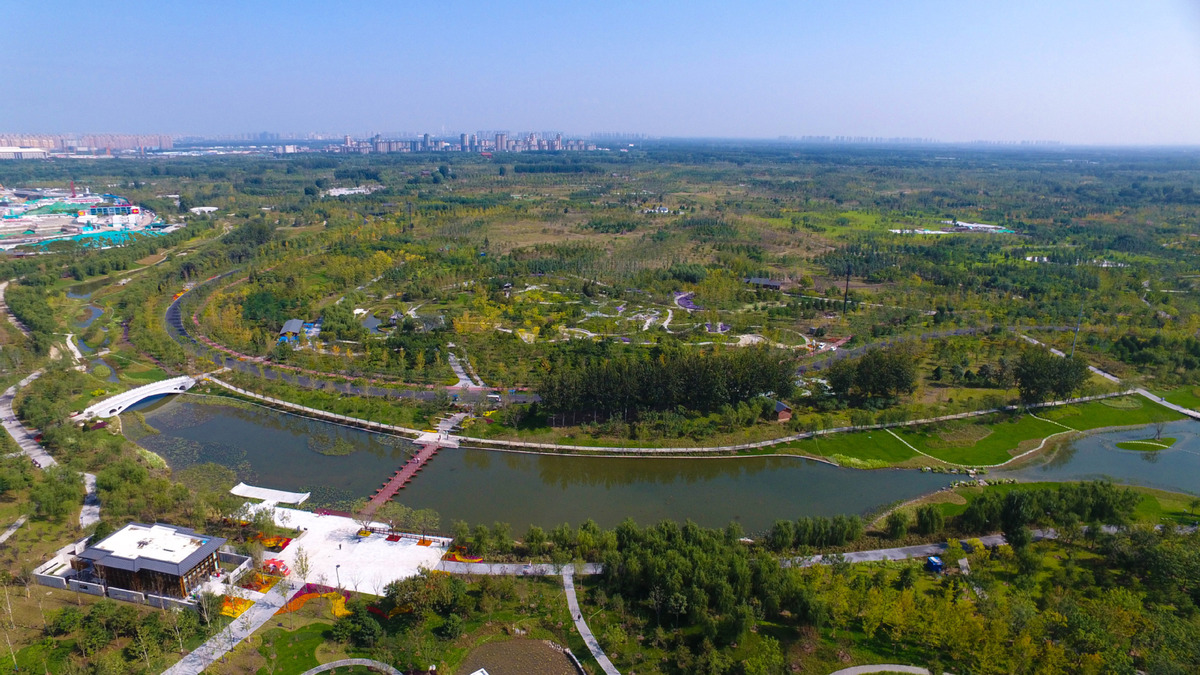
Liu Lili, a resident of Beijing's Tongzhou district, where the capital's sub-city center is located, tried a driverless car on the road near her home just a few minutes after downloading an app.
"It is amazing that I can sit in a driverless car to go somewhere from my home by using an app with simple instructions," she said. "The subcity center has developed so fast in recent years toward becoming a much smarter community."
In the sub-city center, electronic parking lots have replaced the previous disorder of illegal parking and a new green park provides enough shared bicycles for visitors.
"The best part of the development of the sub-city center during 'smart city' construction is that residents can experience the improved environment and much more daily convenience," Liu said.
The "secret" of the sub-city center's smartness is an urban management platform known as the "big city brain", which is located in a renovated building in Tongzhou that used to be a boiler plant.
The platform has integrated around 60 types of data on various city functions, such as heating, road signals, parking and lighting systems.
It can provide accurate data on the real-time traffic situation to help solve congestion and parking difficulties. It can also ensure the safe operation of other city functions including water, natural gas, heating, power and telecommunications.
The sub-city center will become even smarter as more technologies, including artificial intelligence, 5G, big data, cloud computing and block chain, are applied in more sectors, according to the district government.
People will be able to enjoy services such as driverless vehicles and digital renminbi in Tongzhou.
"I moved to Tongzhou in 2013, as my job location changed from downtown Beijing to the city's east, and I have witnessed huge changes in Tongzhou due to the government's great efforts in developing this area," said Liu Tao, who works for a company in the district.
He said he encountered many obstacles at first due to the lack of public facilities. But gradually, the living environment, infrastructure construction and public facilities in the district improved greatly.
That is related to the Beijing-Tianjin-Hebei province integrated development plan, a national strategy aiming to help the three provincial-level governments redistribute resources and industries from the capital to nearby regions to achieve better growth.
President Xi Jinping called for the integrated and coordinated development of Beijing and the two neighboring areas during a symposium in 2014. On April 30, 2015, the Beijing-Tianjin-Hebei integrated development plan was approved, making it clear that the region will be built into a world-class city cluster with the capital as the core.
In the past eight years, the strategy has achieved tangible results, including the growth of the sub-city center.
Beijing's municipal government has been relocating noncapital functions from the downtown area, and many municipal-level Party and government institutions have moved to the sub-city center in Tongzhou, bringing talent and new economic growth opportunities to the area.
In November, the State Council, China's Cabinet, issued a guideline supporting the high-quality development of the sub-city center that clarified its functions and those of Hebei's Xiong'an New Area.
Ye Yumin, head of the department of urban planning and management at Renmin University of China, said the guideline set out a detailed path that will help Beijing solve its big city diseases and serve the central government better.
On Feb 12, Beijing Party Secretary Cai Qi inspected the sub-city center and held a work conference on its high-quality development.
He said the sub-city center should strengthen scientific and technological development and make more efforts in the finance sector to attract high-end financial institutions.

- Prison terms issued over deadly 2023 Shanxi coal company fire
- PLA Navy ships depart HKSAR after open ship events
- People spend leisure time during eight-day holiday in China
- Essential workers remain on duty during holiday
- Vibrant China during holiday: Dynamic and bustling nightlife
- Global engineering congress to be held in Shanghai