Huawei opens new chapter on profit surge









Challenges galore, but firm will focus on innovation and breakthroughs
Huawei Technologies Co is banking on long-term investment in innovation and intensified efforts to seek system-level breakthroughs to cope with challenges like chip shortages and broader fallouts of the prolonged US government restrictions, top company executives said on Monday.
Huawei, they disclosed, recorded a full-year 2021 net profit of 113.7 billion yuan ($17.8 billion), up almost 76 percent year-on-year, on better profitability linked to the sale of certain businesses. Cash reserves have been boosted to better cope with uncertainties.
Meng Wanzhou, chief financial officer of Huawei, said at a news conference in Shenzhen, Guangdong province, that despite the company's 2021 revenue recording a nearly 29 percent decline to 634 billion yuan, "our ability to make a profit and generate cash flow is increasing, and we are more capable of dealing with uncertainties."
Meng, who made her first public appearance after returning from Canada to China last year, attributed the profit surge in part to business sales. But excluding such sales, Huawei's net profit margin still improved in 2021 as the profitability of its main businesses rose while operational costs fell.
Meng linked the revenue decline to multiple factors, including the COVID-19 pandemic and plummeting sales of PCs and smartphones, after the United States restricted Huawei's access to US chip-making technologies, software and components in 2019.
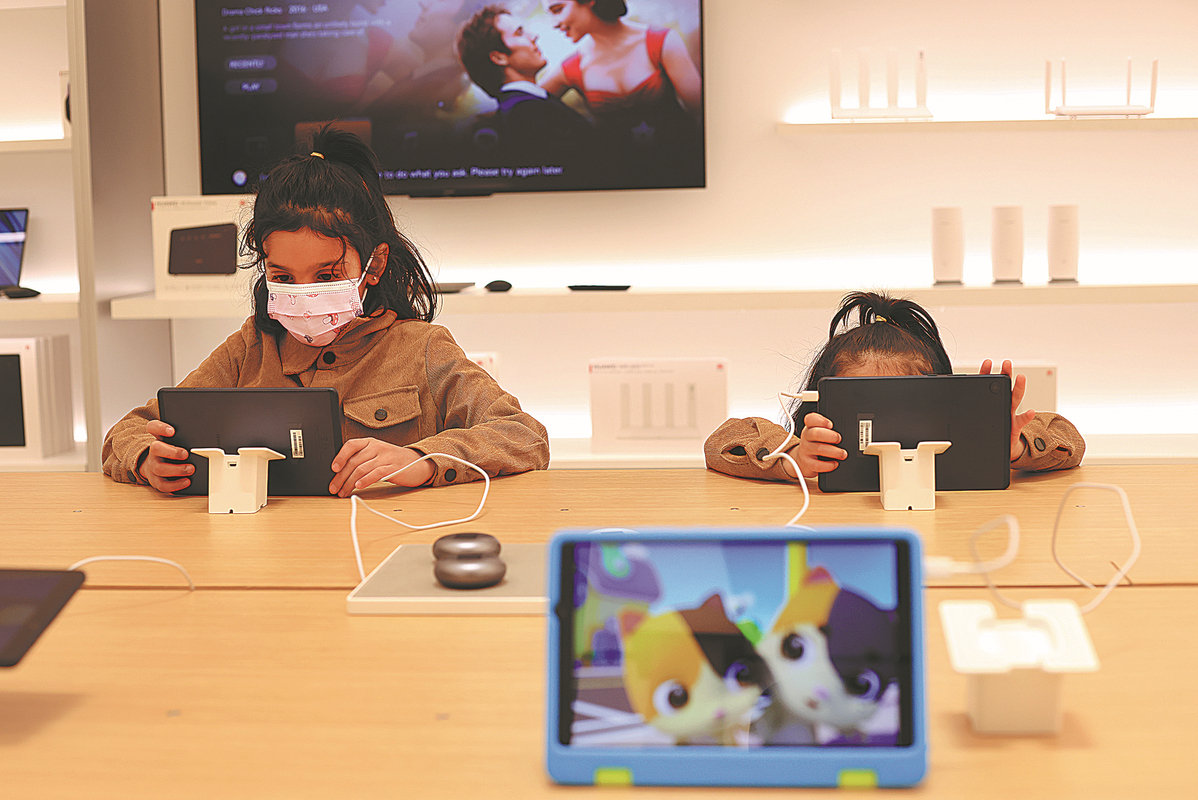
The revenue of Huawei's consumer business group, which includes smartphones and the internet of things devices, reached 243.4 billion yuan last year, down nearly 50 percent.
According to market research company Counterpoint, the company's smartphone market share fell below 4 percent since the first quarter of 2021, compared with its peak of 20 percent in the April-June quarter of 2020.
Guo Ping, rotating chairman of Huawei, said the company's challenges can be solved not through frugality but via innovation.
"When it's difficult to access advanced chip manufacturing process techniques (under the US restrictions), or to achieve leadership in single technologies, we need to seek system-level breakthroughs. For instance, our communication products are now using multi-core chipsets and we are reengineering our software, which will help inject new life into chips to ensure supply in the long-term," Guo said.
This process, Guo said, is complex-and turning sand into chipsets will take a long time. And when global supply chains are good, repeated development of some chip technologies does not make sense. But when industry chains are fragmented, new demand will emerge. So, Huawei welcomes the trend of more companies investing in semiconductor manufacturing.
Guo emphasized that Huawei's enterprise-oriented business, including 5G base stations and digital energy solutions, is not experiencing any chip supply problems.
Huawei said it spent 142.7 billion yuan on research and development in 2021, slightly higher than the 2020 figure of 141.9 billion yuan, despite all the difficulties it has been facing. Huawei's R&D spending over the past decade reached 845 billion yuan, and the company now has over 107,000 employees engaged in R&D work, accounting for over half of its total staff members.
About 10 to 20 percent of Huawei's annual R&D spending, or $2 billion to 3 billion every year, is earmarked as expenses to explore promising, futuristic fundamental technologies.
Huawei executives said the company is actively exploring new revenue opportunities in the automobile business. Experts said information and communication technologies are increasingly important in electrified, connected and smart cars.
Huawei, its executives said, will not make cars itself but help carmakers to better embrace connectivity and intelligence. Huawei's investment in smart car solutions reached $10 billion last year. The company has developed more than 30 smart car components and teamed up with more than 300 upstream and downstream automobile supply chain partners.
Cui Dongshu, secretary-general of the China Passenger Car Association, said there is enough room for the development of smart cars in the 5G era. Huawei can offer a slew of technological solutions and services covering both hardware and software, he said.