


Cocoon of creativity
Artist allows local cultural flavor to emerge by imaginative use of silkworms, Yang Feiyue reports.









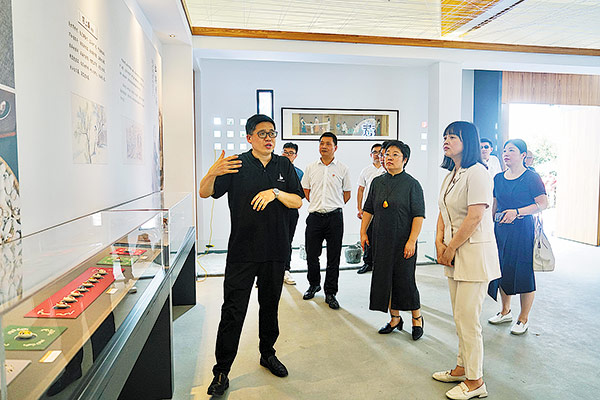
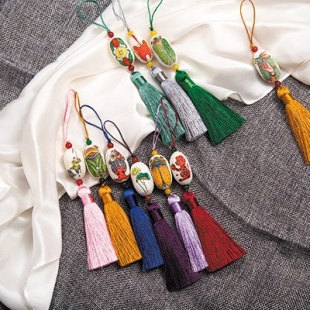
Chen Jianqing's workshop is full of silkworm cocoons. Hanging ornaments of various shapes and sizes featuring Peking Opera facial makeup, cartoons, Chinese zodiac animals and totems also take up space there.
Chen, 52, a native of Tongxiang city, Zhejiang province, specializes in cocoon art. He uses special pigments on cocoons that go through a treatment, including drying and solidifying.
"Only 5 percent of 50 kilograms of silkworm cocoons can be used for 'painting', since the art is demanding in terms of shapes," Chen says, adding that the rest is used for more practical purposes. "It tests one's patience and meticulousness to make the cocoon art, and it takes hard work to deliver a good work."
Chen has been attracted to painting since senior middle school, when he joined a one-year extracurricular art program hosted by teachers from the China Academy of Art in Hangzhou, Zhejiang province, in 1989. "There was so much exploring-the lines, colors and models," he recalls.
The passion made him leave home after graduation, and he headed for Shenzhen, Guangdong province, to paint at an art gallery in 1990. There he picked up various skills and explored the integration of painting with ceramics, which laid a foundation for his art and craft.
"The more I learned, the more I wanted to learn," Chen says.
After working for about four years, Chen threw his hat in the ring of the national college entrance exam in 1994, setting his sights on furthering his artistic pursuit.
His work experience helped him stand out in the test and he was admitted to Hangzhou Normal University, where he studied art education.
Chen worked as a middle school art teacher in 1996 while pursuing his own artistic work in his spare time. He struck on the idea of cocoon painting in 1999 when the local water town of Wuzhen in Tongxiang began to develop tourism.
"I wanted tourists from outside to take something back that would remind them of Jiangnan (south of the lower reaches of the Yangtze River)," Chen says.
The area enjoys four distinct seasons, which is ideal for the growth of silkworms. It is a major silk production center in China, where sericulture, silk reeling, dyeing and embroidery are developed.
After studying cultural and creative products elsewhere in the country, Chen understood that these products had to be based on distinctive local resources to make the cut. That was when he first thought of silk. However, painting on silk was not easy.
"The color, ink and lines just can't interact on the surface of silk to a desirable effect, as they can on paper," Chen says.