Revolutionary base in Dabie Mountains served as CPC stronghold









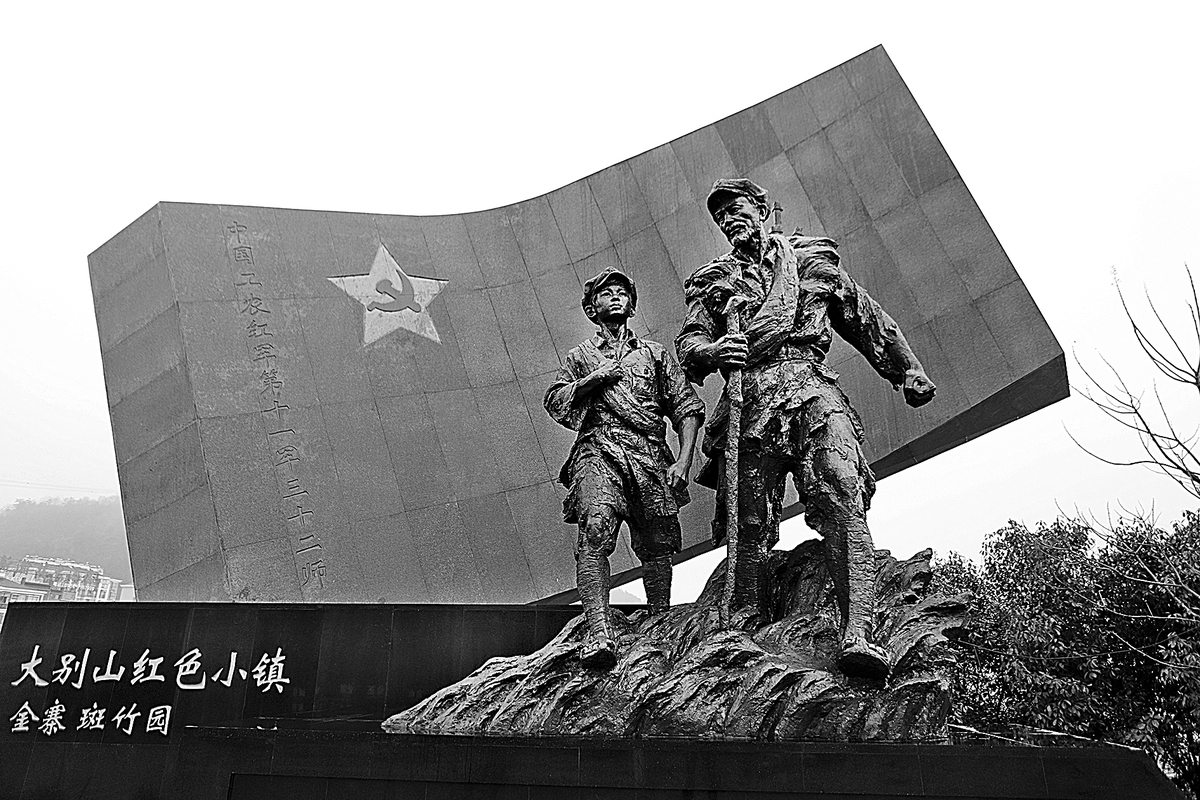
Located on the borders of Hubei, Henan and Anhui provinces, the Dabie Mountains Revolutionary Base was one of the most important in the history of the Communist Party of China. Despite multiple setbacks and numerous sacrifices, soldiers from the area continued to keep the Party's revolutionary cause going.
Historically, the Dabie Mountains were a key military area due to their strategic position. Passes through the hills, usually heavily guarded, were important routes for travelers from the north to the more populous and prosperous south during times of peace, while their flanks impeded quick advances from the north during times of war.
When the first alliance of the CPC and the Kuomintang, or the Chinese Nationalist Party, broke down in April 1927, the Dabie Mountains were one of the first areas to offer military resistance against the KMT.
On Nov 13, 1927, the CPC led the Huang'an-Macheng Uprising, during which they conquered Huang'an (today's Hong'an) county in Hubei. After months of guerrilla warfare, they begin to create a revolutionary base in the border area between Hubei and Henan provinces.
The CPC led two more uprisings in the area in May and November 1929 and established smaller revolutionary bases in southeastern Henan and western Anhui.
In April 1930, under the guidance of the central leadership, CPC military forces in the three areas regrouped as a single united army. In June, a congress of workers, farmers and soldiers in Guangshan proclaimed the establishment of an areawide Soviet government, and the Hubei-Henan-Anhui Revolutionary Base, or Dabie Mountains Revolutionary Base, was officially formed.
Red forces quickly expanded after the regrouping. By November 1931, it could count on nearly 30,000 soldiers. Second only in size to the Central Red Army, it was renamed the Red Fourth Front Army, and was led by Xu Xiangqian (1901-90), who would become the chief of staff of the People's Liberation Army.
The expanded army was able to fend off multiple attempts by the KMT to eliminate the base. In June 1932, when Dabie was at its peak following the defeat of three KMT offensives, there were Soviet regimes in 26 counties home to a population of 3.5 million, again only second in size to the Central Revolutionary Base in southern Jiangxi province.
To secure the supply of grain, the base launched land redistribution campaigns in 1930. It issued loans to help farmers get tools and cattle and to cultivate every piece of land available. Thanks to proper economic and industrial policies, the base was able to support itself despite an economic blockade by the Nationalists.
The KMT launched its fourth attempt to wipe out the base in July 1932, calling in 300,000 troops. Overly optimistic as the result of previous victories, leaders at the time vowed to retaliate. As a result, the core of the Fourth Front Army was unable to rescue the central area of the base. They eventually marched west, away from the Dabie Mountains base, and set up the Sichuan-Shaanxi Revolutionary Base.
Those remaining were reorganized into the 25th Red Army, which attempted to defend the base under difficult circumstances. Dabie was badly affected as local Soviet governments gradually dissolved, but guerrilla warfare led by the CPC continued.
In November 1934, as the Central Red Army began the Long March, the 25th Red Army also began their own strategic move and eventually joined Red army forces in Shaanxi province in September 1935.
A much smaller fraction of about 1,000 soldiers remained and fought at the base for three more years. As the War of Resistance Against Japanese Aggression (1931-45) broke out in earnest in 1937, they were regrouped as a detachment of the New Fourth Army, which operated under the agreement between the CPC and the KMT to jointly fight the invaders.
After victories against the Japanese in 1945, the base again played a role during the War of Liberation (1946-49). In summer 1947, the core force of the Shanxi-Hebei-Shandong-Henan (Jin-Ji-Lu-Yu) Field Army, led by Liu Bocheng (1892-1986) and Deng Xiaoping (1904-97), marched hundreds of kilometers into the Dabie Mountains and led a surprise attack on the KMT heartland. This marked the beginning of the PLA's offensive.





- First cross-border event debuts at the National Games
- China Focus: National Games enhances coordination under 'one country, two systems'
- China's Fujian aircraft carrier to make regular appearances on high seas: spokesperson
- A decade of dialogues
- HK: a stage for art and cultural dialogue
- Tapping truly unknown wonders