Proactive measures key to Q2 performance









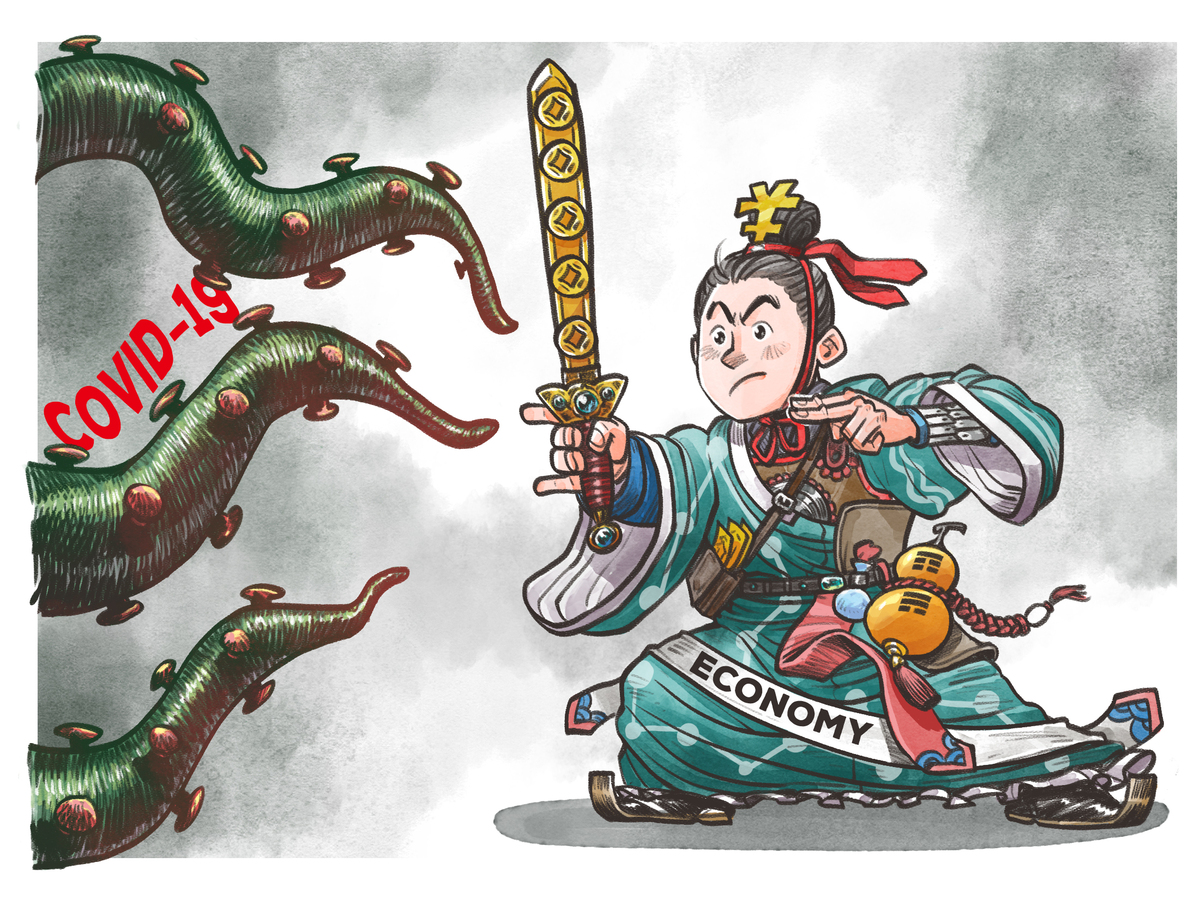
The current resurgence of COVID-19 cases has brought new challenges to China's economic recovery, especially with pandemic outbreaks occurring in several major cities and severely affecting the economy.
Unlike the initial outbreak of COVID-19 in Wuhan, Hubei province, in 2020, which mainly affected Central China, the latest round of infections in Shanghai will have a huge impact on the Yangtze River Delta region and many other cities nationwide, as Shanghai is a logistics and economic hub.
Considering that Shanghai started implementing phased lockdown measures in late March, the impact of recent outbreaks on the economy will mainly be seen in the second quarter. Supply chain congestion has brought challenges to normal economic and social operations, increasing pressure to stabilize employment and slowing consumption recovery.
It is extremely important to avoid long-term adverse effects of COVID-19 on the Chinese economy, which means policymakers should pay close attention to the survival of market entities, improve market expectations, boost domestic demand and prevent the pandemic from causing irreversible damage to the country's manufacturing sector.
We need to effectively control the disease in a relatively short period and strictly prevent a resurgence of COVID-19 infections to realize resumption of work and production as soon as possible.
China should accelerate the implementation of proactive fiscal policy moves, and its monetary policy must be coordinated with fiscal policy to give full support to economic recovery while guarding the bottom line of allowing no systemic risk. Under these circumstances, China's economic performance will be better in the second half.
Shanghai and Guangdong province's Shenzhen, core cities in the Yangtze River Delta and Pearl River Delta regions, respectively, and important hubs of China's internal and external circulations, were severely affected by the latest resurgence of COVID-19 infections. The flareups will have a spillover effect on the manufacturing sector, especially on supply chains, as Kunshan and Suzhou, Jiangsu province, two cities near Shanghai, are part of the country's manufacturing heartland.
If supply chains are held up too long, the survival of many micro and small manufacturing enterprises will be seriously threatened, and global supply chain adjustments may speed up. These factors will weaken China's competitive advantage to some extent.
A survey released by Shanghai Securities News, a leading financial newspaper in China, found that about 92 percent of 667 listed companies said COVID-19 has affected their business.
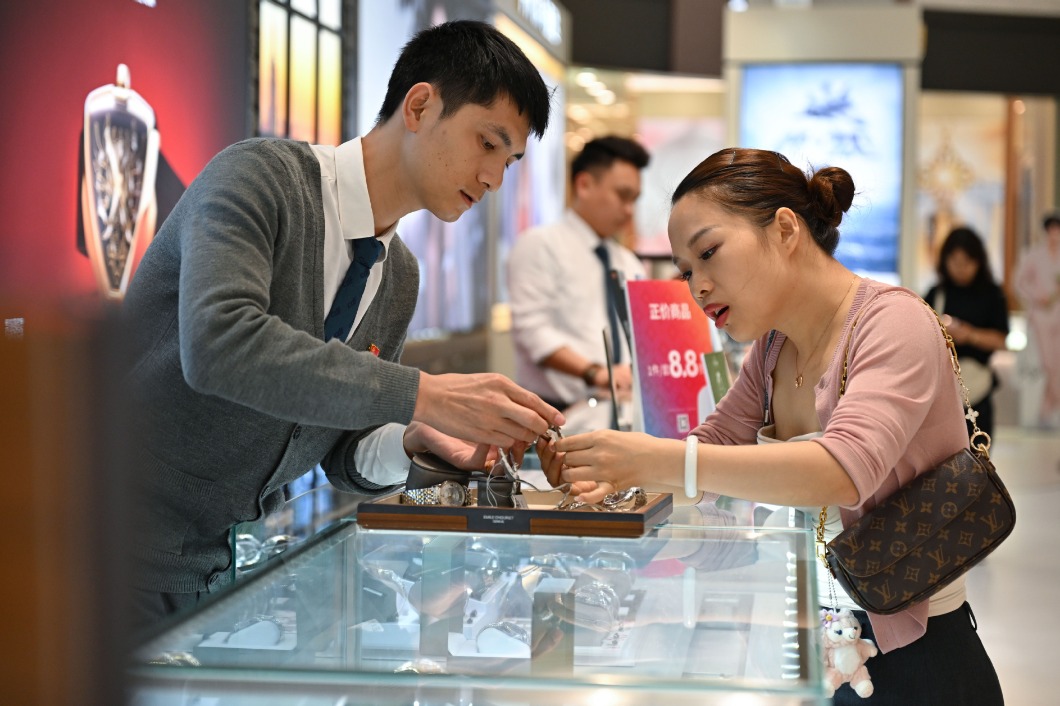
Because of the pandemic, China's total retail sales of social consumer goods fell 0.2 percent year-on-year in the first four months. In April alone, total retail sales of social consumer goods dropped 11.1 percent year-on-year to 2.95 trillion yuan ($436.2 billion), the National Bureau of Statistics said on May 16.
The sluggish consumption recovery is related to the weakening of a willingness to buy goods and services. When COVID-19 hit Wuhan, it was widely believed that the pandemic would end quickly. However, as the disease keeps spreading, many market entities are facing complex challenges. This has led to a decline in consumption potential.
A survey released by the People's Bank of China, the country's central bank, showed that survey respondents who said they were more inclined to spend accounted for 23.7 percent of the total in the first quarter, down 1 percentage point from the previous quarter. Over the same period, survey respondents who said they were more inclined to save rose to 54.7 percent, up 2.9 percentage points.
In the first four months, household deposits grew by 7.12 trillion yuan-2.01 trillion yuan more than the same period last year, the PBOC said.
In addition, a downward trend in the real estate sector will also drag down consumption. China's real estate sector is connected to 38 sectors, which include leasing and business services, accommodation and catering, as well as wholesale and retail trade.
The growth of real estate development has slowed due to the pandemic, which badly affected real estate sales, further worsening market expectations for the sector.
In April, new yuan loans reached 645.4 billion yuan, decreasing by 823.1 billion yuan year-on-year. Specifically, home loans dropped by 60.5 billion yuan, compared with an increase of 341.7 billion yuan in the same period last year, according to the PBOC.
We estimate that China's economy will grow by 1.7 percent to 3.2 percent in the second quarter, and the growth rate will vary according to different scenarios.
In the first scenario, if the country sees relatively high GDP growth during the period without COVID-19 outbreaks, the economic shock of the pandemic would be limited nationwide and the increase in GDP in April and May in some provinces that remain under lockdown would fall by 3 percent from that in normal circumstances. If so, China's GDP growth may reach around 3.2 percent in the second quarter.
In the second scenario, if the country sees stable GDP growth during the period without COVID-19 outbreaks, the economic shock of the pandemic would be fairly significant nationwide, and the increase in GDP in April and May in some provinces that remain under lockdown would fall by 5 percent from that in normal circumstances. If so, China's GDP growth may reach around 2.1 percent.
In the third scenario, if the country sees stable GDP growth during the period without COVID-19 outbreaks, the economic shock of the pandemic is fairly severe nationwide, the increase of GDP in April and May in some provinces which remain under lockdown falls 5 percent from that in normal circumstances, and the increase of GDP in the Yangtze River Delta region, excluding Shanghai, drops 5 percent from that in normal circumstances in the second quarter, China's GDP growth may be lower than 2 percent.
In our opinion, the second scenario is most likely, which means the country's GDP growth is likely to be around 2.1 percent in the second quarter and around 3.5 percent in the first half.
To achieve the full-year goals of economic and social development, the government should proactively implement relevant policy measures while making relentless efforts to control the pandemic. The following are our suggestions.
First, China must ensure smooth transportation and logistics, as well as normal operations of key industrial and supply chains, key infrastructure and companies specialized in pandemic control and supply guarantees.
Second, the country should persist in using infrastructure investment as an important means of growth stabilization, comprehensively strengthen infrastructure construction and build a modernized infrastructure system.
Third, the government should continue to appropriately make adjustments to real estate regulations while sticking to the principle that "houses are for living in, not for speculation" and insisting on risk prevention and control. Regulatory authorities may consider judiciously easing restrictions on home purchase and sales, lowering mortgage rates appropriately and optimizing supervision over presale funds.
Fourth, China should take promoting domestic circulation and improving people's livelihoods as the starting point for bolstering healthy development of the platform economy, promote coordinated development of online and offline businesses, and thus allow consumption to play a leading role in economic circulation.
Fifth, the government should boost confidence throughout society and enhance market expectations, which means it should ensure policy continuity and stability, strengthen communication with market participants before launching policies and actively explain policies after making announcements.
Finally, China should accelerate the implementation of proactive fiscal policy and make good use of various types of monetary policy instruments to coordinate with its fiscal policy and to reduce spillover effects from the US Federal Reserve's monetary tightening and imported inflationary pressure on China.
The views don't necessarily reflect those of China Daily.
The writers are: Sheng Songcheng, dean of the China Chief Economist Forum Institute and former director of the People's Bank of China's statistics and analysis department; Long Yu, a research fellow at the CEIBS Lujiazui Institute of International Finance, and Wang Dan, a PhD student at the Shanghai University of Finance and Economics.