Dynamic clearance puts growth of firmer footing










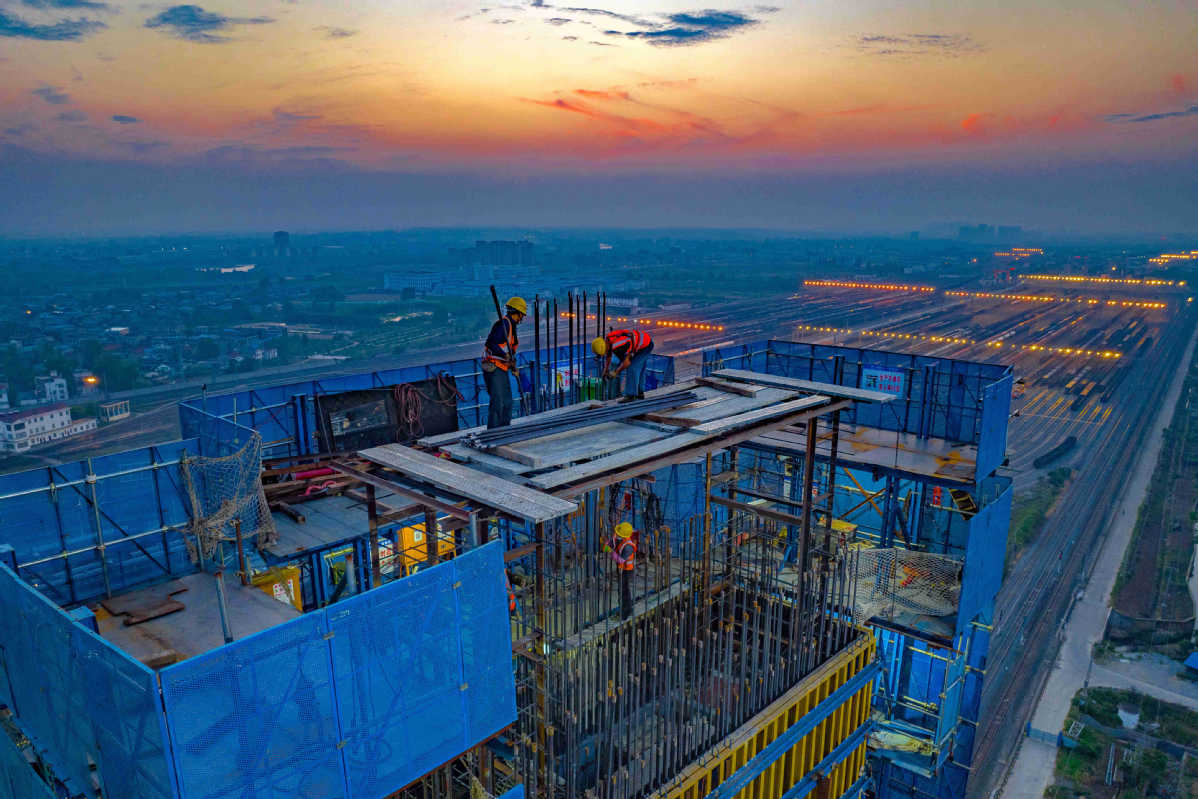
Policy necessary for global trade, supply chains, experts say
After working from home for a month due to a resurgence of COVID-19 cases, Beijing resident Qi Xinxin has had some good news-his new car will arrive soon, with the manufacturing plant accelerating production in Shanghai.
Qi is just one of the countless city residents whose lives have been impacted by the resurgence of the disease, which has also disrupted the economy.
However, despite the hardships experienced, experts said the dynamic zero-COVID policy will place China's foreign trade growth on a firmer footing and help mitigate pressures on the nation's overall economic growth.
Lan Qingxin, a professor at the University of International Business and Economics' Academy of China Open Economy Studies in Beijing, said: "China's successful epidemic control is based on a socialist market economy. When adopting the dynamic zero-COVID approach to protect people against the disease, some temporary suspensions and restrictions have been required, and they will have an impact on social and economic activities to a certain extent.
"But such an impact is short-term and the approach is necessary to ensure stable medium- and long-term growth of the Chinese economy, which is also important for economic recovery worldwide."
Only by quickly tackling the recurrence of COVID-19 cases, and at minimal cost, can market confidence be placed on a firmer footing, providing more time and space for the Chinese economy to continue expanding, Lan said.
"Leveraging social and economic systems to productively allocate resources, China's COVID-19 prevention and control practices have proved the nation can fully tap the advantages of the dynamic zero-COVID approach," said Lan, also deputy president of the university's School of International Trade and Economics.
"In this way, the epidemic can be contained and the long-term benefits and short-term impact on economic growth will be well balanced," Lan added.
Although having a short-term impact on social and economic activities, China's adherence to the policy is not only a responsible decision for the core interests of its people, but also benefits the global economic recovery, Lan said.
From March onward, China has faced and withstood the severest challenge to its defenses against COVID-19 since the disease emerged in Wuhan, capital of Hubei province, in early 2020. It has resurfaced in many places, including major economic hubs such as Beijing, Shanghai and Shenzhen, Guangdong province.
According to the National Bureau of Statistics, or NBS, China's GDP grew by 4.8 percent year-on-year in the first quarter, marking a steady start to this year in the face of domestic challenges and global uncertainties.
However, the nation's value-added industrial output-an important gauge of economic activity among enterprises with an annual turnover of at least 20 million yuan ($2.97 million)-rose by only 4 percent on a yearly basis in the first four months, 2.5 percentage points lower than such output in the January-March period.
Retail sales of consumer goods fell by 0.2 percent from a year ago during the first four months. In April alone, an 11.1 percent year-on-year decline was reported.
Facing downward pressure on economic growth, China is maintaining the dynamic zero-COVID policy at a time when many economies have relaxed social distancing and other restrictions, resulting in the sustainability of the policy being questioned by some observers.
The policy is not designed to realize zero COVID-19 infections, but to achieve maximum prevention and control at minimum social and economic cost, and in the shortest possible time.
Fu Linghui, a spokesman for the NBS, said at a recent news conference in Beijing that although some indicators contracted in April, the impact of COVID-19 would be temporary, and the nation's economy is on track to recovery.
In 2020, despite a dip of 6.8 percent in GDP year-on-year during the first quarter due to the emergence of the disease, China was the only major economy to achieve positive GDP growth that year.
According to the NBS, the nation's average annual GDP growth at times in 2020 and last year was as high as 5.1 percent.