'One country, two systems' continues to benefit HK, whole nation









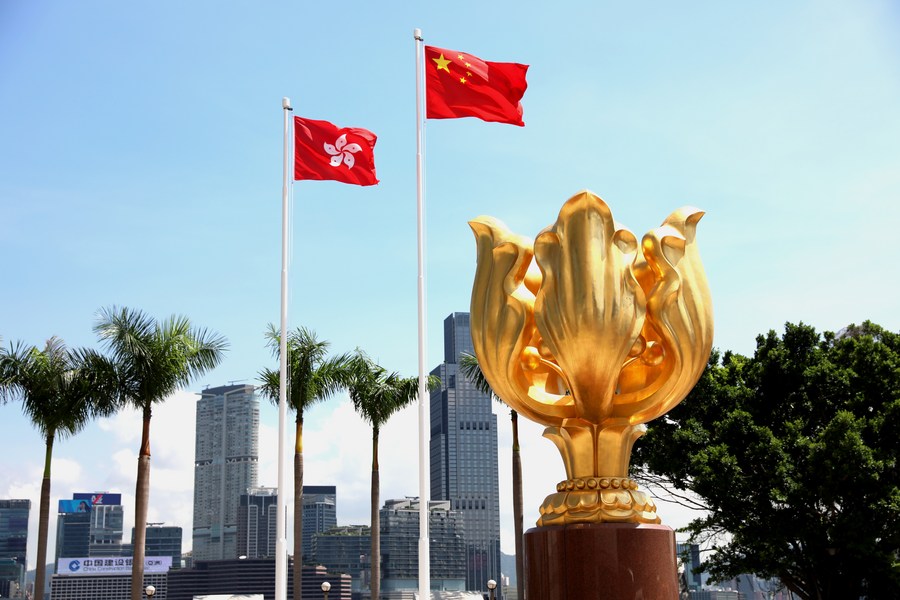
The Hong Kong Special Administrative Region has gone through 25 years of ups and downs in the post-handover period, and now is the right time to review how we can better leverage the "one country, two systems" policy to take the city to another new dimension of development in the next 25 years and beyond.
Looking back after 25 years, this policy has been successfully implemented in the HKSAR despite a short period of serious interruptions in 2019. The policy has benefited the HKSAR as well as the country as a whole in many aspects.
Since 1997, Hong Kong's prosperity and stability have been well maintained under the policy, and it has been playing two major economic roles for the country.
The first role is serving as China's "bridgehead" to attract foreign investment to the mainland for development. The second one is serving as China's window to the world so that China can learn market-oriented economic models from Hong Kong and other advanced capitalist markets in a controlled manner.
China has come up with innovative economic ideas that fit the country's actual situation, lifting its economy rapidly in the past 25 years. Hong Kong itself has also benefited much from being the "super-connector" between the rest of China and the rest of the world, especially after China became a member of the World Trade Organization in 2001.
China's 12th Five-Year Plan (2011-15), adopted in March 2011, endorsed and supported Hong Kong in developing offshore renminbi business. Now Hong Kong is the world's largest offshore renminbi business hub.
On the other hand, the preferential treatment that Hong Kong has received under "one country, two systems" allowed it to conclude a win-win trade agreement with the mainland, the Mainland and Hong Kong Closer Economic Partnership Arrangement, or CEPA, in 2003.
The agreement offers early market access to local and international companies with qualified Hong-Kong-based companies, regardless of nationality or size, providing greater concessions beyond China's commitments in its WTO accession.
Over the years, amendments have been made to the CEPA with new liberalization measures in a number of important service sectors, making it easier for Hong Kong service suppliers and professionals to set up enterprises on the mainland. This can certainly help Hong Kong to integrate efficiently into the Guangdong-Hong Kong-Macao Greater Bay Area.
For most of the past 25 years, Hong Kong has been able to hold on to its ranking as the freest economy, or among the freest, in the world.
In fact, for more than two decades, Hong Kong topped the Heritage Foundation's Index of Economic Freedom until it was overtaken by Singapore and became No 2 in 2020.
However, the Washington-based think tank dropped Hong Kong from the index last year, saying that "developments in recent years have demonstrated unambiguously that those policies are ultimately controlled from Beijing".
The sudden exclusion of Hong Kong from the index was announced eight months after the National Security Law for Hong Kong came into effect in June 2020.
The National Security Law has been effective in deterring the widespread subversive violent protests that almost turned Hong Kong upside down amid the 2019 social unrest. For any global city, law and order is the key to maintaining economic vitality. So the Heritage Foundation's claim was unfounded and politically biased.
Nevertheless, some prominent business institutions gave justice back to Hong Kong. The Global Financial Centres Index, published by the United Kingdom consultancy Z/Yen, and the China Development Institute in Shenzhen reaffirmed Hong Kong's third-place ranking as a global financial center after New York and London.
The International Institute for Management Development recognized Hong Kong in its World Competitiveness Yearbook 2021 as the seventh most competitive economy in the world, while Canada's Fraser Institute ranked Hong Kong the freest economy among 162 economies in the world in its Economic Freedom of the World: 2020 Annual Report.
As Hong Kong is reaching the halfway mark of "50 years no change", some have wondered what the future will hold beyond 2047.
However, Shen Chunyao, head of the Basic Law Committee and Legislative Affairs Commission of the National People's Congress Standing Committee, said, "In reality, 50 years is just a figurative saying. There will not be changes after 50 years. The first 50 years cannot change. There is no need to change after 50 years".
Xia Baolong, director of the Hong Kong and Macao Affairs Office of the State Council, said the central government's determination to implement "one country, two systems" in Hong Kong is unwavering, and the principle will remain unchanged if it can be successfully upheld.
With the implementation of the National Security Law for Hong Kong and the successful completion of three elections, "patriots administering Hong Kong" has been ensured.
Let all patriotic forces from various sectors of the community work together and follow closely the guidance given by the central government to improve Hong Kong's governance continuously under the "one country, two systems" principle. Then we can hold our future in our hands firmly to grow alongside the motherland.
The author is a member of the Hong Kong Association of Media Veterans and a freelance writer. The views do not necessarily reflect those of China Daily.

- Exhibition commemorating the epic relocation of universities opens in Fujian
- Twelve punished for scaffold collapse that killed 7 in Shandong
- Slovenian official visits whole-process people's democracy practice site of CPPCC committees
- China's commercial rocket maker puts two satellites into orbit
- People in Taiwan commemorate victims of White Terror period
- China successfully launches new test satellites