'Localization' buzzword for Siemens Healthineers in China expansion









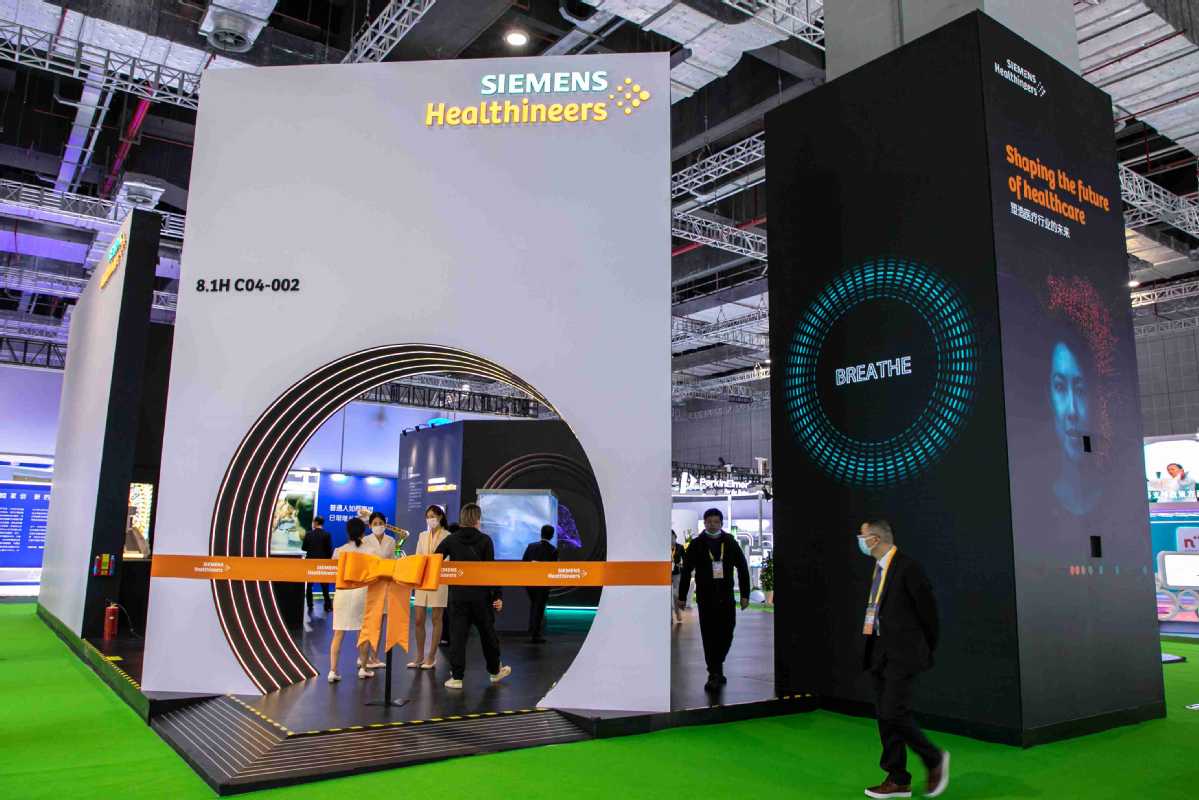
German medical technology company Siemens Healthineers has unveiled its latest localization strategy in China, vowing to be part of China's thriving healthcare system by becoming a "local" company.
The three core pillars of the strategy include promoting localization of full product lines, furthering innovation based on Chinese market needs and upgrading local business models, company executives said at a media conference last week.
The company strategy is closely linked with the 14th Five-Year Plan (2021-25) and the Healthy China initiative, with China also being a "very important location to serve our global customers", according to Elisabeth Staudinger, member of the Siemens Healthineers managing board and president of its Asia-Pacific business.
"The Chinese market is key to Siemens Healthineers, generating great opportunities while possessing its own unique market environment," she said.
"We are committed to continuing to leverage the opportunities we have in China and the capabilities with our suppliers, our own teams, and the innovation power, both for the benefits of patients in China and globally."
As part of the plan, the company will gradually advance the localization of full product lines, further enrich its product spectrum, and facilitate the transformation and upgrading of the local industrial chain.
In the second half of this year, a dual-source CT product and a 5G magnetic resonance product are expected to be officially launched in China, the company said. This is based on the fact that some high-end products, such as a high-performance clinical MRI scanner MAGNETOM Vida, are already being manufactured locally.
Its Shanghai Diagnostics plant is scheduled to finish construction by the end of 2022. Its inauguration will mark the company's first in-vitro diagnostic production base in the Asia-Pacific region.
"The localization strategy is a critical measure for Siemens Healthineers to further integrate itself into China's new development landscape and achieve joint development goals with China," said Jerry Wang, president of Siemens Healthineers Greater China.
According to Wang, localized research and development can be reflected in the acceptance of the company's 7T magnetic resonance MAGNETOM Terra by the National Medical Products Administration, becoming the only ultra-high field MRI device with clearance from the Food and Drug Administration, CE mark and NMPA access in the world.
Also based on the 5G remote scanning assistant, the remote diagnosis and treatment ecosystem has begun to take shape and is gradually expanding its influence in China.
Meanwhile, Siemens Healthineers will consistently strive to explore local innovations. A wider ecosystem based on Siemens Healthineers Shanghai Innovation Center is advancing in an orderly manner.
This year, the Varian Global Innovation Center will open in Beijing. It will establish an integrated cancer diagnosis and treatment platform, focusing on early cancer screening and early diagnosis and treatment, as a world without fear of cancer is built together with local industrial partners.
In the future, the company said it will strive to promote the application of large-scale medical devices in all fields of the whole process of diseases, while gradually improving industrial ecology.
Shanghai and Shenzhen are key manufacturing and export bases for Siemens Healthineers Greater China, said Staudinger. Besides serving the Chinese market, the two factories also export over half of the output of medical devices.
China now accounts for about 20 percent of the global medical device market, according to a study by Deloitte last year. This fast-growing industry is expected to continue on an upward trajectory, supported by multiple drivers including an aging population, rising incomes and the continued enhancement of health services in hospitals and clinics throughout China.
"We've been seeing more foreign firms in China pivot towards an 'In China, For China' strategy, enabling them to seize China's enormous market potential and respond more rapidly to changes in demand," said Deloitte China Financial Advisory Partner Alan MacCharles.
"Looking beyond short-term changes in the competitive and regulatory landscape, multinational medical device companies need to invest in innovative technology and revisit their China business models to capture future market growth," he said.