Report: Intelligent labs to attract more capital









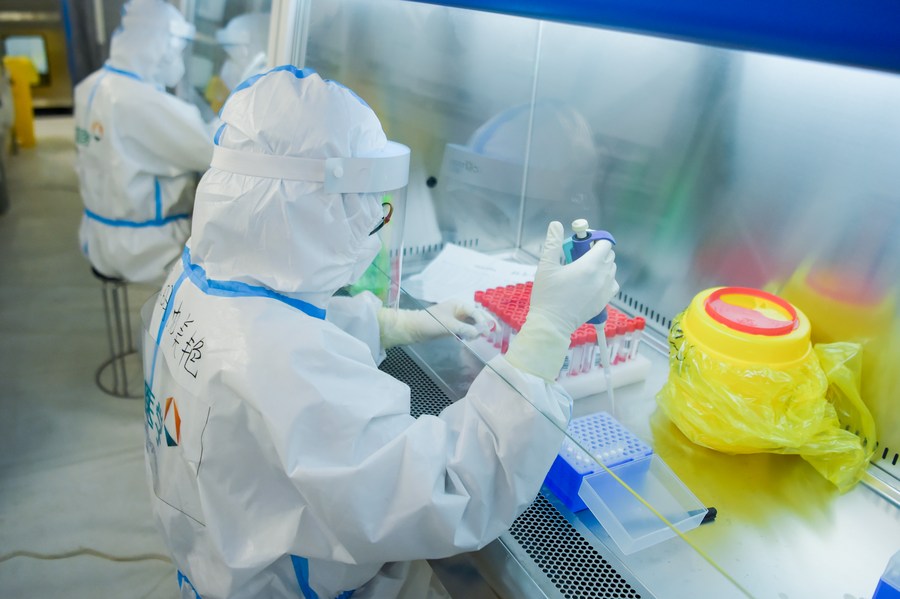
With the digitization and automation development in China's healthcare sector, the intelligent laboratory concept is gradually gaining ground.
By shifting from manual to automated operations, an intelligent laboratory reduces pre-analysis faults, improves the level of biological safety protection, increases test efficiency, reduces labor costs and improves laboratory management competence.
According to a recent survey conducted by the online healthcare website VCBeat, between 2016 and 2019, when intelligent laboratories first emerged in China, there were less than 10 investment deals.
The capital market started to favor the sector in recent years. From 2020 till now, there were 22 investment deals, with the total amount surpassing 2.5 billion yuan ($374.5 million), said the report.
"In terms of the number of deals, investments of A-round and before took up 63 percent. This is because the development of the enterprises is immature, and their business models are still being explored. In addition, due to the weak market foundation of China's intelligent lab sector, some capital is still in a state of testing the waters," said Li Chengping, an analyst at VCBeat.
According to VCBeat, 2021 was an active year for intelligent lab development. Thirteen investment deals took place, with a total amount of nearly 1.4 billion yuan. Investors included Northern Light Venture Capital, Sinovation Ventures, Matrix Partners China and Sequoia Capital China. At the beginning of this year, GL Ventures and ByteDance also followed the lead.
"The digitization and automation of Chinese labs began relatively late. However, the sector has been growing rapidly. Domestic labs are gradually evolving to intensive cultivation, and from labor-intensive to brain-intensive," said a report from Kaitai Capital.
Speaking of the reason for the rapid development of domestic intelligent labs, Li said that the country's supply-side reforms forced enterprises to make technical innovations to achieve a breakthrough of shifting to quality development, and the industry has also begun to transform from scale-oriented to efficiency-oriented.
In addition, he noted that shrinking profits drove the need for automation and digitization in the healthcare industry.
Zhao Jingya, an investor in the biomedical sector of Next Capital, said: "Consulting firm Deloitte estimated that the average cost of a new drug launch rose from $1.19 billion in 2010 to $1.98 billion in 2019, and the internal rate of return for drug research and development dropped from 10.1 percent to 1.8 percent during the same period."
"Competition between biopharmaceutical firms makes decreasing costs and improving efficiency an inevitable trend. Raising R&D efficiency is an important issue, and intelligent labs, to some extent, address the issue," she said.
In the COVID-19 era, Chinese intelligent labs played an important role. For example, the automatic lab system developed by Shenzhen, Guangdong-based Biotech company MGI Tech classifies and labels nucleic acid test samples automatically. Furthermore, by delivering samples from one machine to another, operators don't need to have contact with the virus. In this way, error rate and bio-risk are greatly reduced, and workers' safety is better protected.
According to MGI Tech, its lab system has been applied to epidemic prevention and control in many cities, including Beijing, Shijiazhuang, Shandong province's Qingdao, Yunnan province's Ruili, Anhui province's Lu'an, and Fujian province's Xiamen. In some cities, the daily testing throughput achieves 1 million units per day at most.
"Intelligent labs are rapidly growing. With China's development of the life-sciences field, capital started to flow to the sector. There is vast room for development. However, the field of life sciences is complicated, and issues such as technology bottlenecks, products and talent remain unsolved. China's intelligent lab sector is still at an early stage," said an investor who has been in the sector for over five years and declined to be named.
Li Chenxi, a partner of Enshe (Hangzhou) Health Management Co Ltd, offered suggestions for domestic companies: "They should capture rigid demand and develop a single point of advantage. Furthermore, they should establish and improve the personnel cultivation mechanism, to create a talent reserve."