HK integrates into national development









Greater Bay Area, tech hub plans, young people are playing key role in effort
Since its return to the motherland 25 years ago, Hong Kong has undergone robust growth entwined with national development, and integration continues to deepen, a boon for the city as it seeks to play a bigger role on the international stage.
The central government has enacted policies to benefit Hong Kong's economic and social development over the last quarter-century. Under the "one country, two systems" policy, Hong Kong and the mainland concluded the Closer Economic Partnership Arrangement in 2003, which offers preferential measures to Hong Kong investors seeking to explore the mainland market.
Over the past decade, the central government has initiated a series of national strategies involving Hong Kong, including the national 14th Five-Year Plan (2021-25), cross-border financial product connections, the Guangdong-Hong Kong-Macao Greater Bay Area development project, and policies that make life more convenient for Hong Kong residents living on the mainland.
The GBA, which covers nine cities in Guangdong province as well as the Hong Kong and Macao special administrative regions, is a bridge facilitating Hong Kong's integration into national development.
Major cross-border infrastructure, including the Hong Kong-Zhuhai-Macao Bridge and the Guangzhou-Hong Kong High-Speed Railway, were built to create a solid foundation for closer cooperation.
The Hong Kong SAR government also launched programs to bolster working, investing and starting new businesses across the border, such as the Greater Bay Area Youth Employment Scheme and the Northern Metropolis Development Strategy.
John Lee Ka-chiu, the sixth chief executive of the Hong Kong SAR, also mentioned in his election manifesto that Hong Kong will embrace a future with "unlimited possibilities" if it can "seize on these opportunities and leverage our unique strengths and advantages to create new economic growth areas and integrate into national development".
New roles
Hong Kong has been included in the overall framework of national development since the 11th Five-Year Plan (2006-10). The 14th Five-Year Plan dedicated an entire chapter to strategies for reinforcing and enhancing Hong Kong's competitive advantages.
It proposed eight "centers" for Hong Kong in the fields of finance, trade, shipping, aviation, legal and dispute resolution, innovation, intellectual property trading, and artistic and cultural exchange.
In finance, trade and transportation, Hong Kong is widely recognized as one of the world's top hubs and has also become the world's largest offshore renminbi business hub, processing 75 percent of global offshore RMB payments.
While the plan fortifies Hong Kong's advantages, it also props up emerging sectors in order to encourage diversified development. For instance, the current national Five-Year Plan states support for Hong Kong becoming an international innovation and technology hub for the first time.
"We have come to prime time," said Alfred Sit Wing-hang, Secretary for Innovation and Technology under the fifth Hong Kong SAR government.
Sit said the government has allocated an unprecedented HK$150 billion ($19.1 billion) in investment over the last five years to promote the development of technological innovation and entrepreneurship.
In late 2015, the HKSAR government founded the Innovation and Technology Bureau with the aim of turning Hong Kong into a knowledge-based economy and an innovation hub for technology in the region. The department was expanded, becoming the Innovation, Technology and Industry Bureau under the sixth government.
The number of startups in the city has quadrupled, from about 1,000 in 2014 to more than 4,000 this year. Numbers of those employed in the sector have also surged from 2,400 to 12,000, while the total value of venture capital funds rose from HK$1.1 billion in 2014 to HK$40 billion last year.
The 14th Five-Year Plan also highlighted the life and health industries, in response to which Hong Kong established an InnoLife Healthtech Hub at the Hong Kong-Shenzhen Innovation and Technology Park, a technology cooperation zone between the two cities.
With thriving innovation and creativity, the effort to keep Hong Kong's copyright regimes robust and up-to-date in order to meet the strong demand for IP protection and turn the city into a regional IP trading center has become an urgent task, something that is also proposed in the current Five-Year Plan.
David Wong Fuk-loi, director of Intellectual Property at the HKSAR government, said that through IP trading, Hong Kong can play a role in dual-circulation, which relies on the domestic market as its mainstay while allowing domestic and foreign markets to boost each other.
Wong said that Hong Kong has all the ingredients to be a regional IP trading hub: a robust and independent legal system, a developed service industry, and a large pool of IP professionals and specialists.
According to the World Intellectual Property Organization, Hong Kong currently ranks among the world's top 20 IP application centers for patents. In 2003, Hong Kong and Guangdong IP authorities set up an expert group to strengthen cooperation, and organized a number of forums and expos.
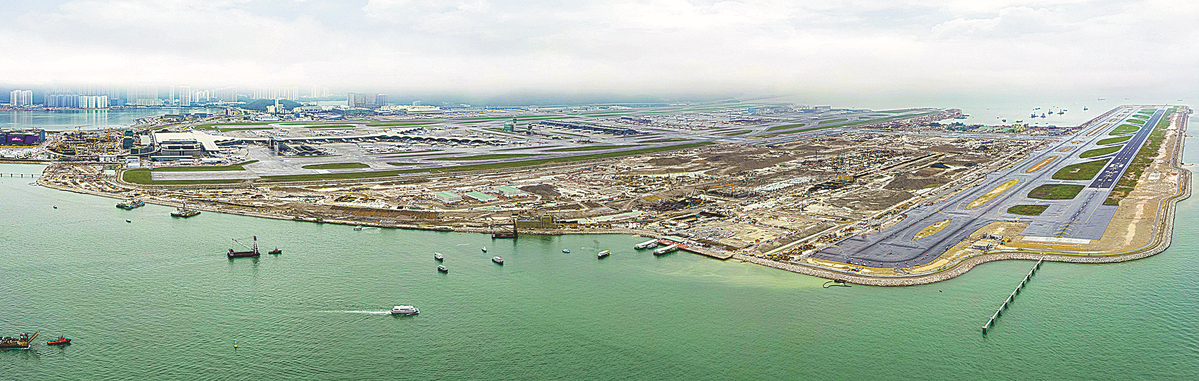
Another new aim for Hong Kong mentioned in the national 14th Five-Year Plan is enhancing the city's status as an international aviation hub. Despite the impact of COVID-19, Hong Kong International Airport has shown enduring strength, ranked by the Airports Council International as the World's Busiest Cargo Airport last year. It shipped 5 million metric tons of cargo, an increase of 12.5 percent from the previous year. To expand capacity, a third runway is expected to open this year.
Hong Kong is also teaming up with other cities in Guangdong to play its part in the world's biggest airport cluster. It is setting up a high-end aviation industrial zone in Zhuhai and a logistics park in Dongguan in response to the soaring demand for cross-border logistics services.
Youth participation
The young generation is an integral part of Hong Kong's integration into national development. The HKSAR government launched the Greater Bay Area Youth Employment Scheme in January last year to help young people develop careers in the GBA.
Eligible applicants will receive a monthly stipend of HK$10,000 for up to 18 months from the HKSAR government, and authorities in Guangdong will also pay monthly allowances toward transportation and accommodation.
Hong Kong graduates had submitted more than 20,000 applications by February, with 400 companies offering 3,500 positions.
Fung Nga, one of the program's beneficiaries, secured a job at WeChat Pay and said the program is a pragmatic approach to encourage more young Hong Kongers to get to know the GBA.
"After actually working and living here, I found it wasn't much different to living in Hong Kong in terms of food, language and culture, and I gradually realized integrating into the area is one of the best choices I have made," she said.
John Poon, who found a job with internet giant Tencent through the program, said the experience has enabled him to gain an in-depth understanding of office culture in mainland cities and to make friends.
Cai Zhihua, director of the Campus Recruiting Program at Tencent, said the company has recruited 63 young Hong Kongers through the Youth Employment Scheme. The experience helps improve their competitiveness in the technology sector, and they are also contributing to the development of the GBA and the nation, Cai said.

- 'Book of Songs' from Chinese imperial tomb proves oldest complete copy ever found
- Exhibition highlighting the 'Two Airlines Incident' opens in Tianjin
- Average life expectancy in Beijing rises to 83.93 years
- Energy drink overdose sends delivery worker to hospital
- GBA and Hainan deepening cooperation to boost innovation and sustainable growth
- Beijing mulls including the costs of embryo freezing and preservation in medical insurance