Ruins help build an image of the past









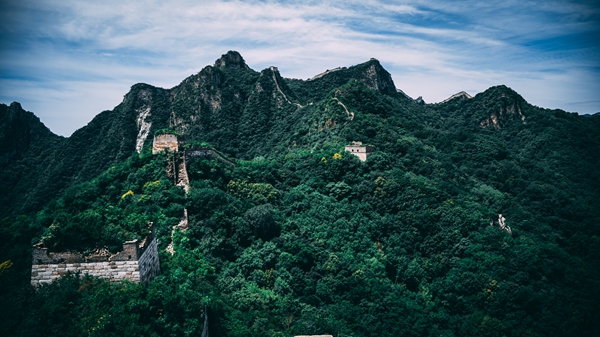
The Great Wall of China, spanning a distance of more than 21,000 kilometers, is a marvel of China's ancient past and justifiably counted among the "new" Seven Wonders of the World. Passing through every landscape the country has to offer, mountains, deserts, plains, even lakes, raising a structure of this magnitude would be a challenge even today. Living in Beijing, I am lucky enough to have some of the most interesting and challenging sections of the wall just a short journey away, and last weekend, I took a trip to one of these.
This wasn't my first time to the wall, having visited Badaling and other restored sections in the past. However, unlike Badaling, which underwent huge renovations in the 1950s, this portion, Jiankou, built during the Ming Dynasty (1368-1644), has had little to no repairs since its construction. Walking along its crumbled paths, with its steep inclines and collapsed guard towers overgrown and reclaimed by nature, I realized how different this was to the restored sections of the wall, such as Mutianyu, just a few hours hike away. This got me thinking about the restoration of monuments and historical sites around the world, and the different approaches that are taken to preserve them.
As a general rule, most historical sites in the UK are maintained and protected, but not rebuilt. They may restore a small section to show how it would have originally looked, but generally these sites remain as they are, with the reasons for their destruction or decay often becoming part of the site's history and narrative, as many are the way they are for a specific reason, and these stories are just as important as the tangible history of the site itself.
Since I was a child, I have always been drawn toward this kind of derelict historical site rather than those that are fully restored, an interest that further increased in university when I was studying archaeology. When I see a location that has been rebuilt, it does give me an accurate portrayal of its original appearance, but in my opinion, it loses something because this is essentially just a replica, often built with modern materials and techniques, which is far less impressive than how it was originally constructed. It could be argued that the lack of this authenticity devalues rebuilt structures as historical monuments.
But for me, it's not that I dislike the restoration of a historical landmark, it's the mystery and unanswered questions that lay in a ruin that I am drawn toward. I can use my imagination to picture how it might have been, or how it got this way, and even though it may be partially ruined, this is something that was built hundreds, if not thousands, of years ago and is, for the most part, still standing here today, which is a true representation of its majesty.
Of course, there are just as many arguments for rebuilding, especially here in China where many monuments are wood based, so to leave them unrestored would mean their eventual total destruction and decay. There is also the educational value, to see a place rebuilt in all of its former glory can provide a tangible education about the site, its history, and the culture from which it came in a safe environment.
There is no concrete right or wrong for the preservation of ancient landmarks, and both sides have their pros and cons, but for me personally, to be able to explore these enigmatic places that have not been tampered with by modern hands, and to be able to use my imagination to think about them, is a far more engaging experience and what inspired me as a child to study this subject.
- Announcement of the International Architectural Scheme Design Competition for Food Safety and Health Industrial Park in the Guangdong-Hong Kong-Macao Greater Bay Area
- A Chinese pastry with cultural features
- Gourd sculptor crafts a new image for market
- Online discussion refuses to melt away over ice cream
- Tsinghua tops global ranking in three subjects