



An orchestral classic










An epic new musical interpretation of the Song Dynasty painting, A Panorama of Rivers and Mountains, is set to make its global debut, Chen Nan reports.
A Panorama of Rivers and Mountains, the classic artwork by Wang Ximeng, who completed the masterpiece during the Song Dynasty (960-1279) at the age of 18, is widely acknowledged as one of the most important works in the history of Chinese fine art.
Like many artists, Chinese composer Zhao Lin has been inspired by the beautiful painting. He spent over a year working on a symphonic poem, using music to interpret the classic imagery.
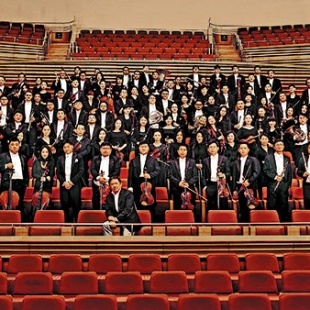
On Saturday, Zhao's symphonic poem, titled A Thousand Li of Rivers and Mountains, will have its world premiere in Shanghai. The Shanghai Symphony Orchestra will perform under the baton of conductor Sun Yifan in the closing concert of the city's 2022 Music in the Summer Air festival. Due to the COVID-19 pandemic, the concert will be streamed online.
A nationwide tour will be launched in August with Chinese symphony orchestras, such as the China Philharmonic Orchestra, Guangzhou Symphony Orchestra, Hangzhou Philharmonic Orchestra, and Shenzhen Symphony Orchestra, performing Zhao's symphonic poem in 20 concerts.
The first stop will be Xi'an, Shaanxi province, with a concert performed by the China Philharmonic Orchestra and its artistic director, conductor Yu Long, on Wednesday.
"Since we decided to turn the iconic painting into a musical work, I've put a copy of the painting in my studio," says Zhao. "My studio is very small. I just surrounded myself with the painting in the small room. I looked at it every day and it kept on inspiring me."
The 11-meter-long scroll painting is a record of people's lives and the natural scenery of that time, mixing realism with creative imagination. There are mountains, rivers, villages, ports, temples and pavilions. The painting is housed at the Palace Museum in Beijing.
Like the painting, which has been divided into six parts with portrayals of Chinese mountains, the symphonic poem also consists of six chapters: an overture, one piece for sheng (a wind instrument and one of the oldest musical instruments in China), a piece for pipa, a piece for erhu and a piece for piano, all accompanied by a symphony orchestra. The final piece is written for bamboo flute and soprano, with a song based on the classic Chinese poem, On Pengli Lake Gazing at Lushan Mountain, by Tang Dynasty (618-907) poet Meng Haoran.
Each of the six chapters stands on its own, with different musical instruments, and each chapter portrays its own picture through music.
The composer tries to not only capture the natural scenery portrayed in the painting, but also display the spirit of the countryside, which is rooted deep in traditional Chinese culture, as well as the spirit of Chinese people.
Zhao says there has always been a harmonious relationship between music and art and that he had dreamed about composing such a piece.
"Classic Chinese paintings are renowned for their delicate details. The artists expressed infinite feelings through their works and their paintings usually display a vivid imagination," says Zhao, who was born in Xi'an in a family of artists.
His grandfather Zhao Wangyun (1906-77) was the co-founder of the "Chang'an school of painting" in the 1960s with two other ink-brush artists based in Xi'an. Zhao Wangyun was known for his landscape paintings and those that portray the daily lives of local people.




















