


Father and son paint the scene for Tibetan culture









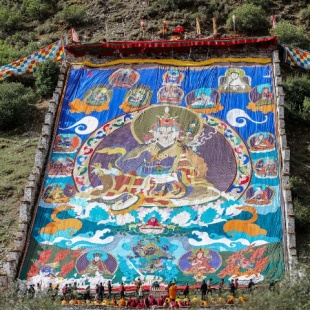
In a studio on the top floor of a three-story Tibetan-style house in Lhasa, capital of Southwest China's Tibet autonomous region, Phuntsok Tobgye and his apprentices are busy working on a thangka painting, measuring more than 10 meters in length and nearly three meters in width.
The painting, featuring mainly warm green tones, depicts Tibet's breathtaking scenic beauty and many famous attractions like the Potala Palace.
"Do not grind the thangka pigments too hard, otherwise its color will lighten," Phuntsok Tobgye instructs his apprentices while holding a coloring bowl.
Phuntsok Tobgye, 49, hails from Tsedong village in Xigaze and is one of the inheritors of Tsedong thangka. It is a branch of the Miantang painting, the most influential school of Tibetan thangka painting since the 15th century, which was inscribed on the national intangible cultural heritage list in 2006.
Through the unremitting efforts of thangka painters like Phuntsok Tobgye, the skills have been passed to younger generations, with their works reaching a wider range of art lovers.
Tsedong village has a tradition of painting thangka. When he was a child, Phuntsok Tobgye developed an interest in the thangka paintings that hung in the homes of the villagers. He started sketching the landscape of his hometown and portraying the stories told by his parents. After graduating from primary school, he began to learn thangka painting.
At the start, his master asked him to draw on a white powder-covered blackboard on his lap. His drawing hand was not allowed to touch the board to avoid messing up the white powder.
"Sometimes, I practiced with the same pose for more than 10 hours a day," he recalls, adding that rigorous training helped him acquire the essential basic skills.
When he was 18 years old, he traveled to Lhasa, learning from other thangka masters to help repair the murals in the Potala Palace. It was there that he learned different styles of the art form.
"I had always longed to see all of the different murals in the Potala Palace. The restoration project made my dream come true," he says.
In the years that followed, he continued to learn the art form in Lhasa. During this period, his works were displayed at various exhibitions, including one in Beijing and one in Vancouver, Canada. His solo exhibition held in Lhasa in June 2015 attracted nearly 1,000 visitors on its opening day and his works gained extensive popularity among art collectors.
Penpa, vice-chairman of the regional artists' association, calls Phuntsok Tobgye's works "flavorful", adding that they exude a strong sense of ancient charm.
"His thangka paintings have an unadorned tone compared with other works from the Miantang school of painting. The proportions of portraits and landscapes in his paintings are also peculiar," Penpa says.
Early last year, Phuntsok Tobgye established a thangka art company with his younger brother. The company sells thangka paintings to places all over China, including Beijing and Anhui province.
Sonam Wangden, Phuntsok Tobgye's son, is learning thangka painting from his father together with other apprentices. The 24-year-old says that he can only recall his father being constantly busy with the canvas.
"I respect my father. He is gentle and tenacious and regards thangka painting as his lifelong pursuit," Sonam Wangden says.
Not long ago, Sonam Wangden and his father went to the outskirts of Lhasa to undertake restoration work of temple murals. After finishing their work, they sat by the wall and savored Tibetan yogurt while chatting about their restoration work.
"Thangka brings me closer to my father and makes me understand his persistence better. I will also make thangka painting my lifelong pursuit and pass on the knowledge," Sonam Wangden says.
Now, it is not only Phuntsok Tobgye's son, but also many of his relatives, who paint thangka. Phuntsok Tobgye is proud of them. "I am getting older, but more confident that there will be many people to pass on these traditional skills," he says.