


HK deepens marine knowledge with nation's support










Stronger development
Cheng and her marine scientist colleagues in Hong Kong were recommended for the mainland-funded ocean expedition by the institution they work for — the Hong Kong branch of the Southern Marine Science and Engineering Guangdong Laboratory (Guangzhou) at HKUST.
The branch, established in 2019, was cofounded by the Innovation Academy for South China Sea Ecology and Environmental Engineering at the Chinese Academy of Sciences, the Guangzhou Science and Technology Innovation Committee, and HKUST. The branch aims to strengthen marine science development in the Guangdong-Hong Kong-Macao Greater Bay Area and promote cross-border collaboration for Hong Kong oceanographers.
Qian Peiyuan, a veteran marine scientist and director of the branch, said Hong Kong could play a bigger role in the national marine economy blueprint and ocean governance. The city has many world-class research universities and talent, and in recent years it has paid more attention to technology and innovation, he added.
Hong Kong occupies a sea area of 1,641.21 square kilometers. Known for its shortage of land, the city has reclaimed 77.6 sq km from the sea over the past 130 years. It also boasts a world-class container port — the Kwai Tsing Container Terminals — and Victoria Harbour.
However, the city is little-known for its marine science. In the 2022 QS World University Rankings, three universities in Hong Kong ranked among the top 50 in the world — the University of Hong Kong, the Chinese University of Hong Kong, and HKUST. However, for Earth and Marine Science, only one of these universities was ranked 50th-100th, while the other two were not in the top 100.
Qian, who has studied oceanography in Hong Kong for nearly 30 years, said that for historical and political reasons, the city's marine science community pays little attention to waters beyond the city's boundary, and mainly focuses on marine biology in local waters, including environmental protection and pollution control.
Although marine conservation and diversity protection is important to Hong Kong, marine science covers a much broader spectrum, involving physics, chemistry, geography, among other topics, Qian said.
Since Hong Kong's return to the motherland in 1997, the city has accelerated its integration into the nation's overall development, resulting in more cross-border collaboration among the marine science community.
Hong Kong's first national-level marine laboratory, the State Key Laboratory of Marine Pollution, was established at City University of Hong Kong in 2010. A branch of the laboratory was also opened at Education University of Hong Kong in 2018.
In 2019, Cheng's institution opened and studied the ecosystem and ecological safety in the South China Sea, including the Greater Bay Area, and new technologies for mining biological and microbiological resources in the region.
Over the past three years, dozens of researchers from HKUST and other local institutions have been recommended by Cheng's institution to take part in four state-funded expeditions in the South China Sea and the Pearl River estuary. Such an opportunity, which occurs once a year on average, allows more Hong Kong researchers, especially the younger generation, to gain first-hand experience and an insight to marine science.
Last summer, Frances Xiao Yao, 26, who is studying marine environmental science at HKUST, boarded a research vessel bound for the South China Sea. Before studying in Hong Kong, Xiao completed her undergraduate education in marine science on the mainland, but had yet to join an ocean expedition. The journey proved to be an eyeopener for the young scientist.
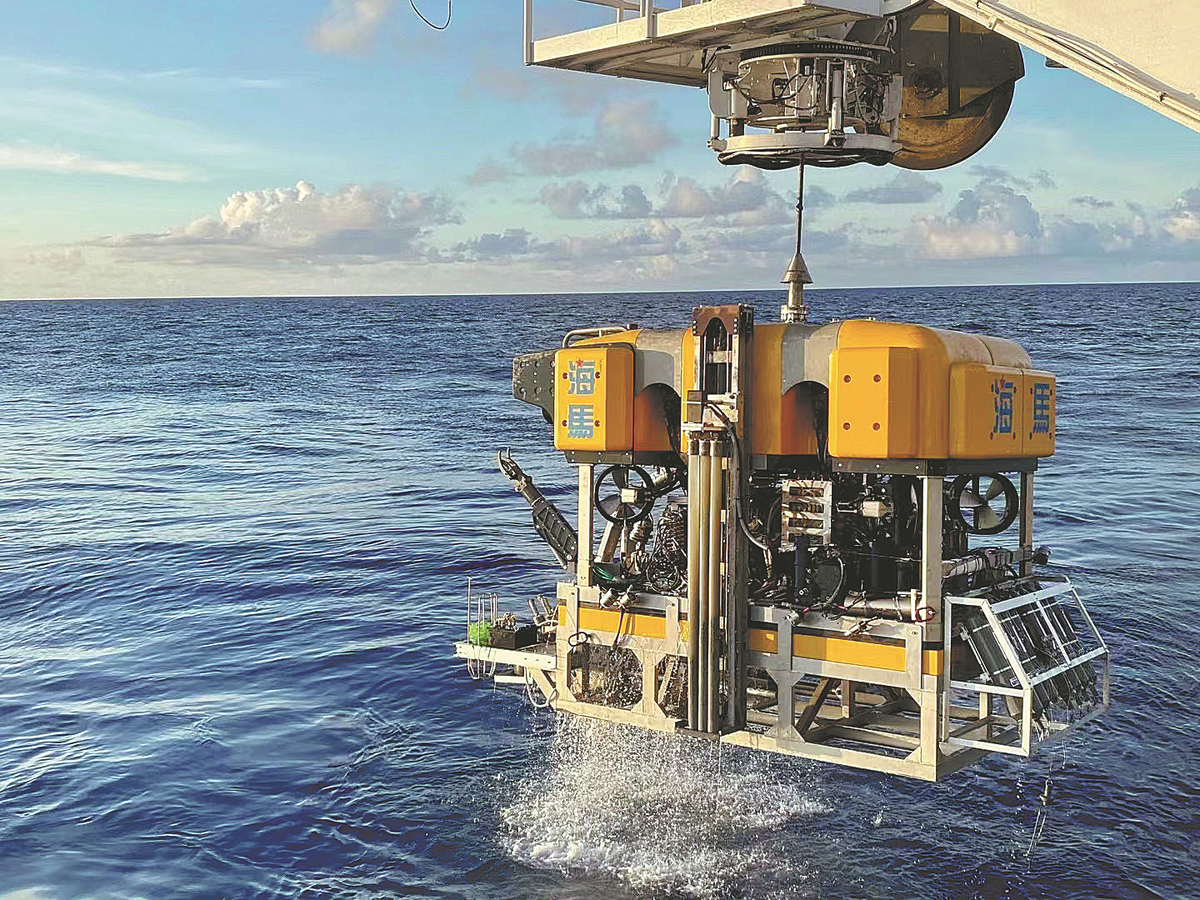
"Through the ROV's cameras, I saw the real deep-sea environment and the way in which samples were collected. The trip gave me a deeper understanding of the complexity of this environment," she said.
Taking part in these programs gives Hong Kong oceanographers a rare opportunity for face-to-face communication with their mainland counterparts, as most cross-border exchanges over the past two years have taken place virtually due to the COVID-19 pandemic.
Cheng said: "It was a great experience to work with and learn from researchers from different institutions. Some of them may have the chance to become our potential partners."
Qian, who is also a chair professor at the Department of Ocean Science at HKUST, said more cross-border collaboration would help Hong Kong marine scientists tap the nation's top scientific resources.
It costs hundreds of millions of yuan to build an oceanographic survey vessel, which no local institution can afford, Qian said, adding that mainland institutions also have advanced equipment that is not available in Hong Kong.
After returning to the city in mid-June, Cheng sent the samples she collected from the South China Sea to a laboratory in Beijing for genetic sequencing. Although she is still awaiting the results, she believes they could help her carry out further research.
As more scientists from Hong Kong become involved in national programs, the local marine research laboratory branch has enhanced cross-border collaboration by inviting more mainland and overseas scholars to join its work. The branch now has a total of 98 oceanographers from Hong Kong, the mainland and overseas countries as members.
The branch was established as Hong Kong's innovative and technological ambitions were backed by strong support at national level.
In June 2017, in a joint letter to President Xi Jinping, 24 Hong Kong academicians from the Chinese Academy of Sciences and the Chinese Academy of Engineering said they wanted to contribute to the nation's scientific and technological development. Xi attached great importance to their wish, and issued instructions to promote scientific cooperation between the mainland and Hong Kong.










