Xi's Inner Mongolia visit left a deep impression









Editor's note: Before the 20th National Congress of the Communist Party of China, China Daily journalists traveled to three places President Xi Jinping has visited to discover how local people's lives have improved over the past decade.
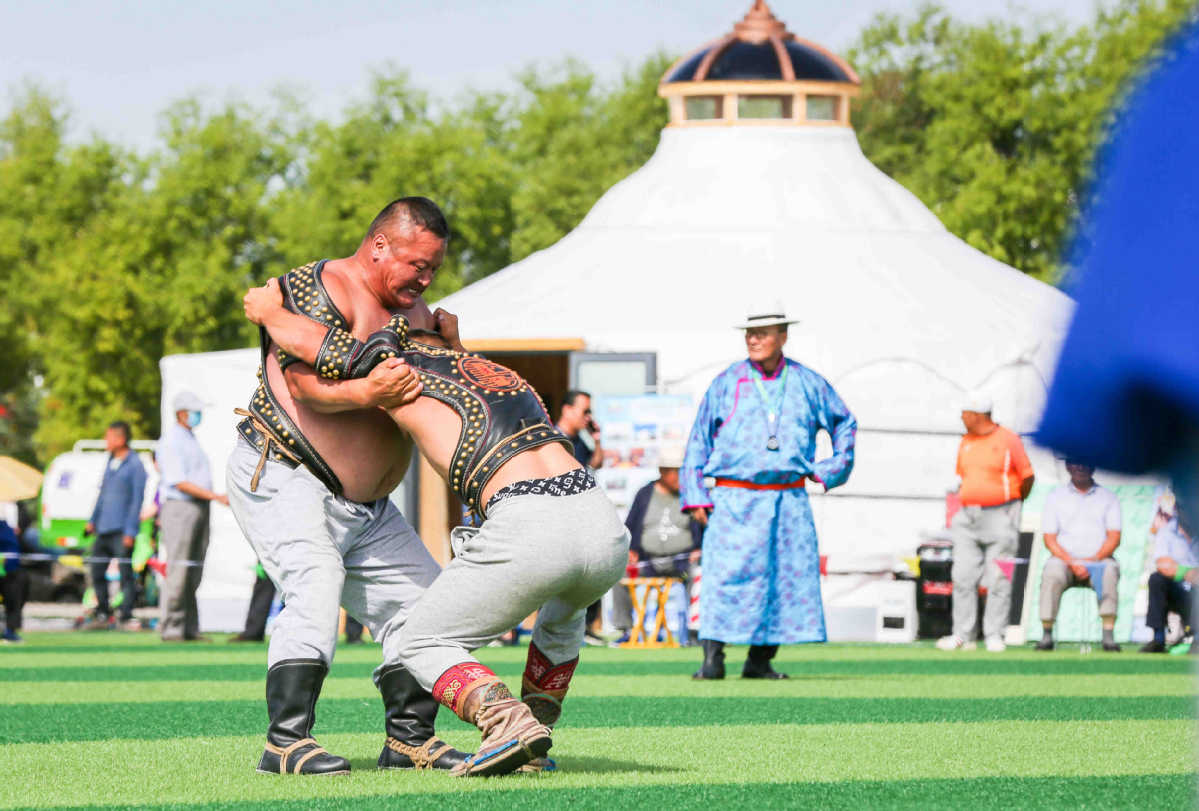
When President Xi Jinping was about to make a visit over a few days to the Inner Mongolia autonomous region eight years ago, it seemed all but inevitable that he would eventually find himself in the close company of wrestlers, archers and horses.
After all, wrestling, archery and horse riding and racing are activities that are regarded as hallmarks of the region. They also play a central role in the winter Nadam Fair, which is held each year in the city of Xiliinhot and was an event on Xi's itinerary. The fair's origins go back 700 years.
In addition to watching horse races, listening to traditional music and admiring dancers in spectacular traditional clothing, Xi honored a local custom by taking part in a ceremony in which he gently flicked three drops of milk into the freezing winter air as a blessing for a fruitful year for the Mongolian ethnic group. He also extended New Year's greetings to all of the region's ethnic groups.
In addition, Xi, who on such tours is always keen to rub shoulders with locals and talk about their needs, met herders in a yurt, a traditional tent dwelling, and talked about their lives, finding out any ways in which their lives could be improved.
One of those herders was Tsolmon, a well-known wrestler, who organized wrestling events at the fair.
"The fair is an occasion where you can connect with many people, and it's a good place to bring traditional and modern wrestling together," Tsolmon said.
"When I met President Xi in that yurt, he was just like a family member coming into the home. In fact he was very interested in wrestling and even appraised my performance."
The memory of that day is still clear for Tsolmon, whose voice wavers as he talks of the events that he witnessed and took part in.
"As the president dipped his ring finger into that milk and flicked it three times, he said, 'I wish the New Year to be prosperous, and the grains, the grass and livestock to be prosperous'."
Xi's knowledge of and respect for Mongolian customs was both surprising and moving, Tsolmon said.
The issues that Xi pays close attention to are many and varied, including education and development, poverty relief and development plans.
Before Xi's visit in January 2014 to Xiliin Gol, Tsolmon lived in the urban part of Xiliinhot, the capital of Xiliin Gol, because there was no stable supply of electricity or water in the nearby countryside, he said.
During his visit, Xi urged the local government to develop a plan to solve such problems. He also inspected the region's work on economic and social development and environmental protection.
Eight years later, vast improvements have been made in those areas, including the availability of electricity and water, and Tsolmon's family has returned to its rural roots and keeps more than 100 horses and sheep.
"President Xi also emphasized the work to help develop an accurate understanding of history, country, ethnicity and culture among people, so all ethnic groups can have greater sense of the Chinese national identity and sense of belonging to the motherland," Tsolmon said. "For me, grassland culture means respecting and loving nature, which is in the blood of our nation."
Though Tsolmon, 53, is a dyed-in-the-wool man of the land, that does not keep him from making his way to the city now and again to hit the clubs and dance and sing the night away.
On such occasions traditional urtiin duu (long song) singing brings to mind prairies as far as the eye can see, roaming cattle and grazing sheep. That mental pleasure is accentuated by the visual feast of members of ethnic groups in spectacular clothing shaking their heads and moving their bodies to traditional dance music.
Tsolmon, who is lucky enough to enjoy all of this, said, "Art and music always bring people together."
That is a sentiment that Xi conveyed when he told lawmakers in the Xinjiang Uygur autonomous region in 2017, "We should cherish ethnic unity as we cherish our eyes, treasure ethnic unity as we treasure our lives and hold tightly together like pomegranate seeds."

- Countdown to 15th National Games: On-site warm-up entertains audience
- Eight missing after cargo ship collides with fishing vessel near Shandong
- Investing in people: a worthwhile investment
- Exhibition commemorating the epic relocation of universities opens in Fujian
- Twelve punished for scaffold collapse that killed 7 in Shandong
- Slovenian official visits whole-process people's democracy practice site of CPPCC committees