


The Long and colorful journey of enamel










Cloisonne enameling, used in the West since ancient times, entails affixing thin metal strips to the pre-drawn surface of a metal object. This creates many small compartments — the French cloisons means partitions — into which a paste of finely ground, colored glass and water is placed. The piece is then fired, turning the glass into enamel and fusing it with the metal. Often the enamel shrinks, and a second or even a third application and firing is needed to fill the cloisons completely.
Contemporary writings of the Ming era traced cloisonne enameling, believed to have been introduced to China in the late 13th century, to the Arab empire (632-1258) and the Byzantine empire (395-1453), in the latter case the art peaking in the 12th century. While the Byzantine cloisonne often used gold featuring miniature-sized religious objects, Ming cloisonne had colors bursting on the copper surfaces of daily wares, with the standing edges of the copper strips polished and gilded to contrast with the objects' signature turquoise and lapis blues.
The blues, which gave rise to the Chinese name for cloisonne enameling, jingtailan (jingtai is the reign mark for the seventh emperor of Ming, and lan means blue), were made possible through imported and later domestically produced cobalt pigment, one of the few that can withstand extremely high firing temperatures. In fact, it was the same pigment that led to the production of chinaware painted in underglaze blue, a famed category of Chinese porcelain whose blue-white combination bears a clear Islamic influence.
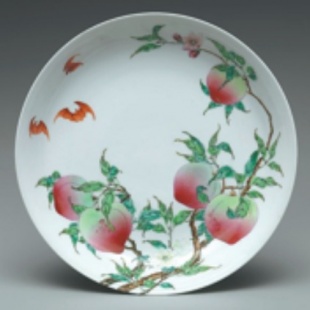
Not unlike cloisonne, such wares, known as qinghua (blue flower pattern), were initially considered vulgar, before being celebrated and made in large quantities at the beginning of the Ming Dynasty in the mid-14th century. When cloisonne enameling had its own moment soon after, its saturating colors overflowed onto porcelain.
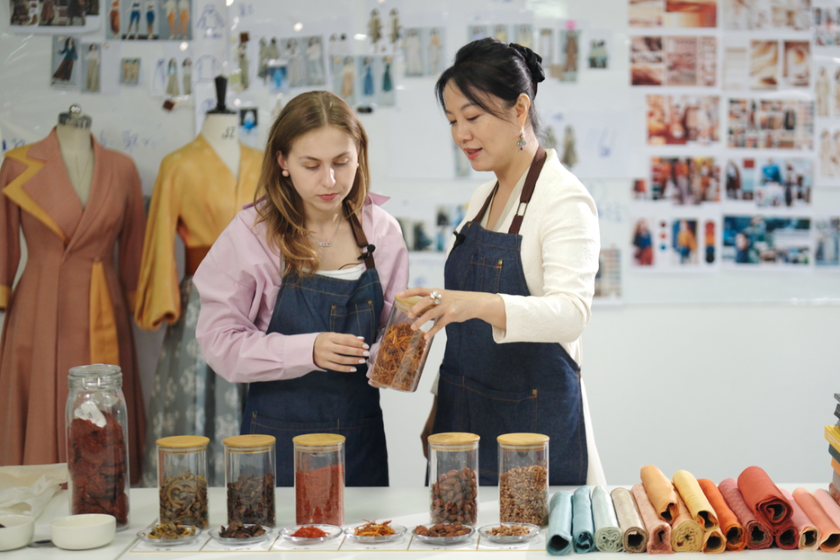
"This was no accident since porcelain had always been what China was known for in ancient times," says Lu, whose Chinese color story is partly centered on cloisonne and partly on porcelain. "Both involved enameling. While cloisonne was never realized on the surface of porcelain, it did every bit to inform its chromatic overglaze."
In the same way copper strips were used with cloisonne, the underglaze blue was employed to draw the outline and provide partition for the varied colors of the overglaze, added during a second firing.
Within those well-delineated spaces, Lu sees an amalgam of influences, ones that had come from far and wide.
- Christie's Shanghai to showcase two masterpieces for limited time
- Guizhou craftsman brings clay whistle alive
- Calligraphy and Painting Challenge themed on the Spring Festival calls for entries worldwide
- Amazing China in 60 Seconds: Liaoning
- Artworks shown at national academy picture routes to rejuvenation