


A torrent of knowledge










Advice
"Previously many people thought that the Yellow River pushed sediment directly downstream and into the sea after flowing from the Qinghai-Tibet Plateau. However, the results of our research provided a different picture," Nie says.
In order to control the sediment of the Yellow River, people need to know where it comes from. Nie says that the team will communicate and cooperate with the waterway's authorities to provide relevant advice pertaining to the management of sediment in the river.
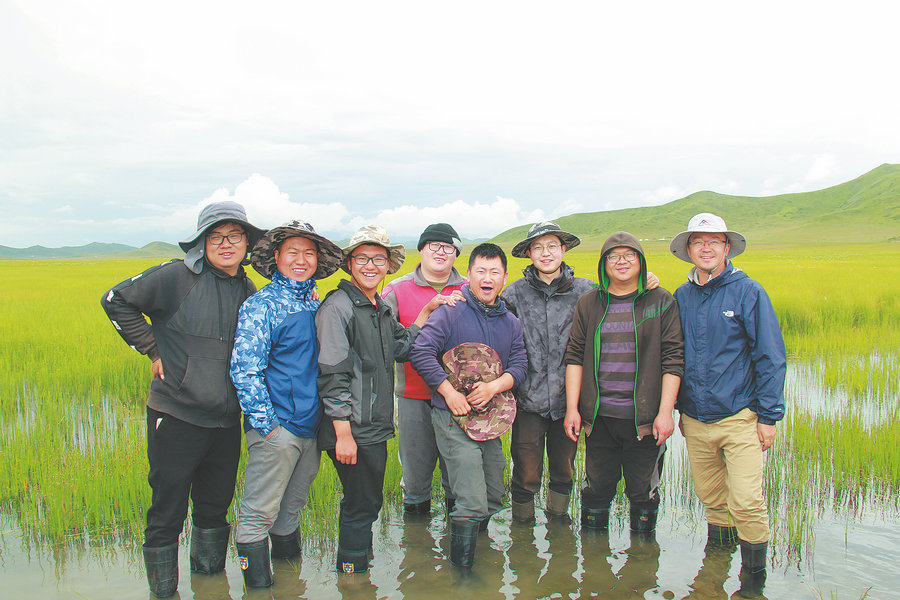
This month, the faculty and students of Lanzhou University's alpine grassland ecology research team are about to finish their work at Gansu Gannan grassland ecosystem field scientific observatory, which is located in the eastern part of the Qinghai-Tibet Plateau in Gansu province.
Their work at the facility started in March and, over the past seven months they have carried out multiple tasks, including seed rain collection and identification in alpine meadows and swampy wetlands, as well as species identification.
According to professor Du Guozhen, a member of the team, the water recharge capacity of the alpine grassland in Gannan accounts for 48 to 50 percent of the total runoff of the Yellow River in the region.
"It has some of the highest quality natural grassland in Asia, which makes it an alpine meadow ecosystem with the highest primary productivity and species diversity on the entire Qinghai-Tibet Plateau," Du says.
"The Yellow River, along with several other great rivers, originates from the Qinghai-Tibet Plateau, so its ecological advantages are extremely important to our country," he says.
The degradation of alpine meadows and wetlands in the region will have serious consequences, including affecting the water recharge function of the upper reaches of the Yellow River and the ecological security of the waterway's middle and lower reaches.
To guard against that, and restore areas where degradation has already occurred, Du and his team have been working on theoretical and restorative ecology in the region, which has some extreme natural conditions and an altitude of nearly 4,000 meters.
Du's team has been committed to building innovative technical systems, as well as conservation and utilization models that are applicable to the restoration of vegetation in the Qinghai-Tibet Plateau ecosystem.
"Gannan grassland is severely degraded after grazing, and virulent weeds are rampant, but I am not in favor of using herbicides," he says.
According to Du, by increasing the plant coverage to 80 to 90 percent, natural suppression of toxic weeds can be achieved, which allows good forage grasses to multiply.
The team proposed specific land management technologies and developed different scales of sand fixation systems using alpine willow.
They also established corresponding conservation indices for alpine grassland resources in Gannan and proposed grazing management measures for optimal utilization of grassland resources.
In October 2021, the Gansu Gannan grassland ecosystem field scientific observatory, recommended by Lanzhou University, was approved as a national field station.
From analyzing the composition and nutrients of soil samples to observing and recording the growing process of various plants, as well as studying different responses of plants to their environment as the seasons change, Du says that it would be difficult to conduct ecological research on the grasslands without an observatory.
Soil and water conservation on the Loess Plateau is also an important element of ecological protection and high-quality development of the Yellow River basin.










