China's coffee industry booms amid opening up









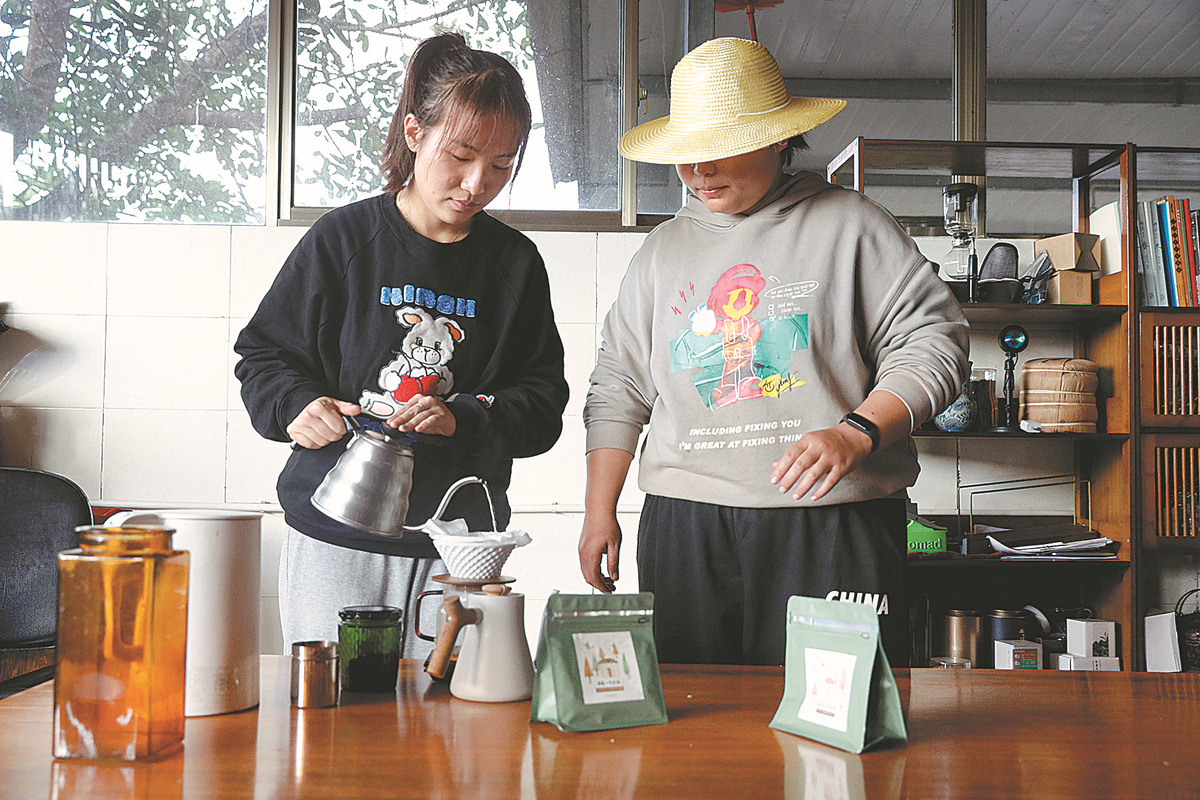
Yang Hongjian, born in the 1990s, is building a coffee estate in his hometown in Pu'er city, Southwest China's Yunnan province.
Yang, whose grandfather and father were the earliest coffee farmers in Pu'er to engage in large-scale plantations, has had a profound interest in coffee plantation since childhood. He quitted his teaching job in 2020 and returned to his hometown to build the coffee estate.
Unlike the extensive planting methods adopted by the older generation, Yang and his business partners planted trees on the edge of the reclaimed fields to ensure ecological protection. This new approach not only helps restore the forest vegetation but also prevents pests and diseases.
Over the years, the significance of coffee to farmers has expanded beyond its role as a source of income and merged into the cultural identity. In rural Pu'er, many born in the 1980s and 1990s have taken over their family coffee business. They believe the transformations in their lives, such as building new houses and buying new home appliances, are somewhat attributable to the coffee harvest.
Around the 1980s, there were only some 7 hectares of coffee in Pu'er. In the late 1980s, the local government began to cultivate coffee as an advantageous backbone industry to adjust its industrial structure and increase farmers' income.
Today, numerous farmers in Pu'er cultivate both tea and coffee. They harvest coffee fruits in winter and pluck tea leaves in spring.
Shi Yugang, deputy Party head of Yunnan, noted that the coffee plantation area and the coffee production in the province respectively account for 98 percent and 99 percent of the total volumes of the country.
The coffee plantation area in Yunnan was 1.39 million mu (about 93,000 hectares) in 2021, with a total yield of 108,700 tonnes, according to data from the Yunnan provincial department of agriculture and rural affairs. Pu'er city accounts for around half of the coffee plantation area and production in the province.
In Menglian county, located near the China-Myanmar border, Na Nu, an ethnic Lahu farmer from Paliang Village, has planted over 1 hectare of coffee, earning more than 70,000 yuan (about $9,800) by selling coffee berries in the 2021-2022 coffee production season.
During the season, the coffee industry helped locals, the majority of whom belong to ethnic minority groups, earn a total of 266 million yuan.
In Pu'er, the coffee output value hit 2.78 billion yuan last year, with more than 400 companies or processing workshops and nearly 250,000 farmers in the sector.
In June, Pu'er exported more than 300 tonnes of coffee beans to Europe, the first time for the local coffee to be transported to Europe via freight train services.
Since the beginning of this year, the export volume of coffee beans in Yunnan had reached 18,000 tonnes, with a value of 550 million yuan, up 2.3 times and 3.8 times respectively, customs data showed in late June. The products have been exported to the European Union, ASEAN, America, the Middle East and other regions.
Domestic coffee consumption is also robust.
"In the past, our company exported more than 6,000 tonnes of coffee beans every year. But since last year, beans have been sold domestically," said Yang Chunhong, general manager of a local coffee company in Pu'er, adding that the growing demand and big development potential mean enormous opportunities for the industry.
Customs data shows that the import volume of coffee beans in China reached 122,700 tonnes in 2021, up 74 percent year on year.
So far, Nestle, Starbucks, Volcafe and other enterprises have had business cooperation with Yunnan in the coffee industry.
Liao Xiugui, an 80-year-old senior agronomist in Pu'er, has transformed 20 hectares of barren mountain slopes into a distinctive coffee garden.
"It is the reform and opening up policy that has helped develop the local coffee industry. In the future, both coffee and other crops will embrace more opportunities," Liao said.