China, India key shapers of the Asian Century









The 20th National Congress of the Communist Party of China was held in Beijing in October. The congress was significant for both China and the world at large. The meeting presented crucial strategic plans to transform China into a modern socialist nation in all respects. China made significant progress toward a number of milestones over the past five years, all of which will have long-term implications for both the Chinese people and the international community.
There are three significant events that have had a tremendous impact on the wellbeing of the Chinese people over the past 10 years.
First, the Chinese people embraced the CPC's first centenary goal, then the new era of socialism with Chinese characteristics, and finally, with the resolve of the Chinese leadership, China completely eradicated extreme poverty in the country.
Most of the international community applauds what China has accomplished and supports its efforts to advance world peace and create a community with a shared future. And many countries are now trying to draw lessons from China's development plans for their own development.
With this in mind, China has introduced the Global Development Initiative, which could accelerate the UN 2030 Agenda for Sustainable Development and foster synergy for global development, and it continues to advance the Belt and Road Initiative. China has significantly improved global economic governance with the establishment of the Asian Infrastructure Investment Bank. Asian countries in particular are keenly interested in and eager to see how China's future social and economic development can increase global stability and promote global development. The policies introduced by China in the coming years will not only guide China's progress on the road to modernization but in doing so also help stimulate the global economic recovery. China has offered a model for global development, which will have a profound impact on both Asia and the rest of the world. China's ongoing development will help support an open global economy by creating new opportunities for other regions. President Xi Jinping has consistently urged all nations to uphold the principles of humanity, peace, development, fairness, justice, democracy, and freedom and to foster intercultural understanding and establish stronger ties with other peoples.
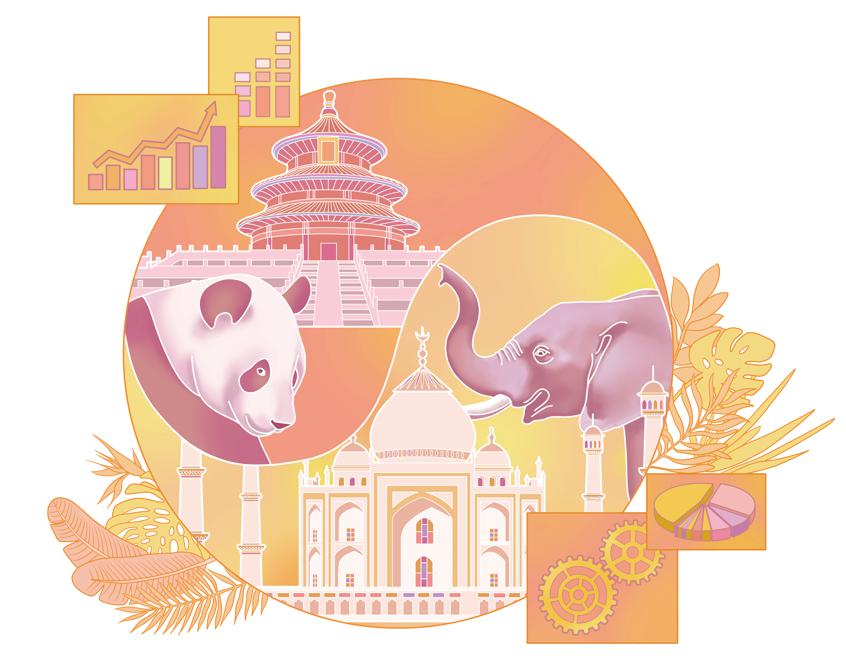
India and China are intertwined economically and culturally, and with their enormous youth populations and abundant resources, China and India's rapid development will radically change the world. China and India agree that pragmatic people-to-people engagement and reciprocal cross-cultural understanding are the keys to a community with a shared future, and both countries are on similar modernization paths. China is currently India's biggest trading partner, and challenges including food and energy security are high on both countries' list of priorities.
Both countries now command a level of global influence. China since 1978 and India since 1990 have both experienced significant economic growth, which has pushed Asia toward an unprecedented level of regional affluence. When it comes to developing friendship and collaboration with other nations, China and India both abide by the Five Principles of Peaceful Coexistence. Both nations are dedicated to advancing a fairer approach to international affairs, advocating partnerships founded on mutual respect, transparency and cooperation, and seek to extend the convergence of interests with other countries. China strives to strengthen solidarity and cooperation with other developing countries and protect the shared interests of the developing world, guided by the principles of equality, genuine results, affinity and good faith. China is also committed to the greater good and shared interests. The policies of China and India will shape the Asian Century as well as the world system.
It is necessary to look at the key components of cultural and people-to-people exchanges between the two civilizations as well as opportunities for rapprochement in a variety of fields such as health, education, tourism and natural heritage conservation in order to enable the development of appropriate interaction between India and China.
China upholds the goal of common prosperity for all countries and it will continue to offer novel and constructive suggestions and concepts to promote global development and solidarity.
The author is founder and director of Xu Fancheng Culture Study Center in India.
The opinions expressed here are those of the writer and do not necessarily represent the views of China Daily and China Daily website.
If you have a specific expertise, or would like to share your thought about our stories, then send us your writings at opinion@chinadaily.com.cn, and comment@chinadaily.com.cn.