Strikes over pay make for bleak midwinter in UK









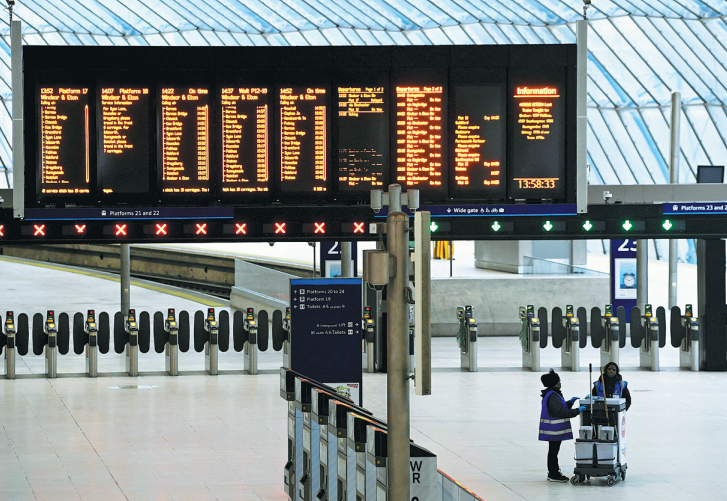
As the cost of living has skyrocketed and wages have remained stagnant this winter, a wave of strikes has swept across the public sector in the United Kingdom, disrupting the lives of millions of people.
Experts warn that with the government unwilling to budge, the various industrial actions could result in prolonged harm to economic recovery.
Nurses, rail workers, ambulance staff, customs and immigration staff, bus drivers and postal workers are all either in the middle of strike action or are planning walkouts.
"The reason why there are so many strikes is that the cost of living has dramatically increased, which means that real wages have dramatically decreased," said Bernd Brandl, a professor of management at Durham University Business School. "If wages are not adjusted to rising living cost and inflation, employees have to bear the costs for the increases."
According to the Office of National Statistics, inflation in the UK has been hovering at around 10 percent since July, hitting a 41-year high of 11.1 percent in October, before dropping slightly to 10.7 percent in November.
However, average wages in Britain have risen much slower than inflation, at around 5.7 percent. The Office of National Statistics reported that in the public sector, regular pay growth from July to September was just 2.2 percent, compared with 6.6 percent in the private sector.
Nora Colton, director of the Global Business School for Health at University College London, said: "This situation means that the real wages of employees in the UK are not keeping pace with the costs, so the purchasing power of the pound is weak. Alongside this, the costs of essential goods, such as food and fuel, have risen and, in some cases, at a rate higher than the average inflation.
"Given the inflation levels in the UK and concerns about a looming recession, public sector employees who are worried about their future and their ability to keep up with the uncertain economic outlook are striking for more pay."
Mick Pender, a lecturer of human resource management at Keele University, said, "It is important to recognize that the current disputes to some extent represent the culmination of a number of years of wage stagnation, especially in the public services, where the government has attempted to freeze or keep pay rises to very modest levels since the 2008 financial crash."
However, it would be a mistake to view all of this action as purely economic, Pender said. In many cases, workers have also seen their workloads increase as a result of spending cuts in the public services, and in some sectors, understaffing has added to work intensification.
In an escalation of their pay dispute with the government, nurses are set to walk out at dozens of hospitals across England on Jan 18 and 19, while network railway workers started a fresh wave of strikes on Jan 3.
Despite the chaos, the government does not seem willing to reopen pay negotiations, insisting that high pay demands will hit the fight against inflation and jeopardize recovery.
Chris Bovis, a law professor at the University of Hull, said, "The government does not want to give in during the industrial disputes because such action will adversely affect the perception of the government and allow every sector of the economy to demand pay rises, which in turn will escalate the rising of inflation."
The government is hoping the frequent disruptions in public services will result in public support fading away, Bovis said. However, such an assumption is not safe, because the cost of living and the negative economic outlook of many sectors could instead galvanize support for existing industrial action and even prompt other sectors to join in.
"My worst feeling is that the industrial disputes will be widespread over the next year, often with disruptive effects which have not been seen in the UK for at least 40 years," Bovis added.
Brandl said the reason that Prime Minister Rishi Sunak's office is standing firm is because it wants to show strength and the ability to resist demands, and the government has the impression that it has more chances of winning in the medium term.
"It is very much unknown if the government's solution impacts spiraling inflation at all," Brandl said. "The main reason behind this is that the reason for the inflation is not caused by higher wage demands. … Even though politicians and some media are saying that there will be (a) wage inflation spiral, this is far from true because the cause of inflation is imported inflation."